Wednesday, July 16, 2008

Missionaries: A Prophet is Not a Missionary

Another title to this post was, The Method is Not the Message.

This post is some of my comments on this week's Sabbath School lesson, Lesson 3, John the Baptist: Preparing the Way for Jesus.

How far would John the Baptist, operating and giving the message in the way he did, have gone with, oh, let's just say, 21st century Japanese people in Japan? Probably about as far as the end of his tongue, I suspect. Bluntness, directness, and boldness are very negative attributes to express in Japanese culture. To do so would get one blacklisted in a hurry.

How far would John the Baptist have gone with most of 21st century North America? Again, I suspect not very far, though perhaps a little more inroads than in Japan. Talking about sin and spirituality without first establishing a close relationship is more and more taken as hate behaviors in this culture. To do so easily causes barriers to go up and can negatively affect any future interest in even considering the message.

Why do I think so? Because John the Baptist was a prophet to his own people (primarily) at the early part of the 1st century AD. His calling wasn't to be a missionary to the Gentiles (though many apparently did seek him out, for whatever reason), nor to 21st century Japan or North America.

And that, I think, is the weakness of this week's lesson in the Study Guide. The reader can easily take away the idea that because John the Baptist had a special calling to be a prophet to his people, we too, should mimic the behaviors, the precise message, and the delivery of the message. The reader can get the impression that because the Seventh-day Adventist church was formed in response to the belief that the end was near, the church should embrace the methods of John the Baptist because Jesus spoke so highly of him.

John the Baptist didn't go into the city to preach. People came to him. There's no evidence he did any sort of advertising or marketing. It was all word-of-mouth. I might even give John the Baptist as an anti-pattern of an effective missionary.

When a person is sought out, that inherently gives that person a certain measure of privilege to speak out. When a person is part of the people group seeking him out, and in the case of John, he also came from a priestly family (held in high regard already), I believe that gave him quite a degree of credibility and authority from the start. When he spoke out against civil and religious abuses, that only added to the sense of authority granted to him. John was a prophet, sent to his own people. He was sent to break down and level obstacles that the Jewish religious regulations (mostly) had placed in the way of recognizing their Messiah.

Missionaries don't enjoy the same sort of rights, privileges and authority. They are foreigners (even if they're simply going from an inherently religious world to a secular one -- down the street, for example) where they must first earn the right to speak. Missionaries who act like prophets in today's world, I believe, more often than not create a negative impression of the gospel.

There are still parts of the world where prophet-like missionaries are still effective. But in much research I've seen, this is not going to last much longer. The whole world is quickly moving towards attitudes regarding religion and spirituality that resemble North America and Western Europe.

The Study Guide also dwells on the Three Angels' Message of Revelation 14:6-13. I spoke on this passage earlier this year. In it I observed that Revelation was written with believers as its primary audience. So the Three Angels' Message is primarily for those who claim to be Christians. As far as the "eternal gospel," I find it interesting that it specifically applies to just the first angel's message, "Fear God and give him glory, because the hour of his judgment has come. Worship him who made the heavens, the earth, the sea and the springs of water" (Rev. 14:7 NIV).

In the sermon, I noted that we need to apply this message in order to render it relevant for today's people. In it I suggested that the Three Angels' Message, translated for today might look something like this:

For us (Seventh-day Adventist Christians) to...

  • Show and tell to the world that there is a loving and trustworthy God.
  • Show and tell to the world that only God offers real rest and peace.
  • Show and tell to the world that God accepts and loves us as we are, and he will accomplish our desires to change for the better.
  • Show and tell to the world that God is just and works through us to promote it.
  • Show and tell to the world that God is already with us today and wants us to be with him forever.

The church may need prophets, but the world needs missionaries. We should not confuse the two. Both should ultimately proclaim the gospel, but the methods and audiences are vastly different. We must learn our audience and employ appropriate methods to accomplish the greatest good. We must never excuse negative methods for the sake of expediency.

Tuesday, July 15, 2008

Photography, Philosophy

Perusing through Issue 77 of LensWork, I came across this quote by Brooks Jensen:

"Philosophically, any given thing is perfectly unknowable because we can never know it completely. Said another way, any given thing is known by its relationships with other things -- and this is the trap that thwarts creativity.

"The moment we define a thing, we limit our thinking about it. At the speed of thought, we restrict it, box it, classify it, limit it..."

Now the context of this is in making photographs and photographic art. The point being made is that photographers are usually self-limiting in the pursuit of making art. Photographers tend to make art that fits within boundaries of what already is. Brooks Jensen goes on to describe how truly creative work is created when boundaries are pushed and stepped over, when commonly accepted norms are set aside or even broken.

I find the quote above deeply significant because I think it applies to much more than just creative processes. So let's strike out the last phrase of the first paragraph -- the one that reads, "and this is the trap that thwarts creativity" -- for the moment. Now I think we have a philosophical statement that is broadly applicable to just about all of life.

Of course, being this particular blog and the nature of the work that I do, my thoughts naturally turn to the religious and spiritual applications of the above statement. I've mentioned this before, but I frequently find the most profound spiritual insights within the pages of LensWork. This is yet another example.

The history of religions, wherever and whenever, has tended to box God (or gods) in. Through stories, through teachings, through commandments, in their pursuit to define God people have erected boxes (and temples, sanctuaries, and churches). People have defined what is within the boundaries and what is outside. The longer and stronger religion gets, the more definite and certain the boundaries become.

When I look at my own religious tradition, Christianity and its sub-genre Seventh-day Adventism, I can find this trend and tendency. It's a far cry from what the founder, Jesus, taught. Jesus taught that God cannot be boxed in, God cannot be defined, and God can only be known by an experiential relationship with Him.

The application of Brook Jensen's statement is that every person's relationship with God is necessarily going to be different from everyone else's. One person's view of God, necessarily is going to be different from another's perspective of God. To rehash perhaps a tired cliche, it's like the blind men and the elephant. Every person is going to arrive at a different idea of God. And that's okay. When the best from each perspective is gathered together, we come closer to seeing God as He is. But we should never be arrogant in saying that we've actually seen or known God completely, because if we ever did, we would be claiming to be greater than God.

The statement, "We have the truth," is one of the most offensive to my ears. So also is the statement, "We are the remnant." Both smack of foolish certainty and arrogance. Both tend to lead to a mindset that closes itself off to fresh ideas and perspectives.

As for me, I know what I think I know, but what I think I know, I know may be quite wrong. I am quite certain that what I think I know will more than likely change as time goes on as I am exposed to more perspectives and experience God's workings within and around me. The one thing I hold fast to is that my God ultimately is a God of love and freedom. I am a follower of Jesus, pursuing God's love and freedom, and I pray that I'll never become so fixed and rigid as to end up as yet another box, useless on the shelf.

Overflowing Cat

I thought this week would be better for outdoor photography, but that hasn't been the case yet. Here's a photo of Stripey from this past Saturday to make up for lack of photos this week. I'm not expecting much in the way of good photos from Anchorage and Palmer either. The weather forecast says "rain."

_MG_2377

Book Review: Choice, Desire, and the Will of God

Choice, Desire, and the Will of God: What more do you want? by David Runcorn

David Runcorn is an Anglican minister, currently serving in the Diocese of Lichfield.

This was a book from the bargain/closeout list at ChristianBook.com that I added to my cart just because the title sounded interesting. I was not disappointed with my expectations about the book.

If you want some of the traditional assumptions about God, His omnipotence and omniscience, and His reasons for Creation and the Incarnation challenged, this book will definitely do that. The major premise (at least what I got from reading it) is that the traditional views of God's omnipotence and omniscience (which are strongly influenced by Calvin's theology), are strongly at odds with God's love and and freedom of choice.

From the very start of the book, Runcorn challenges traditional thought. He suggests that God's incarnation as a human was not just to resolve the sin issue, but it was something that He had planned to do, even without sin. In chapter 1 Runcorn writes:

The incarnation is the fulfilling of God's original plan of and for creation. It is not a solution to a problem dreamed up in God's merciful imagination ('I know, I'll try this'). It is much more than God taking our humanity. In the end it is about the taking of our humanity in God. (2)

In chapter 2, Runcorn argues against the commonly held view that God being omnipotent has pre-planned everything, everywhere, across all time; and also against view that God's being omniscient means that He knows everything that will ever happen. In a number of ways, Runcorn seems to express views of God posited by the Open and Process schools of theology. Runcorn argues that nowhere in the Bible does it say that 'God is omni-" anything. Rather, he writes, "Significantly the nearest the Bible gets to a definition of God is 'God is Love' (1 John 4:8)." (13) From this point he argues that love, be definition, must limit itself, both in doing and knowing. Runcorn argues that interfering with choice (what the common held view of omnipotence would require) is not love at all.

Chapter 3 starts with another rather challenging and thought-provoking statement:

GOD IS USELESS.

I mean, he serves no purpose. He does not need a reason to exist. Being God is not a job. No one appointed him. He is complete in himself. He just is.

And that means creation is useless too. God did not need to create the world. He was not lonely or lacking in any way. He does not need our love or worship. So we are not here to make a point... (19)

From these foundational propositions in the few opening chapters, Runcorn goes on to provide more details of how he sees the God's love and desire manifesting in creation and incarnation. The latter half of the book moves into how, being created in God's image, humans have been given the gift of love, desire, and choice. Runcorn discusses how humans might engage in a relationship with God, experiencing and employing these gifts from him.

I recommend this book as another perspective on the tension between God's omnipotence and omnipresence; and love and free-will. Maybe the universe and history aren't as fixed and predetermined as we may have been led to believe. Maybe God isn't out there just handling billions of marionettes. Maybe God really can be surprised and delighted by what we do. Maybe God really does value freedom -- freedom to destroy, or the freedom to create and restore -- so that he chooses not to interfere with our choices and their consequences, evil or good.

Sunday, July 13, 2008

The sun returns and the cold goes away

The sun fought a fierce battle all day with the clouds and the rain. By this evening, it looked like the sun was winning. We are supposed to have a few days this week with at least some sun.

Just in time, I think I'm finally past the cold that I caught about 10 days ago. The headache (not sure if it was a migraine or just a bad tension headache) that I had all day yesterday finally went away this afternoon.

Elise and I are heading to Anchorage on Thursday. The weather for the weekend doesn't look very good, however. We have some business, personal and church, to conduct up in that part of the state. This means that I won't have to finish my next sermon preparation until next week. And this means that if there is a day or two that are good this week, I can afford some time to go out and see and photograph the landscape.

This evening, Amy brought back some freshly picked kale stalks from the garden. I cooked half of them with a fresh tomato sauce. I also put together a potato gratin with sauteed Vidalia sweet onions. Nearly the entire contents of the 13x9 casserole disappeared among the four of us. Finally for dessert I used more the peaches on sale for a fresh peach shortcake.

Saturday, July 12, 2008

Sermon: But Standing by the Cross

(Click HERE for MP3 sermon audio.)

Today's sermon explores John 19:16b-27. This is the account of Jesus' crucifixion as found in John's gospel.

For the opening illustration on the audio I brought out an army knife (fixed blade about 6 inches long), a kitchen knife (santoku style), and a Leatherman fold-out knife.

This sermon discusses a few mentions of knives/swords in the New Testament, how it is often described as dividing things, and explores what that might mean in the context of Jesus' crucifixion and in the actions and words of the people surrounding the event.

Friday, July 11, 2008

Recipe: Lentils and Vegetable Curry

The Adventist churches in the southern part of Alaska will be getting together on Vank Island (a short distance south of our island) in a few weeks. Our church is responsible for putting together Sabbath lunch. I've been trying to come up with an interesting recipe that doesn't involve a huge amount of prep work, exotic ingredients, or complicated cooking steps. One idea that's been suggested is haystacks (taco salad using corn chips for non-Adventist readers). I think we'll still do that, but as I'm not a huge fan of haystacks, I'd like to put something together that is interesting and different from usual camp fare. And that's how I ended up with this curry recipe.

This is a basic lentil curry recipe that can be varied by changing the vegetables added to the curry. If the chili pepper isn't hot enough, cayenne powder can be added to adjust the heat to your liking.

I haven't done it yet, but I think it should be possible to use a slow-cooker with this recipe. Step 1 would have to be done in a frying pan and the contents transferred to the slow-cooker. Steps 2 through 4 would then be done as a single step and all added to the slow-cooker. The tomato paste (step 5) would be done a few minutes before serving. (Adding the tomato too early will probably prevent the lentils and possibly other vegetables from softening properly.)

Lentils and Vegetable Curry

Serves: 6 to 8

Prep time: 15 minutes

Cook time: 60 to 70 minutes

Ingredients

  • 3 tbsp. vegetable oil
  • 1-inch piece of ginger, finely grated
  • 1 medium yellow onion, chopped
  • 4 cloves garlic, minced or crushed
  • 1 hot chili pepper, seeded and chopped (or to taste)
  • 2 tsp. ground cumin seeds
  • 2 tsp. ground coriander seeds
  • 1 tsp. garam masala
  • 1 tsp. ground paprika
  • 1/2 tsp. ground turmeric
  • 1-1/2 tsp. salt
  • 1/2 tsp. ground black pepper
  • 3 cups water
  • 1 cup dry lentils, sorted and rinsed
  • 2 to 3 cups total of one or more of [carrots, potatoes, cauliflower, zucchini, or others], cut into 1/2 to 3/4-inch dice
  • 1/2 cup chopped cilantro leaves and stems, divided
  • 2 tbsp. tomato paste

Directions

  1. Heat vegetable oil in a large pot over medium heat. When hot, fry ginger, onion, garlic, and chili pepper until onion begins to turn golden, 10 to 15 minutes.
  2. Add water and lentils. Bring to boil, then lower heat, cover and simmer for about 20 minutes.
  3. Meanwhile, prepare vegetables.
  4. Add vegetables from step 3, cumin, coriander, garam masala, paprika, turmeric, salt, black pepper, and half of the cilantro. Stir to combine. Bring back to boil, then lower heat again, cover and simmer for another 20 to 25 minutes until vegetables are tender.
  5. Add tomato paste and stir until dissolved and well mixed. Add more salt if needed. Continue to simmer another 5 to 10 minutes until the curry takes on a thick consistency as the lentils break down.
  6. Remove from heat, add remaining cilantro, mix, and serve with (Basmati) rice or flatbread.

Recipe: Peach and Apple Cobbler

I'm not sure that "cobbler" is the right term for this. Until someone gives me a better name, "cobbler" will have to do. (The top/crust resembles cake more than anything...)

When I put in all the sugar, I thought it would end up being too sweet, but it turned out to be quite well balanced -- letting the fruit flavors come through without overpowering them.

The process of macerating and mashing, and the idea of using apples came from the July/August 2008 issue of Cook's Illustrated. What it does is pulls out more moisture from the fruit to provide more natural juices than otherwise would come out. The apples add more natural pectin to the fruit mixture, resulting in a thicker sauce.


Peach and Apple Cobbler

Makes: Fills one 13x9 baking dish

Total prep and cooking time: About 1-1/2 hours

Ingredients

  • 2 lbs. fresh peaches (about 6 small or 4-5 medium)
  • 1 Granny Smith apple (large)
  • 4 tbsp. + 2/3 cup sugar
  • 1-1/3 tbsp. orange juice
  • 4 tbsp. butter
  • 1-1/2 cups Bisquick baking mix
  • 1 cup milk
  • 1/2 tsp. ground cinnamon

Directions

  1. Peel and slice each peach into 8 wedges. Set aside in bowl. Peel, core, and slice apples into 1/8 to 1/4-inch thick slices. Set aside in another bowl.
  2. Take about a quarter of each of the peach and apple slices and place in a microwave-safe bowl. Add 1 tbsp. of sugar and the orange juice. Loosely cover and microwave on high for about 4 minutes until the fruit is very soft. Mash results with a potato masher until a coarse paste forms. Set aside.
  3. Meanwhile, sprinkle 2 tbsp. sugar on the remaining peaches and 1 tbsp. sugar on the remaining apples. Mix to distribute the sugar well. Set aside and macerate for about 30 minutes.
  4. While waiting, melt the butter and preheat oven to 400F. When butter is melted, take 1 tbsp. and coat the inside of a 13x9 baking dish with it.
  5. Mix together the peaches, apples, and peach/apple paste. Distribute evenly in baking dish. (Use a silicon spatula to make sure to get all the juices!) Cover with foil and bake for about 10 minutes.
  6. Meanwhile, mix the Bisquick mix, remaining 3 tbsp. butter, 2/3 cup sugar, milk, and cinnamon in a bowl. The batter consistency should resemble pancake batter -- not too runny, not too stiff.
  7. Take baking dish out of oven, uncover, and pour in the batter making sure to distribute it evenly over the fruit. (Or, if you prefer a more biscuit-like appearance, drop spoonfuls of the batter onto the fruit.) Place dish back in oven, uncovered, and continue to bake another 20 minutes or until the surface is cracked and starts to turn light brown over the entire surface.
  8. Remove from oven, let cool for 10-15 minutes and serve.

Another brief update

There hasn't been much in the way of newsworthy things going on in our/my lives this week.

I've had a cold since last Thursday. It seems that it is finally starting to clear up today. I've gone through headaches; sniffles; sore throat; some mild coughs; and now, my voice seems lower than usual. I think I got it from Shelley, who had the cold early last week.

The weather has been pretty much wet through the week. Add to that the cold, and I haven't been outside much. I've taken the bike for errands, but that's about it. The back lawn needs mowing, so I just may force myself out today to do that.

Peaches are on sale this week -- at 99-cents/pound. Granny Smith apples are also on sale -- also at 99-cents/pound. Believe me, for here they are a VERY good price. I'm thinking about putting together a peach and apple cobbler (British style - more like a crisp or crumble, crust on top -- rather than the U.S. kind, crust mixed in).

I've been researching notebook PCs to replace the one that died. I like Toshiba PCs, but they don't ship to Alaska. I don't particularly like Dell notebooks, but their price and options seem to be the best around. Gateway doesn't offer the customizability nor do they offer the combinations of options I'm looking for in their configurations. HPs doesn't cost too much more than some Dells, and offers options that are more or less equivalent. HP has tablet-style notebooks, which Dell doesn't (at least not under $2,000). I don't get it... Why can HP sell a tablet PC with double the capabilities for half the price of a Dell? I guess I'll try to look around in Anchorage next week and see if I can find something there.

Tuesday, July 08, 2008

Summer Muskeg

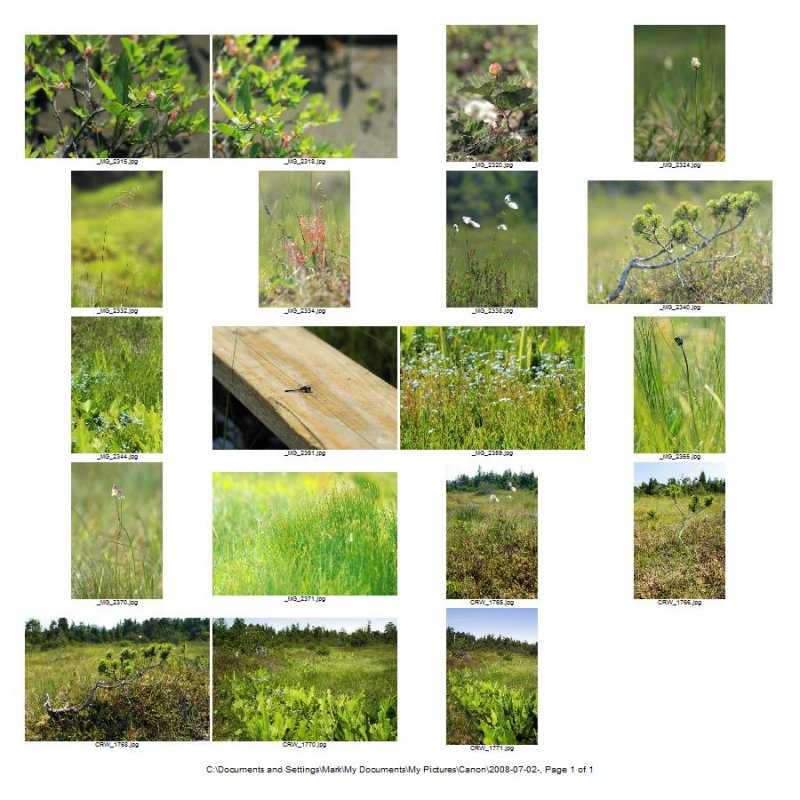
These photos were taken on the last sunny day last week (July 2). (It's been cloudy and/or rainy since then.) It's quite astonishing how different the muskeg looks in a matter of weeks.

(Click on image to enter gallery.)

Opens in new window

Missionaries: Everlasting Gospel, Ever-Changing World (A Book Review)

This post contains comments related to lesson 2, "'All Things to All Men': Paul Preaches to the World," of Agents of Hope: God's Great Missionaries.

In this post, rather than really going into the lesson, I will review Jon Paulien's recent book, Everlasting Gospel, Ever-Changing World: Introducing Jesus to a Skeptical Generation (or from the Adventist Book Center HERE).

The majority of us as Christians will not go far from our homes, neighborhoods, workplaces, and churches to serve as missionaries. More and more, research shows that the secular societies of North America and Europe are becoming the largest mission fields. In other words, for many (based on visitor data of this blog) who read this, our mission field is not South America, Africa, or India, but literally right next to where we live, work, play, and worship.

The problem is that the majority of people we associate with today have little or no Christian, or even spiritual, backgrounds. To launch directly into the story of Jesus, of sin, of Creation, or anything that uses vocabulary and background based in the Bible has the potential to, at best, be ignored, and at worst, alienate.

Dr. Paulien's book is an attempt to bring Paul's "all things to all men" principle into the 21st century. The first section of the book draws pictures of how today's secular people think about and relate to the world and how that differs from even a few decades ago. Paulien discusses whether "successful" churches (primarily Adventist ones) are really succeeding in meeting today's secular people (the answer is, "No"). He goes on to discuss the evolving definition of the term truth in today's world.

This first section of the book, I see as a broad summary of many other research and works on postmodernism. As such, a reader new to the idea might want to do further reading on more extensive works.

What Paulien adds to the broader discussion is an Adventist-specific context to postmodernism. He describes how Adventism is uniquely affected by it, and how Adventism can make unique contributions towards engaging postmodernism. This forms the middle section of the book.

The last half of the book begins with general principles to keep in mind while engaging postmodernism. For me, one of the large contributions that the Paulien makes is that idea that most things in this world are not easily categorized as black and white, but as shades of gray. He begins the discussion with boundaries. In the middle of it he draws a Best/Better/Good/Fair/Poor/Bad scale (p. 117) and uses the scale to discuss the need for flexibility and resiliency. On the ends are things that are clearly right and wrong. But in the middle, context and relationships make a difference.
Another key point Paulien makes it that not everyone is called to be missionaries to secular people. I believe what he is trying to bring out is that it takes someone who is flexible and resilient, yet not swayed and moved, to successfully minister to secular people. For some, temptations in the secular world may be too great. For them, it may be best to stay within the "fortress" of the church and support those who are out in the mission field (being the "salt," p. 86). But even those within the "fortress" still need to adapt -- if not their behaviors, at the least their ways of thinking to that the support offered is sincere.

The final portion of the book gets into more practicalities of what being "salt" in the secular world around us might look like. Once again I see this section as a broad summary of many previous works, adapted to the Adventist context. As such, I believe it offers a valuable perspective.

I recommend this book to all who are seeking to understand and minister to secular people, and to reach them with the good news of Jesus Christ. The message does not change; but how we communicate it, and the portions we choose to emphasize or de-emphasize (Paul did this, too), must change if we are to become and remain effective missionaries in our backyards, front yards, side yards, school yards, work, and church yards.

An article about mission in the local neighborhood

Since this quarter's Sabbath School study topic is Missionaries as Agents of Hope, I thought I'd pass on a link to an article from the Spring 2008 issue of Leadership Journal. Its title is "Parish Without Partners?" (I don't know for how long it will be free to access.)

The article's theme is that the gospel must be holistic. It must meet both the spiritual and physical needs. Churches are usually good at meeting the spiritual, but when it comes to meeting physical, it is often wanting. On the other hand, service agencies and groups are good at meeting the physical, but they are often not equipped for moving people beyond getting their immediate needs met. Rather than one organization trying to accomplish two different things, it might make better sense to have multiple organizations separately run with their own focused goals, but are accountable to one another.

Saturday, July 05, 2008

Sermon: Power Struggle

(Click HERE for MP3 sermon audio.)

Today's sermon goes through John 19:1-16a. It is the account of the power struggle between Pilate and the Jewish religious leaders over Jesus. Each party has their own vested interests, and tries to manipulate one another into getting their ways. Jesus' own actions and words stand in stark contrast to the actions and words of those "of the world."

Missionaries: Be Who You Are

Yes, this posting is after the fact this week. I had a rather busy week, and with the unexpected laptop breakage, all original plans sort of flew out the window.

I'll just write up a brief set of thoughts regarding today's Sabbath School study, Lesson 1, For Such a Time As This: The Apostle Paul.

I'm not a Paul, and I'm pretty sure there aren't too many people who are very similar to Paul. Peter was not like Paul, and John definitely wouldn't be mistaken for Paul. There might be a few attributes, interests, and personality traits that I might liken to Paul, but as a whole, I'm not what anyone, even with a stretch of imagination, would call outgoing, bold, quick with words kind of person.

Christians -- leaders and churches -- I think have often hyped up, intentionally or not, the super-missionaries or the super-evangelists as patterns for the rest of us. While I believe it's useful to look upon exemplary persons in Christian service as role models from which to learn, to expect myself to be just like one of them would be heading straight for failure and disappointment.

The fact is, and I think this week's study guide does bring it out, we are all unique. We each have a different set of skills, talents, interests, background, place, and time that makes us most effective in performing service for God when we are who we are; i.e., who God designed us to be. Some of us were never meant to go door to door in a strange neighborhood. Rather, we simply befriend people around our daily lives. We bring them into our lives and into our homes. On the other end of the spectrum, there are those who just have the gift of starting up conversations and relationships with nearly everyone. They have the ability to draw out, in just a few minutes of acquaintance, deep needs and hurts that the rest of us might takes years to do.

Missionary service and mission work: what is it? Is it mainly about preaching? Or is it more about living? I think that when we read the missionary activities of Paul, we often get a one-sided picture where all he seems to do is preach, talk, and write. I believe it is important to balance this side of Paul with the side where he simply took up residence in a city, then lived and worked among the people. Words of hope are meaningless unless one can show a life of hope.

Even prior to his conversion, Paul was a missionary. He had a desire to serve God. It was just that prior to conversion, he had wrong ideas about God and about what He wanted, and thus his missionary efforts were rather misdirected. When Paul encountered Jesus and had a paradigm shift (as the study guide puts it), that's when his desire and efforts came into line.

Even today, the first qualification for anyone to become a missionary is simply a desire to serve God. I'm sure there are many people who go out on mission work, short-term or long, without really having experienced conversion. But the Holy Spirit has impressed upon them and given them a desire to serve. From Paul's experience, it appears that God is able to work with that. A person's desire can grow into an experience with Jesus. For some, it is in doing that Jesus is experienced. When a person really encounters Jesus, it leads to a missionary becoming a truly effective missionary.

The one thing none of us should do is to wait until we obtain perfect knowledge and understanding before we decide to work in our God-appointed mission fields. If we do wait, we will be waiting forever. And that would be like the man given the single talent in Jesus' parable.

Be who you are. That is God's plan for your life.

Friday, July 04, 2008

Too busy/tired for fireworks

But we were able to see them (that is, the fireworks sponsored by the City Chamber of Commerce and fired off at the ballfield about 1/2 mile away) anyway without going out of the house. Amy was fast asleep already, but we could see them from our bedroom window and from Shelley's. Our view was mostly filtered through some trees, but we could still see enough. From Shelley's there were less trees blocking, but it has to be viewed at an acute angle to the window. The whole show lasted about 15 minutes.

Data and applications migrated

Seven hours later...

I think I have all the key applications and critical data moved over and accessible on my desktop PC.

  • Outlook and all of its data stores, e-mail account settings, etc.
  • Internet Explorer favorites and RSS feeds
  • BlackBerry Desktop
  • MS Money and data file
  • OneNote files

In addition to SyncToy mentioned in the previous post, I had the first opportunity to use Windows Live OneCare Backup's restore function to bring over the Favorites and RSS feeds. It worked very well once I figured out how to get to them. OneCare's Backup also offered a little peace of mind at the start of all this because even if the laptop became non-functional before I could get SyncToy to move the data, at least the backup data was less than a week old.

The display hardware is definitely on the way out. When the laptop has been turned off for a while, it works for a few minutes after I turn it back on, but the problem seems to be getting worse each time. I think if I take it into one of the commercial freezers in town and run the laptop, it might continue to work for a little while longer. I think the operating heat adversely affects it. The problem with laptops is that you can't just replace failed hardware. One big plus for desktops, even today.

It was a good laptop -- 10 6-1/2 years old (I must have been thinking of another laptop). It's probably lasted about twice as long a couple years longer than it was meant to. So not too many tears shed. But I sure didn't need to work on this for half the day...

I researched some replacements, and it looks like a good one can be had for between $900 and $1200. It isn't quite how I wanted to spend the "economic stimulus" funds... I had hoped the laptop would last one more year. I'll see if I can function without a laptop, and if I can, I'll likely postpone purchasing a replacement until next year.

One reason I upgraded my BlackBerry handheld was to try to get by on short-duration travels without having to take along a full PC. It looks like I won't have much choice in the matter now.

Now I can return to my original plan for the day: to work on tomorrow's sermon.

It isn't Friday the 13th, is it?

My 10-year old (or almost 10) laptop showed signs of going kaput this morning. It looks like the display hardware is going out on me. This is the PC where I have all my sermon stuff, all my e-mails, all our finance data, etc. In other words, it's the most critical PC in the house.

This being Friday and all, it's the one day I can't afford to have it go out because I still have to put together tomorrow's sermon. I tried last night, but the thoughts didn't flow and I was feeling rather sleepy.

Anyway, I'm working on getting all of the data moved onto my desktop PC (the one I'm writing this on) using Microsoft's SyncToy utility. After that I can at least get to the sermon files and notes (they're in OneNote, which I already have installed here). As for e-mail, I'll make do with the BlackBerry and Windows Live Mail to access my e-mail accounts until I get Outlook installed.

Microsoft Money is another issue. Even if I could find the original installation disc, it's now 4 years old and Microsoft doesn't support it. I'll have to purchase and download a new version, I guess.

As for the laptop... Anyone who offers free or low cost shipping will certainly be on my list from where I purchase a replacement. Sigh...

This being Independence Day, I had planned to go out and at least watch the parade - even if it is kind of wet and rainy. But with the problems of this morning, I may not even get to do that today.

You're welcome to join my pity party today...

Tuesday, July 01, 2008

Southeast Alaska Photographic Society

A new photography forum went online just recently. Its goal is to be an online gathering spot for photographers from all over Southeast Alaska. Whether or not you are from this area, you're welcome to drop in, visit, and take a look at the photos that are being posted. If you are from the area, consider joining the forum and post the diverse beauty and interesting sights from your area.

Site URL -- http://sealaskaphotographicsociety.com/

Dancing and Deer -- or is it Prancing Deer...?

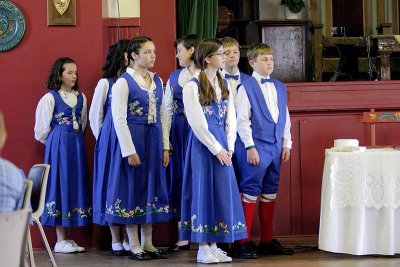
Shelley was called up to fill in as a member of the Leikkaring Dancers dancing for cruise ship passengers at the Sons of Norway Hall. She went there in the morning and in the afternoon. I stayed to photograph the dancing during the afternoon performance.

(Click on photo to enter gallery.)

Opens in new window

In the late afternoon while preparing supper, Amy came rushing in to inform me that there was a doe and her fawn munching about in our backyard. So armed with camera, I dashed out. I was surprised at how calm they were. Neither appeared terribly skittish, so I got to spend quite a good amount of time snapping photos of them.

(Click on photo to enter gallery.)

Opens in new window

Monday, June 30, 2008

Last Day of June

The year 2008 is half over. That's seems almost unbelievable. It seems only a few days ago that we were still covered in snow and ice.

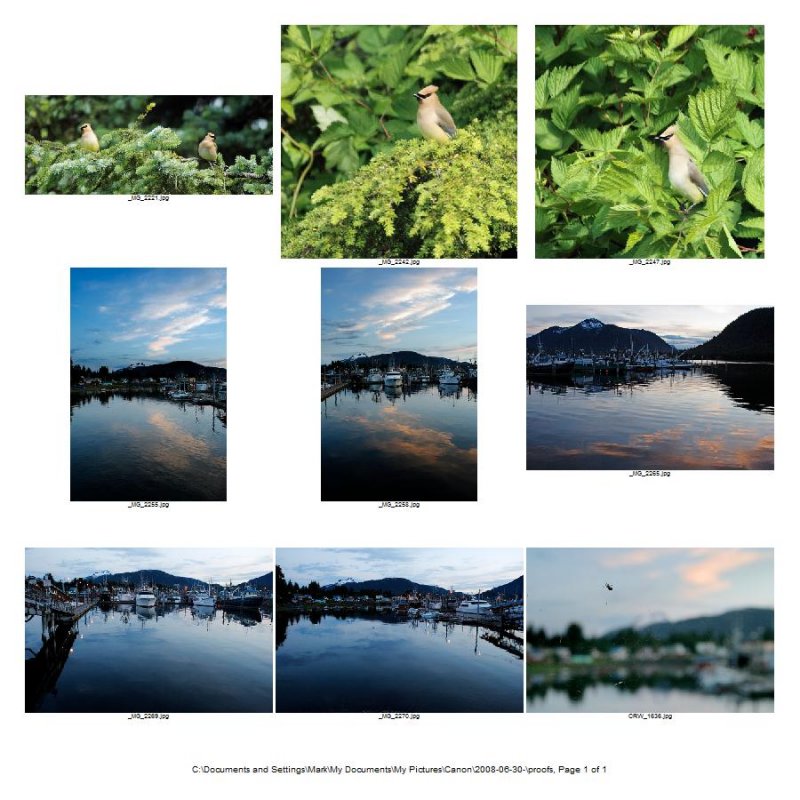
A few photos of Cedar Waxwings and some sunset photos today.

The birds were taken through the upstairs window at a rather acute angle to it, so the sharpness is pretty poor. The birds are pretty small, so even with a 400mm lens, I had to crop rather severely to get what you see.

Yesterday's sunset was very good. As I was watching the skies last night, I didn't think the sunset would be that great. But it was. This evening, I was watching the skies and I thought it might be at least as good as yesterday. It wasn't. It was pretty poor. For the future, I think I should flip my sunset predictions around.

The most interesting (in my estimation) image I got this evening is the last one with the spider. The others are all ho-hum, mediocre, not very interesting.

Opens in new window

Saturday, June 28, 2008

Sermon: Truth Possession

(Click HERE for MP3 sermon audio.)

Today's sermon explored John 18:28-40 (ESV) and 1 Corinthians 13:1-14:1 (TMSG).

I'm sure many of us are familiar with the phrase, "We have the truth," or some variant of it. But is that statement really biblical in the way it is frequently used to mean? Or is it better to turn the phrase around and say that "the Truth possesses those" who choose to belong to Him? Today's sermon argues against the former and argues for the latter using Jesus' words to Pilate as recorded by John, and also by taking into account Paul's famous words on the primacy of love.

Friday, June 27, 2008

Stormy

The day started out dry but cloudy. The grass was again looking somewhat tall so I went out to mow the lawn. After showering and recovering from the workout I went out to return a video and pick up a couple more from the library. I also picked up this week's newspaper and a few groceries.

The rain began on my way back. Amy spends a large part of Fridays in town. When she came home some time later, the rain had turned into a downpour.

Later in the afternoon I attached the bike trailer for a trip to get the mail. The wind had picked up and it was now blowing rain. It was somewhat hard pushing against the wind, but the trailer seemed to handle well and the drysack kept the mail dry.

It's been quite some time since we last had rain and wind like this. As I tap this out, I'm listening to the rain pour down onto the roof.

Sent wirelessly via BlackBerry from T-Mobile.

Thursday, June 26, 2008

Jesus: His Return

These are comments on this week's Sabbath School study, Lesson 13, His Return as King and Friend.

The lesson for Sabbath Afternoon has the following:

Though there are unpleasant elements associated with the Second Coming (as we will see), it is not the fear factor that will cause people to turn their eyes toward heaven. Fear is important, and we do not proclaim the whole truth about the Advent without including it.

Is this a tacit acknowledgment that the way some of the Adventist doctrines have been put together and taught by some have indeed resulted in a fear-based gospel? Yet at the same time is it difficult to completely dismiss the idea that God originates fear because the Bible seems to teach that God does? We can't have it both ways. The gospel of love casts out all fear (1 John 4:18).

The best way I've found to settle this dilemma is to believe that God acts, and this singular act is interpreted by the recipients, the people, in different ways according to how they view themselves and how they view God. Some turn away in fear; others are drawn to God. The mistake Christians have made through history is that because it appears that God allows fear and God even seems to bring good out of fear, that we should originate and motivate through fear. I cannot believe God does that, and if God doesn't, his disciples shouldn't either.

Half of this week's lesson deals with this issue of fear and the Second Coming. Are we as Adventists that mistaken about what is going to happen? Are that many of us without assurance of acceptance and salvation by God? Have we, perhaps, grossly misunderstood and misapplied what it means "to be ready" and "to be prepared" for Jesus' return? Are we still holding onto a rather distorted portrait of God?

In my rather simple and big-picture way of seeing things, I believe that the only requirement to be ready is to want to be with God forever. It's not my job to struggle to grow my faith or to be a better person. It is the faithfulness of Christ that will accomplish all those things for me. (Many modern theologians and commentators interpret "faith in Christ" as "faithfulness of Christ" as the more correct rendering of the intent of New Testament writers.) The only thing I need to do is to make a choice to be with God.

The second half of the week deals with predictions and timings surrounding the Second Coming. Is God limited to bringing about the close of the world's history exactly in the way we think God has told us it will happen? Or does God have an infinite number of ways to accomplish his ultimate purposes? Could it be that the predictions recorded in the Bible are just a few of the ways in which things could transpire? That if and when they do occur, they are recorded so that we won't be surprised?

As I look at the Old Testament prophecies regarding the Messiah, deliverance, and a new earth, it didn't necessarily have to happen the way it did. I believe it was people's response to God through history that caused God to work in history the way he did. I believe the prophecies were left open for multiple means of fulfillment. The post-exilic Jews latched onto a singular fulfillment which turned out to be wrong.

I believe the same can be said for prophecies and predictions surrounding the Second Coming. We should be very careful about making detailed pronouncements about what is supposedly going to happen, how they might occur, and particularly the when (and the order) of events.

I really resonated with the recorded discussion that took place over at the Good Word. I was particularly taken with the idea that we should wait for the Second Coming, "living life as usual." The idea is to live our lives as Jesus taught his disciples how to live: by selfless, loving service to others; in order to reveal more fully and more accurately the truth of God's character -- his love and mercy for all people.

The first definition of the word advent is defined as "a coming into place, view, or being; arrival." As Seventh-day Advent-ists, perhaps even more important than our doctrine of the Second Coming is how we bring God into view into the world today. As necessary as they are the doctrines of Judgment, Heaven, and others tied to an eschatological end of the world; more important is is simply "living life as usual" to reveal God's glorious love to the world. The advent begins in the here and now. The Second Coming, whenever and however it happens, will simply be a climax and a continuation of the advent of which we are already a part.

Honestly, I don't have the foggiest idea how history is going to be closed. Oh, I know about the different charts and such that supposedly detail the time of trouble, persecution, laws, and all the rest. But I no longer give it much weight, because I believe they are the wrong foci. The focus simply needs to be on Jesus and the mission He's given us -- to be witnesses of His love. All the rest will take care of themselves. God is faithful to bring me through and bring everyone else through who trusts in Him. There is absolutely nothing to fear.

Tuesday, June 24, 2008

Recipe: Asparagus and Portabella Enchiladas

I wanted to break out of stereotypical Mexican dishes. While perusing Cook's Illustrated I saw a recipe for Chicken Enchiladas with Verde Sauce. It sounded interesting, but for vegetarians what else could I put in the enchiladas other than beans? Asparagus is in season, and I found portabella mushrooms selling for a little less than a few months ago. I decided to try putting the two together for the filling.

The Cook's Illustrated recipe was mainly about the sauce. I wasn't about to go there since I don't think I can find tomatillos here. Perhaps canned. But the main thing for me was to try to figure out the filling.

I used store purchased, canned, green enchilada sauce for the bulk of the sauce. I also got some canned verde salsa that actually did use tomatillos which I used to top off the enchiladas. Also, even though enchiladas are supposed to use corn tortillas, I didn't have any at home so I made do with flour (soft taco size) tortillas. So I guess these were more like baked burritos.

I should also add that because our kids don't like mushrooms, I had to cook the mushrooms and asparagus separately in two pans and make part of the enchiladas with just the asparagus filling.

Asparagus and Portabella Enchiladas

Serves about 6
Total prep and cook time about 1 hour

Ingredients

  • 1 bunch (about 2 lb.) fresh asparagus, trimmed and cut into 1-1/2 inch lengths
  • 2 portabella mushrooms
  • 1 tbsp. Canola oil
  • 1 yellow onion, diced medium
  • 3 cloves garlic, crushed
  • 1/2 tsp. ground cumin
  • 1/2 cup chicken or vegetable broth (there is usually enough salt in commercial broth that additional salt isn't necessary)
  • 1/2 cup loosely packed chopped cilantro
  • 2 cups grated pepper jack cheese, divided
  • 3 cups green enchilada sauce or verde sauce (see discussion above)
  • 15 to 20 corn tortillas
  • 2 green onions, thinly sliced

Directions

  1. Boil water in a large pot. Blanch prepared asparagus in boiling water for 2 minutes. Drain and rinse under cold water until cool. Set aside.
  2. Wipe portabellas with paper towel, remove stems, and slice into about 2 x 1/4 inch strips. Set aside.
  3. Preheat oven to 450F.
  4. In a large saute pan heat oil over medium heat. When hot, fry the onions, stirring frequently until golden, about 6 minutes. Add garlic and cumin, stir to mix and fry for 30 seconds. Carefully add broth. Add mushroom slices and cook until soft, 4 to 5 minutes. If there is too much liquid in the pan, increase heat and boil off excess liquid until just a little remains. Reduce heat to low. Add asparagus and continue to stir and cook another minute. Remove from heat and transfer to a large bowl. (If using homemade or low-sodium broth, you may need additional salt in the filling.)
  5. Add 1-1/2 cups cheese and the chopped cilantro to the bowl. Mix well.
  6. Prepare 13x19 baking dish by pouring 1 cup of sauce in bottom of dish.
  7. Heat frying pan (large enough to heat tortillas) over medium-low heat. When hot, heat each tortilla for a few seconds as you work with them to make them easier to roll.
  8. Place 1/4 to 1/3 cup asparagus-mushroom filling on tortilla. Roll tightly and place in baking dish, seam down. Repeat until dish is full.
  9. Pour in remaining sauce and spread evenly over enchiladas. Sprinkle remaining cheese evenly over the enchiladas.
  10. Bake, covered with foil, for 15 to 20 minutes. Remove from oven, uncover and sprinkle green onions on top. Serve immediately.

Monday, June 23, 2008

An 8-Point Buck

This evening Elise noticed a nice big (for a Sitka deer around here) 8-point buck nonchalantly grazing and chewing its cud on our back lawn about 30 feet from the back door. Since no hunting is allowed within city limits, he just sat there while I changed the lens on the camera, got the flash, and shot away. The big problem was that he was always staring directly at me, so other head angles weren't really available. Another problem was the noseeums buzzing about attacking me.

Sermon: Trumpet of Salvation

(Click HERE for MP3 sermon audio.)

This past Sabbath's sermon discusses John 18:12-27. This is the passage where Jesus is questioned by Annas while Peter is questioned by servants and guards. How does each respond? What do their responses teach us about witness? What does the story tell us about mercy and judgment?

Sunday, June 22, 2008

Sun and Rain out front

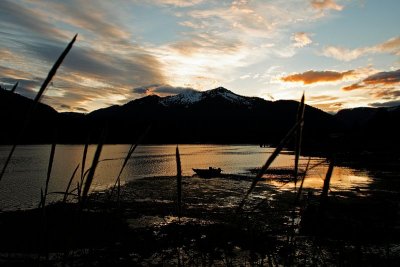
This evening, while doing something on the computer (I can't recall what it was now), I noticed that even though there was sunshine through the clouds blinding me, it was raining quite a bit. The backlight made for rather picturesque scene outside the window. As the scene kept changing into new and interesting forms, I quickly grabbed one camera (zoom or fixed 20mm... I chose the 20mm) and dashed outside. (What I could really use is a remotely controlled camera atop a 50' pole that I can raise above the house...)

The scene that prompted me to dash outside was gone by the time I got past the guardrail. It seemed that maybe the most interesting scenes had all passed by. But then I saw the light change to stream over Sasby island, filtered by the clouds and backlighting the falling rain. Then I heard and saw the skiff coming through. Would the light hold long enough...? And with the speed of the skiff, there was just one chance at a good composition. Would my previsualizing match what the camera captured? I think this image made my mad dash in the rain (and standing about with noseeums attacking me) worthwhile.

Here's one other image that made the cut for keeping in my files.

Sunset photos

The sunset yesterday was absolutely spectacular. Unfortunately, I didn't have a camera. Well, I did, on the BlackBerry. The problem was that it was too dark and the couple images that I got were quite blurry.

There are a couple of mountain peaks, which with the far north sunset angles during the summer, when the light and clouds cooperate just right, glow red like red-hot steel. I've seen it a few times, but never when I had a camera handy.

Tonight the sunset wasn't developing as nicely as it did yesterday. But I hoped that it would be worthwhile. It was at least somewhat promising about an hour prior. I drove out to the Scow Bay area, about 3 miles from home. But as sunset approached, it quickly became a rather drab, disappointing one.

Even so, there were a few (six) images that, with a little bit of Photoshop post-processing, turned out decent, if not spectacular.

Click on photo to access gallery page.

Click to open gallery in new window

Saturday, June 21, 2008

Narrows photos

Here are a few photos from yesterday's Thursday's walk down the shoulder of North Nordic Drive.

Opens in new window

Friday, June 20, 2008

I saved $2 today!

The BOB Ibex bicycle trailer I ordered on Sunday was delivered this morning. It took about an hour to assemble, and then I hooked it up to the bicycle for a test ride on the street out front. I was surprised at how easily it handled. I thought that it might take a little practice and time to get used to it, but it was really quite natural and effortless. I've never used the 2-wheel trailers so I don't know how the BOB compares to them. But what I know is that the BOB trailer, because it's a single wheel, leans and tilts and turns like a natural extension of the bike.

Connecting and disconnecting the trailer, too, was not as difficult as I had imagined. As long as the bicycle is able to sit up straight, there's very little effort in the connect and disconnect operations.

I went out with it to get groceries and the mail this afternoon. Maneuvering it into a parking location, I found, could be a little troublesome. It adds nearly a full bike length, so think about having to park something that long... And backing it up to try to get it into position is a trick I haven't quite figured out yet. The trailer seems to want to go its own way.

From the downtown grocery store to the Post Office and the other grocery store is an uphill trek. I had purchased probably 10-15 lbs. of groceries at the first one. Going up the hill I could definitely feel the weight. Once up there, the return trip was all level or downhill so that was quite easy, even with another 10 lbs. or so of groceries. I may need to consider my routes based on what I'm planning to purchase where.

Some of the roads were dirt and gravel. The trailer handled them with ease. The Ibex has a suspension to help ease some of the bumps. Again, since I've never had any other trailer, I don't have a comparison point.

I think I've found the way for me to haul my camera gear when I go out for a photo expedition. Since I usually stick to roads, both paved and dirt, it shouldn't be a problem. I don't know how well the trailer would handle true singletrack. The trailer is fairly narrow, so with care and practice, I think it is possible.

I saved about $2 in gasoline today!

Recipe: Split-Pea and Spiced Apple Curry

Following a recipe from one of my Indian cookbooks, I made my own garam masala yesterday. It is Punjabi style and has a large amount of cinnamon and cloves, giving it a very sweet aroma and flavor. I had placed it into a Ziploc bag because the spice bottle I wanted to use was still a little damp inside. This morning the bottle was dry and I poured the garam masala into it. While doing so, the aroma just enticed me to do something with it. I had some Pink Lady apples about and I put the two together for a different interpretation of the common spiced and simmered apple.

After I had tasted the result, my thought turned to how this could be the basis of an interesting curry. I looked in my Indian cookbooks, but could not locate the sort of curry I had in mind. I decided to try combining a basic split-pea type curry with the spiced apples. I attempted the combination this afternoon and had the result this evening for supper with some Basmati rice. It is a sweet-tart curry. I think it would go well with a salty, savory, spicy hot vegetable or meat dish as the sweetness of the curry tends to moderate the heat from chilies. To moderate it even more, instead of water in the curry recipe, you might use milk, cream, or coconut milk. (I tried adding a bit of cream in a little of today's curry result, and it seemed to work well. However, I don't know how the milk or the coconut milk will alter the curry.)

I'm presenting the two parts of the recipes separately as the spiced apple is quite good all by itself. The garam masala that is used needs to be heavy with cinnamon and cloves. Check the ingredients of any store-purchased bottle and make sure the two key ingredients are at or near the top.

These recipes may appear quite involved, but in reality they are quite simple. I completed the whole thing in about an hour. I think it helps that the different parts of the cooking process can be multitasked.

Recipe: Garam Masala Spiced Apples

Ingredients

  • 1 Pink Lady, Braeburn, or other sweet-tart and firm apple
  • 1 tbsp. butter
  • 1 tsp. Garam Masala (see discussion notes above)
  • 1 tbsp. finely grated ginger
  • 2 tbsp. dried currants
  • 1 tbsp. sugar
  • 1 tbsp. lemon juice
  • 1/4 tsp. salt
  • 1/4 cup water

Directions

  1. Peel, core, and slice apple. In a small saucepan, heat butter over medium heat.
  2. When butter has melted, add the apples, garam masala, ginger, currants, sugar, lemon juice, salt, and water.
  3. Bring to a low boil, then lower heat and simmer for 10 minutes.

Recipe: Split-Pea and Spiced Apple Curry

Serves 4 to 6

Ingredients

  • 1 cup dry yellow split peas
  • Full recipe, Garam Masala spiced apples (above)
  • 2 tbsp. canola oil
  • 1 tbsp. butter
  • 1 tsp. whole cumin seeds
  • 1/2 tsp. fennel seeds
  • 1 tbsp. finely grated ginger
  • 1 serrano chile, with or without seeds, minced (optional)
  • 1 tbsp. ground coriander
  • 1 tsp. ground cumin
  • 1/2 tsp. ground turmeric
  • 1/4 tsp. cayenne pepper powder
  • 1 14.5 oz. can crushed tomatoes
  • 1 tsp. salt
  • 1/2 tsp. black pepper
  • 2 tbsp. chopped fresh cilantro
  • Up to 1/2 cup water (or optionally, milk, cream, or coconut milk -- see notes in discussion above)

Directions

  1. Sort and wash split peas. In a medium pot, cook peas in 3 cups of water. Cook until desired tenderness is reached, then drain (see also step 4 below).
  2. While the peas are simmering, prepare spiced apple.
  3. While the apple is simmering, heat oil and butter in a large saucepan over medium heat. When hot, drop in the cumin and fennel seeds, stir and fry until fragrant, 1 to 2 minutes. Immediately add ginger and if using, the chile. Stir and fry for about 30 seconds until fragrant. Drop in the ground coriander, cumin, turmeric, and cayenne. Stir once or twice and then immediately (but carefully) add the crushed tomatoes. Add salt and pepper. Stir to blend.
  4. At this point the peas are probably at about the right tenderness. If still a little crunchy, let simmer until desired tenderness is reached. Drain and add peas to the tomato and spice mixture.
  5. In a food processor, process the spiced apples until they are finely chopped (but don't let it get to a puree). Add the chopped apples to the tomato, peas, and spice mixture. Stir and mix well.
  6. Reduce heat to low and continue to simmer another 15-20 minutes to blend the flavors.
  7. If the curry seems too thick, add water until desired consistency is achieved. Add cilantro. Bring back to a simmer and continue to cook another 5 minutes.

Wednesday, June 18, 2008

Jesus: The True High Priest

Here are some thoughts on this week's lesson, The Efficacy of His Priestly Ministry (Lesson 12).

Once again the topic for this week is one that is controversial and at times divisive. The founding of the Seventh-day Adventist church and the doctrine of the pre-Advent (or Investigative) judgment are closely tied to the topic of the heavenly sanctuary and Jesus' ministry as High Priest.

Again, I want to ask the question, "Why does any of this matter?" What difference does it make, particularly as it pertains to daily living in the real world?

The Study Guide asks this same question and proposes an answer (Thursday),

"It probably has something to do with loyalty and faithfulness...

"The way has been made for us, through Jesus, to approach God in the heavenly sanctuary. And to follow Jesus by faith into the sanctuary is not only to have one's soul cleansed by His marvelous grace but also to experience a new appreciation for His immutable law... This transaction... defines the difference the sanctuary teaching makes for us. By faith we enter with full assurance into that sacred place where Jesus ministers. And there, against all possible odds, we cling to the One... Thus anchored, we do not drift -- not into a view of the law that leads to the abandonment of God's holy Sabbath and not into evolutionary conceptions of origins that seek to dethrone the living God from His own universe. The doctrine of the sanctuary thus becomes a protection for us against rebellion and secures for God a faithful remnant in a revolted world."

Before I continue to develop how I've come to look at the topic of the heavenly sanctuary and Jesus as High Priest, I have to digress and point out what I see as a serious error in the Teacher's comments on p. 147 under Step 4. The whole section reads (bold emphasis supplied):

"For there is one God, and one mediator also between God and men, the man Christ Jesus, who gave Himself as a ransom for all, the testimony given at the proper time." (1 Tim. 2:5,6 NASB)

During the second century Irenaeus of Lyons taught that Jesus was offered as a ransom to the devil to free peoples' souls. The devil, however, was defeated because he did not know that Jesus was God Himself!

For hundreds of years this theory was adopted by the Christian world, until Anselm of Canterbury pointed out that Irenaeus's theory assumed that the devil had far too much power. Instead, Anselm said that Jesus' life was paid to God and not to the devil!

What a more poignant picture that makes -- Jesus' life given as a ransom to God in exchange for my eternal life!

It may be "poignant" for some, but for most I believe this is the very picture of God that turns them off. It pictures a god that requires appeasement. It pictures a god who is never truly satisfied. It pictures a god who reluctantly saves because Jesus makes him do it. It is a picture that is completely at odds with what the book of Hebrews (and the rest of the New Testament) is trying to show.

George R. Knight in The Cross of Christ (pp. 69-70) explains how the text in 1 Timothy (above) is a metaphor. He explains that the ransom described does not need a specific recipient. The concept of a ransom helps explain an aspect of Christ's work of salvation, namely that of freeing people from slavery to sin itself.

[End digression.]

I believe that this week's study and the book of Hebrews can be summarized by its first four verses --

Long ago, at many times and in many ways, God spoke to our fathers by the prophets, but in these last days he has spoken to us by his Son, whom he appointed the heir of all things, through whom also he created the world. He is the radiance of the glory of God and the exact imprint of his nature, and he upholds the universe by the word of his power. After making purification for sins, he sat down at the right hand of the Majesty on high, having become as much superior to angels as the name he has inherited is more excellent than theirs. (Hebrews 1:1-4 ESV)

In my processing the topic this week, I've come to the realization that in the big picture, the Hebrew sanctuary, the temple, and all its services were meant to reveal God more fully. The earthly high priest was seen as the representative of God, and as such was to reflect God's character and also bring people to God. The offerings and sacrifices were meant to remove obstacles that the people themselves had put up between themselves and God. The sins of the people made them afraid to approach God, and so they needed tangible means of obtaining assurance that they could be purified before they came close to God.

All these, however, being human failed to accomplish their intended purposes. Oftentimes they ended up driving people away from God rather than bringing them to Him. It was for this reason that Jesus came as the true High Priest, the only One (because He was also God) who could represent and accurately portray God to people. Through His actions and through the cross, Jesus demonstrated that there is no obstacle big enough that could keep God and people apart. Jesus took care of the sin problem. No obstacle, other than a person's own choice, stands between him or her and God. Throughout His life, Jesus' mission was to bring people to God.

In John's gospel account, we encounter themes of replacement (see Jon Paulien's commentary on John). One of these is the replacement of the earthly temple with Jesus Himself. Thus I tend to understand the High Priest, Sanctuary, and the work of mediating (or more accurately, reconciling or bringing together) the new covenant in the book of Hebrews as all coming together in Jesus Christ. I see it as both a completed work (as revealed in Jesus' life, death, and resurrection) but also an ongoing one through the Holy Spirit as Christ's disciples today bring people the gospel message.

Jesus continues His work of representing God via the Holy Spirit working through us. Jesus continues His work of drawing people to the Father via the Holy Spirit working through us. Jesus continues His work of removing obstacles, both real and perceived, via the Holy Spirit working through us. (See John 13-17.)

Perhaps why any of this matters to me is the assurance that God continues to be with me today, and that I have nothing to fear from God. I know this because Jesus has represented God completely faithfully and accurately. Because I am certain of this, in turn I can be an instrument in God's hands of spreading the message of God's true character to the world. This, I believe, is the central message of Hebrews.

Tuesday, June 17, 2008

Landscapes along the beach

The unexpected dry weather continued through this morning. I went out with my cameras in the late morning to see if the flowers from last week were still in good condition. About half of them were, as I discovered.

Today I took along my EOS-10D outfitted with the usual EF 20/2.8 and my Rebel XTi outfitted with the EF 135/2.0L. It's been perhaps two years since I used the 135. It was great getting reacquainted with an old friend. The only problem with it is that it won't auto-focus closer than 1.6m. I recall having this problem the last time I used this lens, so it's not a new problem. I ended up manually focusing most of the time. That was probably just as well since the breeze would have caused the auto-focus severe problems.

After I had just gotten out and set up my first shot, a person living across Nordic Drive from where I was came by to chat about photography. It turns out he is interested in getting back into still photography after quite a number of years' absence. I gave him a little of what I know about the Canon digital SLR system. Since we're basically neighbors (just a short block down the road), we might be seeing more of one another in the upcoming months.

For close-up floral images with the 135mm, after reviewing the frames, I saw that f/4 to about f/5.6 works really well and fits my tastes and vision. Anything less than f/2.8 just doesn't have enough depth of field unless I'm going for an artistic (almost Impressionistic) effect. Above f/5.6, the background clutter begins to become noticeable. I did use smaller f-stops for a few frames where the background was basically the sky.

I spent most of the rest of the day working the images in Photoshop. I took some artistic liberties with a few of them.

Here's the gallery (click on image to go to the site):

Opens in new window

Monday, June 16, 2008

Unexpectedly sunny

I thought the whole week was going to be clouds and rain, but nearly all clouds disappeared today and the day ended up quite sunny and warm. Unfortunately, as it frequently seems to be the case, I didn't actually get to enjoy much of it other than from the inside.

The city is looking at some capital improvements in the area where our church is located. And it would like to charge the property owners for that through special assessments. Anyway, in the morning the neighbors got together to discuss the matter and how the city was proceeding with trying to get funding for it. I bicycled over and back, so I was outside for a bit.

After returning home, I mowed the lawn. I was indeed outside, but not necessarily enjoying it. As I know I've mentioned before, no matter how warm it might be, in order to keep bugs from eating me alive, I have to be covered head to toe while mowing. It was quite warm today, and especially so with a manual reel mower.

While I was mowing, Shelley was outside on a blanket, covered with Off!, working on a math assignment.

In the afternoon I went to run my usual daily errand of Post Office and grocery shopping. I would have preferred to bicycle to do these, but there is only so much (and not much) that I can fit into a backpack. I will have this problem resolved, hopefully by the end of the week, when I take delivery of a new bicycle trailer. With the cost of fuel at $4.30+/gallon now, each trip costs $1 to $2. The cost of the bike trailer will be made up in less than a year. And the bike trailer is a lot cheaper than an electric vehicle, however nice that may be. The point of all this is that I was driving around when I would have rather been out walking or on the bike.

In the evening, it was off to the City Council meeting. It turns out this next year's city budget included funds for the capital improvements mentioned earlier. The key was to make sure that it there was no reference to "Local Improvement District" in the line item. One of the councilors tried to remove it altogether, but there was no support for that. In any case, at least the initial planning and engineering work will come directly out of the city's regular tax collections rather than through a special assessment. I rode the bicycle to and from the meeting.

What I had really wanted to do today was go out to the beach area and re-photograph some of the wildflowers with a good camera and tripod. That will have to wait for another day, but not too long because some of the flowers may fade if I wait too long.

Sunday, June 15, 2008

New Pasta Cooker and Steamer

It's Father's Day and what did I get? A new pasta cooker and steamer. I'll be the first to acknowledge that this isn't at all a typical Father's Day gift. But I bet I'll make more use of this than say a tie. Or a hunting knife. Or a fishing pole.

It wasn't exactly a surprise, since last week, after I off-handedly made mention of it and how I'd been eyeing it since last year, Elise went out to the store. Today, she told me that when I mentioned it, she couldn't understand why I'd be longing for yet another "pot" for the kitchen. But after she saw it, she fully understood why it looked so wonderfully useful.

Here's how it looks with all the pieces in its storage position.

IMG_1503

And here are all the individual pieces.

IMG_1504

It comes with a stockpot base, a large pasta insert, a smaller steamer insert, and a vented lid.

The pasta cooker fits inside but its bottom doesn't touch the pan bottom. That means that even if the cook isn't terribly conscientious about stirring the pasta, it won't stick and burn onto the bottom. Not only that, but the bottom layer gets the circulating water so that the pasta should cook more evenly. Once the pasta is done, just the insert needs to be lifted out, and all the draining happens within the pot. No lifting heavy pots from the burner over to the sink, tilting it into another colander to drain. And it also means that I don't have to remember to reserve cooking liquid for pasta sauce recipes that call for it. It seems that half (or more) of the time I forget to reserve and end up using plain water.

The steamer insert fits at the top of the pot. It's got handles that allow the insert to be conveniently lifted up and out of the pot. This will be particularly useful for a mashed potato recipe that includes a step of rinsing the potatoes midway through steaming (this step removes more of the stuff that causes "gumminess" in mashed potatoes). This insert is definitely more sturdy than the little folding one that is commonly available. Elise thinks it will be more convenient than the electric steamers (of which we have a fairly deluxe model), particularly when it comes to washing and cleaning.

As a related aside in case you don't know, when using stainless steel pots and pans, you should add salt only to boiling water. Otherwise salt can etch the pan surface.

No sermon from yesterday

Pastor Brown spoke yesterday and I didn't have the recorder handy. So there is no recorded sermon from yesterday. Just letting you know in case you were wondering.

Friday, June 13, 2008

Going to Anchorage mid-July

There is a church Conference meeting held every few years that is coming up this July. Elise and I will be heading there. Not that we particularly want to go, but I guess we're supposed to. It isn't cheap and the church (i.e., the few of us in the church) have to foot the travel costs. It's been a few years since we've stayed at a place other than one of our WorldMark resorts, and I forgot how expensive accommodations are! :(

Pyrex is not broiler-safe

I didn't know this, did you? Maybe it said so somewhere in the original packaging, but who stops and reads the instructions for a casserole dish?

I found this out while reading about vegetable gratins in the current issue (Jul/Aug 2008) of Cook's Illustrated. This also might explain an explosion our friends experienced last week with a Pyrex dish in the oven...

Now I'm going to need to search out a clay or porcelain casserole dish for use with the broiler. And I suggest you do the same too, if you've been using Pyrex with the broiler.

Wildflowers along the beach

I had a few things to run over to town this morning. While there I found seven years' worth of Cook's Illustrated in hard-bound volumes at the Salvation Army Thrift Store. At 50-cents each, I couldn't pass it up.

Anyway, on the return trip I came by way of Nordic Ave. and walked along the top of the beach, right next to the road. I wanted to see how the wildflowers were coming along this year. I found that they were just beginning to bloom, with a few plants here and there in full bloom.

I didn't have a decent camera with me; however, I did have my BlackBerry device with a built-in (arguably) 1.9 megapixel camera. In a pinch, you make do with what you have. Mainly I wanted to record the locations for some of the interesting flora so that on the next good day I could take my real cameras for better photos.

The BlackBerry photos are not great, but they are usable. They do seem to require quite a bit of color, brightness, shadow, contrast correction, and noise reduction. They also look a whole lot better when the resolution is reduced to about 800x800 (or less). I reduced the ones posted here to 450x600.

Wild Iris buds Different view of iris buds Columbine Columbine, different color Three colors of Colombines Fern Hackweed Pink Columbine White wild Iris? IMG00018

Wednesday, June 11, 2008

A couple of scanned film galleries

I own a Cosina-Voigtlander rangefinder film camera that I use from time to time. I recently finished off the roll that I had in there since last summer, got it developed, and scanned the negatives to digital format. I think I've mentioned this before but film can be fun in its own way -- there's no immediate feedback so I'm more methodical about composing and releasing the shutter -- in other words, I take more time. Because I don't always finish off a roll, it means there are photos sitting around from who knows how long ago. There's the anticipation of not knowing quite what to expect when getting back the negatives (or in my case, seeing the small digital proofs at MPix.com).

I put up two galleries: one from 2007 and one from just recently. Click the links or photos below to open gallery pages.

2007 Summer

2008 Frederick Point area

Jesus: Proof of the Power of the Passion

This week's Sabbath School lesson subject is The Power of His Resurrection (Lesson 11).

The big question of the week is, "Why does Jesus' resurrection matter?" The Study Guide asks the same question on Monday, "What is so important about the Resurrection to our faith?" The Study Guide makes the statement on Sunday, "It [the Resurrection] is the central doctrine of the Christian faith." Do you agree with it? Do I? If we do, then do we truly believe it and live it? Monday's lesson contains a quote by Alan Richardson from A Dictionary of Christian Theology, "All other Christian doctrines are dependent upon the proclamation of the resurrection..."

(An aside: I think that Seventh-day Adventists are considerably handicapped when it comes to the resurrection because of our historical/traditional aversion to anything that remotely touches Sunday. I think we need to get past the unreasonable fear of Sunday because I believe this fear limits our proclamation of the full gospel message.)

I think there are other ways of approaching the question, "Why does Jesus' resurrection matter?"

For instance, we might ask, "If Jesus wasn't resurrected, does His life and death make any difference to the world and to you?" Or we could ask, "If there is no substantial evidence and hope for a future resurrection, would you live your life any differently?"

In many ways, if Jesus was not resurrected -- if He is not alive today -- then Christianity wouldn't be much different from any of the other religions and philosophies that teach people to do good and live a life that contributes a net positive to the world. In that case, we are on our own. We may have substantial evidence of some divine being's love and compassion upon us, but we would be left with this being succumbing to the even stronger power of death. Ultimately, if we want to do any good, if we want to be remembered beyond our short lives, if we want to leave the world a better place, if we want to leave a legacy -- we have to do whatever it takes using our own efforts to accomplish that. Because without the resurrection, this world really is all there is.

It's really a pretty hopeless picture. The environment is deteriorating rapidly. Violence, crime, and chaos of all sorts are on the rise. Peace and security are found less and less. It seems that the world is beyond fixing. Even if a significant number of individuals come together to work towards a vision and goal of improving the world, it seems that would only serve to slow down the inevitable collapse and implosion of the world.

My response to, "Why does the resurrection matter?" is that I believe that the resurrection is the proof of the power of the passion of Jesus. The resurrection is proof that love is the greatest power in the universe. God's love cannot die. God's love brings life. God's love transforms. God's love offers new motivations for living.

Whereas people might live good, moral, upstanding, positive, contributing lives without God and without the resurrection; I believe that it would be essentially for selfish reasons. I think that the motivations generally will come down to self-preservation and self-perpetuation -- perhaps not the individual, but for the human race as a group.

But for the Christian who believe in a risen Christ, the motivation for living a good, moral, upstanding, positive, contributing life is because all of life and all that he or she touches is to bring honor and glory to God -- to make every part of life a means of revealing God's love of the world, to the world. Leaving a legacy, forestalling the collapse of the world, and other such motivations become secondary.

Christians try to leave a positive legacy so that those who follow can be encouraged in their journey with God. Christians try to leave the world a better place because that is how we believe we show God's love and care for the world. Christians care for one another, not for quid pro quo, but because the resurrection is proof and promise of an infinite abundance in supplying all our needs for eternity.

The cross of Christ was the exhibit of the depth of God's love and the power of sin. The resurrection is proof of God's love and His victory over sin and even death.

Monday, June 09, 2008

Cats and Trees

Cats often climb trees. This post has nothing to do with that. Today, I simply have both photos of our cats and photos of some trees and such from yet another walk to get the mail. (How's that for a run-on sentence?) The humane association in town puts together a fund-raising calendar each year and for $10, a photo can be submitted for inclusion in the calendar. I'm thinking of submitting the middle photo of the top row.

Here is the gallery link for the cats:

Here is the gallery link for the trees and muskeg:

Sunday, June 08, 2008

Sermon: When Your World is In Chaos

(Click HERE for MP3 sermon audio.)

Yesterday's sermon was based on John 18:1-14. This is the account of Jesus' betrayal and arrest.

The first half or so of the sermon is a hypothetical, first-person account that John might have given as he was in the midst of the betrayal and arrest scenes. My intent was to try to capture the confusion and chaos, and betrayal and destruction of hopes that the disciples likely experienced and contrast that with what John wrote about the same scene decades later as his message to second- and subsequent generations of Christians regarding confusion and chaos in the world.

Saturday, June 07, 2008

Yesterday's photos updated

Yesterday's photos have been edited/updated/processed/enhanced/altered.

Click HERE to open gallery page

Thursday, June 05, 2008

A 2-Hour Walk to the Post Office

I thought most of this week was going to be rainy, but today turned out to be quite dry and with quite a bit of sun. I took the opportunity to mow the lawn. It seems the warmth and the sun are accelerating the grass growth. Later in the afternoon, I chose to walk to the Post Office and back. I took along both of my Canon EOS cameras. The first one was outfitted with a standard 28-135 zoom. I put a 20mm (32mm on a standard 35mm frame, after the 1.6x APS-C sensor conversion factor) on the other.

The walk to the Post Office and back is normally around 40 minutes. Since this turned out to be such a picturesque day, I took my time, took a few detours, and ended up returning home 2 hours after I left. I also returned carrying two packages back.

I found that having two camera bodies with different focal lengths on each is much more convenient than having to swap lenses back and forth. Not only is it more convenient, but I think there is reduced risk of dropping the lens, the lens caps, and getting dust and such inside the camera. Now if I could figure out a convenient way to transport two camera bodies, two or three lenses, and a tripod while riding a bicycle, I'd have it made...

Anyway, here is the gallery from today. I haven't yet adjusted the contrast, brightness, colors, etc. to improve their appearance. (Click on gallery image.)

Wednesday, June 04, 2008

Jesus: He Died Because...

This post are some comments on this week's Sabbath School lesson, Lesson 10, The Meaning of His Death.

How would you complete the sentence, "Jesus died because...?" That's the question this week's lesson attempts to answer. This is a question people spend entire lifetimes trying to figure out, and the Christian church has been trying to come up with the definitive answer for nearly 2,000 years now. So I doubt spending a week on it is going to make much of a difference one way or another. In fact, I think we all have some pretty strong opinions about what Jesus' death means, what it accomplished, and how. Going through it again probably isn't going to change things much, if any.

The lesson emphasizes the importance of the substitutionary aspect of the atonement. Tuesday and Wednesday lessons briefly touch upon three other ways of looking at the atonement: ransom, satisfaction (of "God's wrath"), and reconciliation. Throughout this week's lesson, though never directly mentioned but alluded to, almost in a dismissive and derogatory way, is the moral influence theory of the atonement. There is another fairly recent (okay, it's almost a century old now) theory called Christus Victor (founded upon both the ransom and recapitulation theories) which is not mentioned at all.

There was an article, "A Multifaceted Gospel," in Christianity Today a short while back that proposed that Christians ought to look at the different theories of the atonement as different facets contributing a little bit to the understanding of the whole. In other words, there is no "best" or no single "right" way of understanding the atonement; rather all the pieces must be taken together if we are to better understand what Jesus' death means. (But also see this article and this other article where CT defends the penal/substitution theories as being at the center of the gospel.)

In one of my recent posts reviewing George Knight's book on the atonement, I noted that I am somewhat uncomfortable with the penal/substitution theory of the atonement. I don't dismiss it completely away, because there are a number of scriptural passages that seem to provide a strong basis for the theory. Perhaps I am uncomfortable with the emphasis historically and traditionally placed upon this particular theory of the atonement.

At this particular segment of my spiritual and Christian journey, I find that the Christus Victor (also examine this lengthy discussion comparing C.V. to Satisfaction/Substitution linked to from the previous C.V. page) theory best represents the God that I've come to know. This may or may not help you in your understanding.

Here are several other discussions specifically on this week's lesson:

I provide all the links in this blog entry to show that there is more than one way to consider Christ's atonement work. I think that it is important to become acquainted with different ways of approaching the "diamond" that is Christ's atoning work for us. I believe that by seeing the atonement from multiple perspectives, it can enrich and deepen our understanding and appreciation of God's love for us.

Tuesday, June 03, 2008

Watching some boats go by

Last week when Amy had her birthday party, I moved my office/study area from the kitchen table (where it's been in both the apartment and in our house) to our bedroom right next to the front window.

Now that I've had some time up there, I think I'm going to leave my office/study there. It's just so nice to be able to view the eagles, gulls, ravens, and yes, even crows flying about. It's nice to watch the tides come in and out. And I can watch the boats come and go.

The following is about a 1-minute video clip (there is no audio) of the comings and goings of some of the boats that I saw today. I originally wanted to catch some eagles in action, but as soon as I got a camera, they all disappeared. So all you get are boats. You do get a variety, though.

Monday, June 02, 2008

The rain returns on day 10

Most of the day was overcast, though during part of the afternoon there was some sun coming through. By this evening though, the rain started to drizzle down.

Earlier in the day, I went out into the muskeg one more time to get a little better image of a Sundew (carnivorous plant). While there I also noticed that the Labrador Tea blossoms were starting to open up, so I came back with one photo of that. This time of year, what can be seen in the muskeg changes quite rapidly. Here's the gallery from today:

I finished working on photos from a couple of days ago. I didn't work on all of them. The ones that are different from the original are noted as such in the description text. Click on the cottongrass image to open the gallery::

Click HERE to open gallery

I received back today the Canon EOS-10D that I had left in Oregon for repairs. I held down the shutter for repeated shots and the shutter works fine now. The total repair bill, including adjustments to the mirror assembly and a new shutter was just under $200. If it lasts me another few years, it will have been money well spent. Now I can have two bodies with me so that I don't have to keep changing lenses.

Finally, this town has no rice. Well, that's not exactly true, but all that's left are 1, 2, and 5 lb. bags of various types of rice. I don't know if the rest of the country is experiencing rice shortage, but the last large bags of rice disappeared nearly a month ago (just a couple of days after we came back). It looks like I'm going to have to change my menus to include a whole lot more pasta and potatoes and use rice very sparingly.

Sunday, June 01, 2008

Muskeg photos from 29-May updated

I just finished working on all the muskeg photos from 29-May. You can view the completed images HERE.

Now on to the images from yesterday...

Sermon: The Holy Spirit in John - Part 2

(Click HERE to listen to MP3 sermon audio.)

Today sermon looks at John 16:8-11.

This sermon continues the discussion from last week regarding the Holy Spirit's work as described by the apostle John. Specifically, the subject of the Holy Spirit "convicting" the world concerning sin, righteousness, and judgment is discussed.