Showing posts with label Tradition. Show all posts

Sunday, August 20, 2023

Sermon: When Jesus Called a Woman a "Dog"

Introduction

Cultural Foundations for Ethics and Morality

As much as we may want to believe that we have an objective view of ethics and morality, the fact is that many things which we discern as good or bad, acceptable or not, normal or abnormal, are cultural constructs. Many of these are used as identity markers. They draw boundaries between who belongs and who doesn’t belong.

Can women wear pants? Depending on when and where in history, this had moral and ethical implications, and in some circles, they still do.[1]

Men and growing a beard or not had moral implications and may still.[2]

Is it better to eat with forks, spoons, and knives; or is it acceptable for adults to eat with their hands? Should you eat pizza with your hands, or cut it into pieces with a knife and fork? How you prefer to dine and how you view the use of utensils vs. hands offers an insight into culture and belonging, and in some cases may also carry ethical connotations.

The relative importance between individual freedom vs. collective action is another ethical and even moral consideration for a society and culture. Different societies and cultures place different values. One society might look at another’s and be quite convinced theirs is right and the other is wrong, and vice versa.

These are just a few examples.

Language as Encoders of Culture and Tradition

Furthermore, the language and words that we use are also a part of our culture and tradition. Even when we limit our examination to just English, we see diversity around the world in words and phrases. Within the United States, there are differences among regions. How we say things can be identity markers. These extend to professions, economic and class differences, and racial and ethnic differences.

Words can and are used to divide, harm, and hurt. This is especially true between groups that differ in their available societal power. Those with more power use words to protect their own position while keeping others down. This can be intentional, but it can also be quite unintentional. The words and ways of speaking by those in higher power positions are often absorbed unconsciously because those things said are the norm in that environment.


Problems of Blind Adherence to Tradition

The focus of today’s gospel reading is the story of the Canaanite woman and Jesus, the last part of the reading. But the extended reading before the story provides an important context that strengthens the surprises found in the story.

The first part of the reading involves the Pharisees and scribes coming to Jesus to ask why his disciples do not follow the tradition of the elders of washing their hands before they eat. Walter T. Wilson in his commentary on this text notes that handwashing was not a universal Jewish custom during 1st century CE, but most closely associated with the Pharisees; making this ritual a sectarian identifier.[3] This leads to the implied conclusion that Jesus and his disciples were associated with the Pharisaic group, or at least seen to be most closely identified with that group.

Jesus’ rebuttal is a counterargument. He throws a question at the questioners: why do you place the tradition of the vow of Korban above the commandment to honor one’s father and mother? Jesus referred to a method of vowing Korban that could be used to sever one’s ties with family (it’s complicated and a malicious use of vows).[4] Jesus questions how a tradition, even one that involves a vow to God, could circumvent a commandment from God?

A short summary of this first debate is 1) the Pharisees ask how Jesus and his disciples could be part of the household of Pharisees, if they do not observe the proper ethical boundary markers passed down through tradition; and 2) Jesus rebuts by providing an example where an ethical and moral tradition in fact can be used to destroy a household. Jesus’ assertion is that the observance of tradition is relativized to its value in maintaining relationships.

Problems of Judging by Externals

The second part of the reading relates to the first in that it begins with the concept of eating something that may not be ritually clean, such as food eaten using unwashed hands (but the Markan version of this discourse includes unclean food categories as well). Jesus takes the argument about the boundary marker of ritual purity and turns it into a discussion about the ethics of speech. What one eats merely comes out as physical waste, but speech can destroy people, relationships, and community.

A summary of this section is 1) the Pharisees are solely concerned with external markers of purity; but 2) they mean nothing in terms of what true purity is. True purity is what is in the heart, and the evidence is found in the words that come out through speech.


Story of the Canaanite Woman and Jesus

It is with this prelude of tradition and speech that we come to the story of the Canaanite woman and Jesus’ interaction with her.

The setting changes. Jesus is in the district of Tyre and Sidon, outside of the physical borders of the Jewish region. The narrator uses the term “Canaanite” to refer to the historical animosity between Israelites and Canaanites, and to recall the kind of practices that were associated with them. It reminds the readers of the history of problems that the Israelites had with keeping their religious practices pure and undefiled by Canaanite practices and gods. It also evokes the insider-outsider distinction, where the Jews are in favor with God and the Canaanites are outside of God’s favor.

Jesus Does Not Act Like He Usually Does

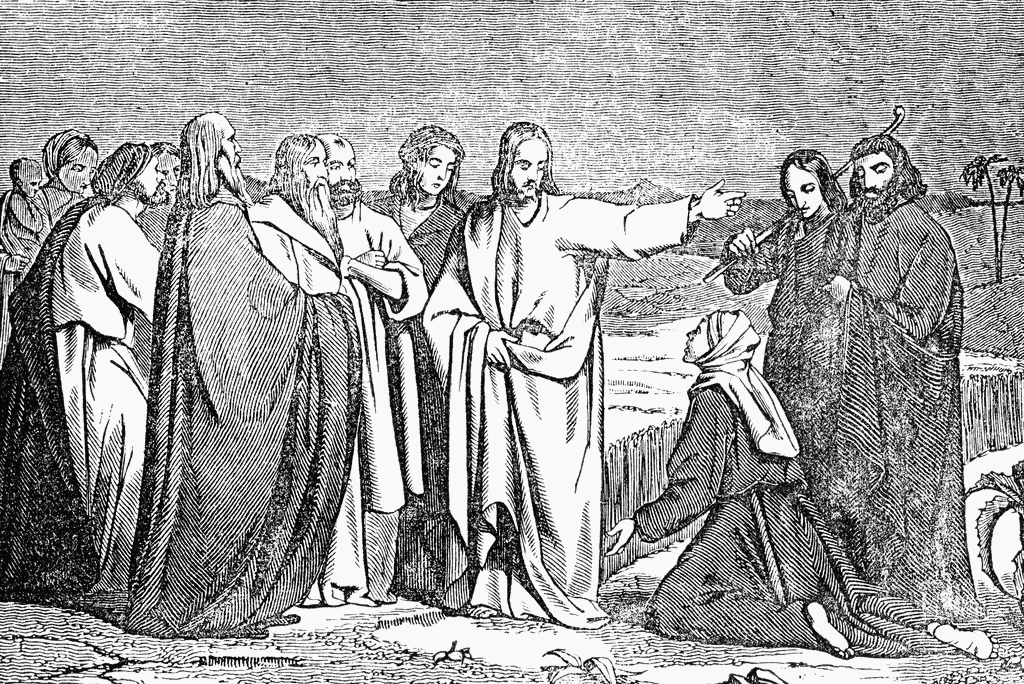
We next see the woman coming to Jesus and shouting at him, “Have mercy on me, Lord, Son of David; my daughter is tormented by a demon.” The act of a woman approaching a man directly, especially one who is not a family member, and a foreigner, it believed to have violated numerous social norms and boundaries. One commentator explains,

The woman’s behavior is unacceptable. Her culture expects women to be reserved in public. When she not only takes the initiative but also shouts her demand at Jesus, she violates social norms. Social affronts do not merit consideration, so Jesus seems to be playing by the social rules of his time when he does not even respond to her.[5]

She persists and the disciples urge Jesus to send her away. Jesus finally says something, but I read it as Jesus responding more to his disciples. The message contained is meant to be heard by the woman, but I see Jesus still avoiding a direct response to her. Another commentator opines, “In terms of civility, Jesus’ silence is the high moment of the pericope.”[6]

Jesus’ response is, “I was sent only to the lost sheep of the house of Israel.” This echoes his instructions to the disciples when they were sent out, described in Matthew chapter 10.

The woman continues to persist in her desperation. Her plea is reduced to, “Lord, help me.”

Racial Epithet

Jesus’ now responds directly to the woman, but it also hits the lowest point. “It is not fair to take the children’s food and throw it to the dogs.”

The interpretation of this response from Jesus goes all over the place. Many traditional Christian interpretations try to save Jesus from his words.

The difficulty with this text is that Jesus calls the Canaanite woman a “dog.” Scholars, theologians, and pastors have tried to tame this beast and tried to defang it. Among some of the traditional interpretations offered include:

1)     Jesus was trying to teach his disciples and really didn’t mean what he said. The woman could tell from his body language and vocal tone that he didn’t really mean it.

2)     Jesus used a specific word, “little dog,” instead of simply “dog,” so it wasn’t really an insult or a racial epithet.

3)     Jesus was testing the woman. He knew she had enough fortitude and faith to overcome an apparent insult.

More recent scholarship takes the position that Jesus did, in fact, use a racial epithet. [7] The difficulty then becomes how to reconcile the traditional position of an perfect Christ with what seems like an imperfect Jesus.

Broadly, the explanations given come down to the humanity of Jesus. In his full humanity, Jesus would have been affected by the cultural and social norms of his day and place.

Defining and Explaining Perfection

Somewhere along the way, we have created a picture of Jesus that is static: that somehow because of his divinity, he had complete human knowledge and could make no mistakes. From this assumption we get the line in Away in the Manger where it reads, “No crying he makes.” Or the story of Jesus, when he is twelve years old in the temple, totally oblivious to his family going home; but it is traditionally interpreted as Jesus doing the better thing and his parents should have known better. But the text actually seems to say that perhaps Jesus’ behavior was not correct, because he afterwards is described as being “obedient” to his parents and learning and maturing.[8]

Where we probably get the idea that Jesus was perfect from the beginning of his humanity comes to us from the Epistle to the Hebrews.

15 For we do not have a high priest who is unable to sympathize with our weaknesses, but we have one who in every respect has been tested as we are, yet without sin. (Hebrews 4:15 NRSVue)

8 Although he was a Son, he learned obedience through what he suffered, 9 and having been made perfect, he became the source of eternal salvation for all who obey him… (Hebrews 5:8-9 NRSVue)

But even these imply that perfection was a process that came to fruition through his experience of crucifixion.

Did Jesus Learn?

Thus, while Jesus was able to see problems with many of the social structures of his time, those were things that he would have come to see as part of his learning and maturing. There would have been many other problems that he would not have seen, simply because he had not yet encountered them. When Jesus began his public ministry, did he suddenly stop learning and developing a more mature understanding of love? Did he get rid of all his blind spots before his public ministry? Or did he continue to learn and grow?

In the current story about the Canaanite woman, we might interpret it as one of the tests that could be included in the text in Hebrews. Would Jesus recognize his blind spot and learn from his interaction? Would he correct his initial mistake, coming from a perspective of cultural and social blind spots?

The hero/heroine of this story is the woman. Despite being ignored, being insulted, being called a “dog”, she persists, and many commentators and scholars today see this woman teaching Jesus and expanding his understanding of how to love more fully. I realize this can be shocking and difficult for many of us who have years of traditional Christian teachings around Jesus. But perhaps it is not a coincidence that the earlier texts we discussed are ones critical of blind adherence to tradition and traditional teachings.

The woman helps Jesus break out of his traditional boundaries, the ones he has not recognized until this point. Through her words, she reveals faith that is in her heart.

27 She said, “Yes, Lord, yet even the dogs eat the crumbs that fall from their masters’ table.” 28 Then Jesus answered her, “Woman, great is your faith! Let it be done for you as you wish.” And her daughter was healed from that moment. (Matthew 15:27-28 NRSVue)

I wonder if by this point being seen and heard by Jesus was more important and affirming for the woman than the healing of her daughter. That the healing was the evidence that Jesus saw and heard.

Jesus’ Example for Us

I believe that the story of the Canaanite woman is Matthew’s illustration of how even Jesus could be bound by tradition and how he could judge by outward appearances, but then how he breaks through them to become more mature in love. In this way, as the writer of Hebrews explains, Jesus can relate to us and “sympathize with our weaknesses.”

The woman was an outsider, one that is initially depicted as having a wrong religion, and one who acts against social and cultural norms. Yet she was the one who had a better and more expansive vision of God’s love and inclusiveness.

Jesus, who was fully divine, was humble in his humanity to recognize his blind spots, could accept instruction and teaching from someone who initially didn’t appear to have anything to offer, and learn from his human mistakes.

We have our traditions, cultures, and social norms that we use to judge people. They blind us to opportunities to love and learn. Perhaps the best way to love someone is not necessarily to offer something to them, but when we take the time to see them as complete human persons, and to learn from them and accept what they have to offer us.


[3] Wilson, Walter T., The Gospel of Matthew (Eerdmans Critical Commentary), on Matthew 15:1-20 (Kindle version, location approximately 1258).

[4] Cairus, Aecio E., “The Heartless Corban Vow”, Asia Adventist Seminary Studies (4: 2001):3-7. Retrieved from https://journals.aiias/edu/jaas/article/download/449/398/819

[5] Feasting on the Word: Year A, Volume 3, p. 832.

[6] Ibid., p. 836.

[7] McGrath, James F., What Jesus Learned from Women, “The Syrophoenician Woman”, p. 87-107.

[8] Luke 2:41-52.

Sunday, October 09, 2022

Sermon Outline: Restoration and Wholeness

Sermon: Restoration to Wholeness

Lectionary: Proper 23(C)

Text: Luke17:11-19

[It was an unusual Sunday. I was at the Lutheran Church as their musician this morning at the 10am service. And then I had volunteered to provide the sermon at the Presbyterian Church, because last Sunday the schedule didn't appear to have anyone assigned for today. I had been writing out complete sermons for a very long time now, but for a number of reasons, including time available and the intended audience for it, I went with an outline format, intending to flesh it out as I delivered it. When I arrived at the church, it turned out that someone had been scheduled and apparently the scheduler had forgotten or forgot to note it. Anyway, the end result is that she gave her sermon, and then I followed. There was really no overlap between the two, and I was relieved to have kept mine as an outline, so that I could improvise on the spot.]

Outline

I. What kind of disease?

A. Leprosy (Hansen’s disease) – No 

1. Older Bible translations and some newer ones retain this word

2. Most modern scholarship reject this disease identification

3. Commentaries and sermons that describe leprosy as a disfiguring, gross, permanent disease were common in the past – still encounter some recent ones

B. Broad category of skin conditions – Yes (Leviticus 13)

1. Could include temporary, short-duration conditions, but also chronic ones – usually serious, but difficult to ascertain from Leviticus text

2. Inspection and rituals to restore purity after condition goes away

II. Ritual Purity

A. Not necessarily having to do with sin (as is commonly defined today)

B. Impurity does not imply individual is bad or did something wrong

C. Impurity itself was believed to be inherently contagious

D. Cuts an individual off from normal social and religious community

E. Rituals to restore purity and restore an individual back into communion

III. Different words used in describing the healing that took place

A. Cleansed [g2511. καθαρίζω katharizō] – vv. 14, 17

1. Origin of catharsis – “to release” 

B. Healed [g2390. ἰάομαι iaomai] – v. 15

1. Modern usage – perhaps one origin of “-iatric”  as found in words such as pediatric

C. Made Whole, Saved [g4982. σώζω sōzō] – v. 19

IV. Specific texts to highlight

A. “And as they went, they were made clean.” (v. 14)

1. They all go without first experiencing healing

2. Healing takes place along the way

3. All are cured

4. Word used is katharizō – a restoration of ritual purity

B. “Then one of them, when he saw that he was healed, turned back, praising God with a loud voice.” (v. 15)

1. Word used is iaomai – physical healing

C. “And he was a Samaritan… ‘Did none of them return to give glory to God except this foreigner?’” (v. 16, 17)

1. Reader/listener now learns that the one who returned was an “outsider”, a Samaritan, a foreigner; one who was despised by the “insiders”

2. The other nine, being Jews had received what they needed to be restored into community. They had rituals and priests. 

3. Those on the margins may realize need and experience gratitude more readily than those who “expect it”

a) Irony that all ten were on the margins before they were made clean

D. “'Get up and go on your way; your faith has made you well.’” (v. 19)

1. Word used is sōzō – made whole and saved

2. It is the first time “faith” is mentioned in this narrative and it is in conjunction with gratitude toward God’s actions

V. What does this mean for First Presbyterian?

A. The community is currently not “whole”

1. Not saying the community is in a state of ritual impurity

2. But it is missing a critical element – a permanent pastor 

B. How might this story find application or offer encouragement?

1. What might it look like for the church to be “whole”?

2. How might the instruction to go about regular business look like?

a) C.f., Today’s Jeremiah reading: Jeremiah 29:1, 4-7

3. What is faith and its role in bringing about restoration and completeness?

4. How does gratitude enter the picture? 

a) C.f., Today’s Psalm reading: Psalm 66:1-12

5. What relevance might there be in Jesus locating himself and being found outside cultic traditions and hierarchy? 

a) But also note that he instructed all ten to adhere to cultic tradition and practices

b) However, healing occurred before any of them were able to practice the cleansing rituals

c) Jesus did not tell the Samaritan who returned to then go and follow through on the rituals


Sunday, August 29, 2021

Sermon: Boundaries


Lectionary Year B, Proper 17

Mark 7:1-8, 14-15, 21-23

Story: The Guru’s Cat[1],[2]

Once there was an Ashram in Kathmandu, Nepal, where a guru lived with many disciples. Also living in this Ashram was a cat. He was a wonderful cat, very friendly and eager to please. The cat was well fed and well loved by everyone in the Ashram.

There was only one problem: during the Ashram daily schedule, the cat wanted to participate. And the cat’s participation began to disrupt the hours of chanting and meditation for the guru and the disciples. Why so? When the guru and disciples would chant, the cat would howl. When they would meditate, the cat would snore quite loudly.

Therefore, the guru asked that every day, during chanting and meditation, the cat be tied to a post in another room. The disciples obeyed the guru’s command, and the discipline of the daily schedule was restored. There was no more disruption from the cat and everyone’s focus was again strong on chanting and meditation.

A few years passed, and one auspicious day the guru peacefully left his body. The disciples continued to tie the cat to the post every day during the period of chanting and meditation.

One day, the sweet cat died. The disciples held a meeting and discussed how important it was to preserve the guru’s teaching. With resolve, they went to the market and bought another cat so that they could tie it to the post during times of chanting and meditation and in this way faithfully honor the guru’s teaching.

Comments on Story

It’s humorous and probably apocryphal. And it illustrates the problem of blindly observing tradition but forgetting what birthed it. Faithful observance of tradition becomes more sacred than what the tradition originally pointed to.

And that is one way of interpreting and understanding today’s gospel text about the washing of hands. There is nothing wrong with interpreting the text as pointing to the problem of excessive observance of outward traditions and reliance on them to appear wholesome and good, while neglecting unaddressed evils inside of individuals and groups. It is a completely valid concern.

Yet there is much more to this text than that.

Literary placement

The first point I’d like to consider is the literary placement of today’s text. The larger literary context begins around the middle of Mark, chapter 6 and goes midway through chapter 8. Here is a series of stories that Mark has placed together to convey a larger point.

The larger section begins with the Feeding of the 5,000. This takes place in Galilee, within Jewish lands. There is a slight narrative diversion of Jesus walking on water that takes him from one part of the lake to another, but still within Jewish land. At this new location, Gennesaret, Jesus heals a large number of people. After this comes today’s text where some Pharisees and legal experts confront Jesus about the washing of hands. From there Jesus removes himself from Jewish territory and goes to Tyre where he encounters a Gentile woman who challenges Jesus. Jesus remains in Gentile territory where a deaf and mute man is healed. This large series of stories ends with the Feeding of the 4,000 which takes place in Gentile lands.

From the literary placement of these stories, it appears that Mark is attempting to convey major boundary crossings that Jesus undertakes. Briefly, these include ethnic, cultural, religious, and gender boundaries.

Clean/unclean discussion

Boundaries have their place when used appropriately. But too often they are misplaced and misused. Boundaries can become imbued with meanings that they were never intended to acquire.

I grew up in a religious environment that observed clean and unclean distinctions regarding food. Beef and chicken are clean; pork is not. Fish has to have scales, and some types of fish therefore, are questionable. Shellfish and crustaceans are on the unclean side of the ledger.

Ostensibly these were “divine health guidance” that God gave to Moses as recorded in Leviticus. But more recent evidence from science is lacking.[3],[4]

Observance of these restrictions is a boundary marker for what it means to belong to this group.

My first few years in this world were in Japan, and I was probably about four years old when this next story occurred.

I attended a public preschool and lunch was provided by the school. One day the lunch included what were probably something like meatballs. Somewhere I had gotten the idea that ground meat was pork. That assumption was probably 99% correct since across the world, meatballs include pork more often than not, but especially in Asia where the use of pork seems to be far more common. I objected to eating it because it would violate, what I had at that young age understood as, a key pillar of my religious faith and community. I was very proud that I stood up for what I believed to be right and true. My very identity of who I was and where I belonged was tied up in this particular and narrow belief.

While that might seem funny now as a limited, black-and-white thinking of a small child, the same thought process can and does occur among much older adults and with more serious consequences. To protect the boundaries of clean vs. unclean, vegetarianism might be encouraged as another boundary. And to provide even more protection veganism might be encouraged. If these were only suggestions, perhaps it would not be so bad. But in boundary-making, especially in religious cultures, these boundaries acquire moral and ethical properties. All of a sudden, those who are able to adhere to stricter and stricter boundaries see themselves as more spiritual and righteous, and perhaps some on the outside might also see those who are sacrificing appetite for the sake of God to be more spiritual.

I think this may be a large degree what Jesus was objecting to in our gospel text for today. Jesus isn’t condemning traditions or their practice, but what they have come to mean. They have become boundary markers excluding all but those most dedicated to a particular brand of religion and spirituality.  

Cultural context

I’ve been discussing today’s subject matter solely in terms of a religious and spiritual context so far. We moderns, particularly in the Western context, live in a world where most of us have separations between religion, civics, social, and personal spheres of life. But that was not the case in the ancient world.

Ritual purity was not just a religious question but affected a person’s belonging within society itself and their participation in any of its spheres. A ritually unclean person was certainly excluded from the religious community, but from participation in civic life, social life, and family life.

For the Pharisees to question Jesus’ disciples (and by doing so were really questioning Jesus’ own practices) about purity rituals was in effect publicly questioning whether Jesus was really a proper Jew. They were defending the honor of all Jews and what it meant to be a Jew. Jesus was, in their view, acting shamefully.[5]

Think about what it means for you to identify as American and for others to see you as American. What goes through your mind and emotions when what you see someone disregard or violate what you believe to be American values, traditions and practices? That is the kind of visceral reaction that these Pharisees most likely felt toward Jesus when they saw him disregarding Jewish rituals they considered vital. It is important to understand that Jesus’ conflicts within his Jewish tradition was not merely religious and intellectual, but that they reached into the core of what it meant to be an authentic Jew.

Drawing New Boundaries

Jesus rises up to the challenge pushed on him by the Pharisees and the legal experts. He confronts accusations of violating tradition by appealing to a different tradition – the prophetic tradition. He quotes from Isaiah to turn the accusation back onto his accusers. The prophetic tradition is stronger than the tradition of the elders. In portions of the text that were not part of today’s reading, Jesus presses his advantage by citing another example where the legal experts placed tradition over justice. Jesus shows that he is a true Jew by utilizing and arguing through a stronger Jewish tradition.

And then Jesus invites the crowd gathered around, who are witnessing this honor contest, to participate by rendering a verdict on his closing argument:

“Nothing outside of a person can enter and contaminate a person in God’s sight; rather, the things that come out of a person contaminate the person.” (7:15 CEB)

Although the crowd’s response is not provided in the text, the lack of any further questioning by Jesus’ challengers and the disciples’ immediate questions indicate that the crowd affirmed Jesus’ position on the debate.

Jesus draws new boundaries. The boundaries aren’t drawn at external observances or their lack. Rather it is the things that come out of a person. The disciples didn’t quite understand so they ask Jesus and additional explanation is provided to them.

“It’s from the inside, from the human heart, that evil thoughts come: sexual sins, thefts, murders, adultery, greed, evil actions, deceit, unrestrained immorality, envy, insults, arrogance, and foolishness. All these evil things come from the inside and contaminate a person in God’s sight.” (7:21-23 CEB)

In the kingdom, the new society and community, that Jesus is establishing, it is not external purification rituals that determine a person’s belonging. The boundaries are, rather, established by the attitudes and actions one has toward another. In this text some examples of the negative kind are given by Jesus. These are each antithesis of love, the positive boundary of Jesus’ new community.

I think that from time to time it can be helpful to see what love is not. When we look at this list of evils, we might be tempted to think that we don’t commit any of them. Perhaps not in their most overt and egregious ways. Every one of the evils listed could have a socially acceptable form. I think all of us would do well to perhaps take some time to think about it and see if we are excusing some evils in our lives because they are socially acceptable.

As we look at ourselves and our communities, perhaps today’s text is asking us to ask, “What boundaries have we erected that hinders or prevent loving relationships to occur among all members of our community?” And secondly, “What boundaries might be necessary to maintain a healthy and loving community?”  


[4] Food Regulation in Biblical Law: A Paper Submitted in Satisfaction of the Written Work Requirement of Harvard Law School, Wendy Ann Wilkenfeld (https://dash.harvard.edu/bitstream/handle/1/8846735/wwilkenfeld.pdf?sequence=1&isAllowed=y)

[5] Misreading Scripture with Individualist Eyes, E. Randolph Richards and Richard James, p. 228-230.