Saturday, February 08, 2014

Review: Transformed–A New Way of Being Christian

Transformed: A New Way of Being ChristianTransformed: A New Way of Being Christian by Caesar Kalinowski
My rating: 5 of 5 stars

Living Missionally (Without Becoming Obnoxious) in the Modern World.

When I requested this book, I expected to receive a fairly standard, traditional discipleship fare. By that I mean more exhortations to obedience to God's ways and developing the fruit (or far too often, mistakenly, fruits - plural) of the Spirit so that I, as a Christian individual, could have impact in the world while not falling to its traps. I was expecting more exhortations to introspection and corresponding guilt that accompanies it. (Oh, none of the discipleship works ever say that's their intention, but really, that's what is usually the result from my experience.) Let's just say I've had too many negative experiences with so-called discipleship books and courses and seminars.

I was very pleasantly surprised to discover Transformed: A New Way of Being Christian by Caesar Kalinowski is quite unlike that. Caesar desire to motivate Christians to get away from the hyper-individualistic mindsets and into missional communities. He wants to get Christians to stop seeing the world as a place that is utterly fallen and evil and the church as a fortress of protection from the world. He wants Christians to exit the fortress (my metaphor) and make church communities happen among the world. He wants Christians to live their lives in the world.

The first part of the book deals with who we are when we enter the family of God and call ourselves Christians. Too often Christianity is presented in a fortress mindset where the church is an escape from the world and a place to hang on until we "arrive in heaven." Whatever evangelism happens is a raid into the world to bring back "captives" for God.

One of the difficult questions that I've been hearing in the church group I'm with is how does one live a Christian life that is modeled after Jesus and the apostles? Is that kind of lifestyle only applicable to people of that time? How can we realistically live in a way where we share things, work for the common good, and reject the idolatry of individualism that is so prevalent, even in the church? Transformed goes a long way to providing a set of positive responses to these questions.

For Caesar, the answer is not found in church, but in Jesus. Christians become a part of "a family of missionary servants, sent as disciples who make disciples." He writes that this is our new identity. Along with a number of other writers that I've read, Caesar makes the point that Christians are no longer "sinners," and not even "saved sinners" in identity. Christians are saints who are part of God's family. Christians still sin, but identity is no longer "sinner." This makes all the difference in how Christians see themselves and their brothers and sisters.

The Christian's identity is not found in what "we do." Her identity is based on what Jesus Christ has already done. His identity is based on his relationship to others as a member of a family, as a missionary, as servants, and as disciples. This is part two of the book.

Too often Christianity is defined through beliefs and doctrines, by what he does in church, and by whether or not she has personally accepted Jesus into her life. Caesar describes how a Christian cannot be one unless he is in relationship to other human beings as well. Far too often this relationship is defined as something that is primarily found through church - attendance at services and participation in programs. Caesar challenges his readers to think of church as happening primarily outside of the walls of a fixed building and outside fixed schedules of worship.

Caesar suggests that Christians have misunderstood what "discipleship" means. He writes that it is usually understood as taking a series of courses, going through a book, listening to lectures (sermons), etc. on topics that are supposed to be essential and helpful to grow an individual's spirituality toward maturity. Traditional discipleship postulates that once a person has the right information, he will live a better life.

Caesar takes a look at John 8:31-32 and suggests that it is in fact the other way around. People learn a better way to live by modeling what they see as a better life. And through modeling, they begin to understand, accept, and believe the principles (truth and doctrines) underlying the better way.

It is upon this premise that the rest of the book is written. Caesar describes how he has practiced this in his Christian community (church) called Soma. He uses stories and examples from his life to illustrate and explain what he terms the "rhythms" of how Christians can live missionally in today's world. These rhythms are: telling and listening to stories; listening to God through scripture and prayer; eating together; offering blessings through words, actions, and gifts; throwing parties and celebrating with one another; and taking time to rest and re-create.

Towards the end of each chapter Caesar has a section where he acknowledges that the principles in that chapter are not always easy to live out, that there may be questions and areas that are not black or white, and provides ways of thinking through the difficulties. The end of each chapter includes questions for discussion. In the spirit of the book, I suspect it would be best to gather a group together to discuss them together.

One of the things I liked best in Transformed is toward the end of the chapter "Celebrate" where Caesar writes that if we have been redeemed, if our lives have been redeemed, instead of running away from culture and its abuses, we ought to go in there and put in the effort to redeem them. Just as Paul engaged with the culture around him wherever he went, we ought to be doing the same. When we retreat from culture and its sins (retreating into the church fortress) we are inadvertently sending the message that there are things in the world that even God cannot redeem because it has been so perverted beyond redemption - we send the message that the gospel is not big enough. And if the gospel isn't big enough, is it really big enough for the issues that I'm facing personally?

The kind of community Caesar describes is one that is very fluid and open. This is the one area where I personally had difficulties, not because I disagreed with the ideas and principles, but because I am an extreme introvert who needs a lot of alone time. I could see how Caesar's model could work for outgoing, extroverted people. I looked but didn't find discussion on good ways on how to adapt and fit the model to introverted personalities. I'm pretty sure he doesn't expect introverts to become extroverts, but I wish there was more discussion on this question.

Overall I found the contents of the Transformed to be excellent. It changes the way a Christian sees herself. It changes how a Christian approaches discipleship. It changes how he defines and practices church. In a very real way it transforms the ways of the "apostolic church" into something that can work out in 21st century Western societies. I did not find (from my perspective) anything that would be a major theological roadblock. I think it will appeal to a broad Christian audience, whatever their theological or denominational persuasion.

(This review is based on an ARC supplied by the publisher through NetGalley.)

View all my reviews

Monday, February 03, 2014

Book Review: Loveology–discussion of marriage and sex from a soft-complementarian

Loveology: God. Love. Marriage. Sex. and the Never-Ending Story of Male and Female.Loveology: God. Love. Marriage. Sex. and the Never-Ending Story of Male and Female. by John Mark Comer
My rating: 3 of 5 stars

From an Egalitarian: Some very good points and some questionable ones.

Loveology, by John Mark Comer, is a study of what the Bible teaches about love and intimate relationships from one theological perspective. I say this because the Mr. Comer writes from a soft-complementarian position in regards to gender roles. He holds to conservative positions on marriage and family, sexual practices, and LGBTQ issues. However, in my reading of the book, he does not appear quite so rigid when it comes to his hermeneutics of the Bible. He takes a position that is much open to reading text through cultural lenses, making evaluations on whether what is found is descriptive or prescriptive, and where it does not conflict with what he perceives as non-negotiable "truths" he will take into account present-day culture for application purposes.

As one who takes egalitarian positions and gender questions and as one who takes a far more progressive hermeneutic, I find it difficult to assign this book a rating. If I take the position of his intended audience - moderately conservative evangelicals - I'd rate this in the four to five (out of five) range. Rating it from my personal perspective and usefulness to me, it would fall to around three because I did not think he engaged opposing viewpoints sufficiently. Mr. Comer provides endnotes, and I wished he would have provided more counterpoints and arguments there, if not in the main body of the text.

That said, there were several good points that were made that did not rely on or connote gender roles or sexual orientations.

Mr. Comer lays a good foundation when he introduces love as both feeling and action. I think that Christians are sometimes fearful of feelings and are afraid to make positive comments about them. Here, caveats are provided, but feelings are affirmed as a good and necessary part of love. To be human is to have emotions. We were created to love, and emotions are a part of who we are.

Mr. Comers offers four reasons for marriage as it was originally intended by God: Friendship, Gardening (vocational partnership in the journey of life), Sex, and Family. There may be quibbles about some of the details that are found in the book, but overall these make good sense.

Some other valuable points he makes include
• There is no "one" person that will complete you
• Don't idolize childlessness or having children
• Don't think either marriage or singleness are God's preference
• Don't marry for the purpose of achieving happiness
• Sex is good - it's from God - it's to be enjoyed

Where things get problematic is when Mr. Comer writes about gender roles. It actually starts out well about a fifth of the way into the book. He discusses the term ezer as an equal helper, and that the term is also used of God. But just around the halfway mark in his discussion of the Song of Songs, he makes the observations that women want men to take them away and for men to chase after them, as described in the poetry. From here he draws the conclusion that it is man's job to lead things, including romance. He bases this conclusion also on the creation order found in Genesis 2. He does clarify that "to lead" does not mean to boss, to dominate, etc. He reminds readers that the Bible has been used to excuse abuses.

A few chapters later Mr. Comer devotes a whole chapter to gender differences and roles. He writes that historically women have been treated badly based on gender stereotypes, but that is no reason to throw out all the ideas about gender differentiation, including the idea that God designed and created into human genders different roles. He acknowledges that God is genderless and that feminine descriptions are attributed to God. He even agrees that "feminist" can be a good term. But based on his interpretation of the creation account, he concludes that because Adam (the man) was created first and given the command to work the earth, it is the male gender's responsibility to lead. He reads this same idea into Paul's writings. He reads the Genesis 2 account as a literal, historical even that is applicable to all subsequent marriages.

At the beginning I noted that I perceived Mr. Comer as a soft-complementarian. I say this because he specifically limits male leadership to marriage and (possibly - it is not clear from his writing) the church (although if you look up the church that he leads, you will only see men in the leadership positions). He acknowledges that the command to "rule the earth" and "to be fruitful and multiply" apply equally to men and women, but that men were created to lead.

In the following chapter he tacitly introduces the counterargument that gender roles are a result of the Fall, but dismisses it without much explanation. He writes that the curse of the Fall was not that gender roles themselves became skewed and corrupt, but that their applications became corrupt so that men began to domineer over and abuse women. In discussing Ephesians 5 and the household codes, he describes how Paul's version is different from traditional ones encountered during that time; that how radical it was in assigning responsibility to those higher on the hierarchy to care for and respect those on the lower rungs. But he continues to see the household codes and the command for submission ("Wives, submit…") as still precisely and literally applicable as it was written. He defends his conclusions by giving the traditional response that if a husband truly respects and loves his wife in a self-giving way, the wife will have no problem submitting. He acknowledges that churches have often been the worst places for women, but does not see the theology of gender roles as contributing to the problem.

The final chapter deals with sexual orientation - the LGBTQ issue. On this point Mr. Comer is far less nuanced. He acknowledges that churches have treated non-heterosexual people badly. He acknowledges that sex should not the biggest "sin" issue in Christianity. He does not view homosexual orientation as sin, but it is sin to act upon it. He differentiates between "who you are" and "what you do." I feel he does disservice to himself by parroting cliché arguments and failing to engage both the science and the complexities inherent. In his arguments, particularly in the discussion of sexual orientation, I see Mr. Comer falling into the trap of logical fallacies, especially that of the "slippery slope" in order to make his arguments.

For me, I found about the first half of the book to contain useful elements. The last half, although interesting to read the arguments for theologies of complementarianism and heterosexual-only marriages, it was something that I did not find useful otherwise.

The intended audience, as I noted earlier, seems to be moderately conservative evangelicals who hold to a more nuanced interpretation of scripture than a strict literalist reading. Those who hold to a very literal reading, and fundamentalists, will have some points of large disagreements. And likewise, as I have described, progressive and liberal Christians will have points of agreement but will likely be turned off by the gender and sexual orientation discussions.

(This review is based on an Advance Review Copy provided by the publisher through NetGalley.)

View all my reviews

Monday, January 13, 2014

God With Us

Lectionary, Year A, Epiphany week 2

Untitled-1

Untitled-2

Although John’s gospel account does not include the infancy narratives that provide accounts of how God came to dwell with humankind, the first chapter uses metaphors and allusions to provide readers with the Christology of the Incarnation.

The first part of John 1 portrays Jesus as the Eternal Word that “camps” [skenoo] with humankind. In the latter half of the first chapter, through the narrative rhetoric of John the Baptist and the first disciples, the text shows the incarnation of divinity among the daily lives of his creation.

What I see is a pair of chiastic structures where the outer envelopes and the centers highlight the identity of Jesus. In the outer envelopes Jesus is the “Lamb of God,” the “Son of God,” and the “Messiah.” In the center portions is described how first, John the Baptist recognizes the divinity of Jesus, and then how Jesus reveals himself to his first disciples. The word meno translated as remain and stay tie these two parts together. This also looks forward to John 15 and the same word used there, frequently translated as abide.

What I take from this is that God isn’t going anywhere. He dwelt physically among humankind in the person of Jesus, but his Spirit remains with us today.

When we see the world around us we often ask the same question of God, “Where are you [staying]?” His response is the same today as it was then, “Come and you will see.” Where does he take the questioners today? I believe it is to his people among whom the Spirit continues to abide.

I first thought verse 42 seemed almost like an afterthought, but upon reflection it seems key to bringing together this pericope. Maybe Peter was asking a similar question. The gospel writer is perhaps telling us that his question was heard [Simon] and as a result Jesus became the source of stable identity for him [Cephas – “rock”]. Sure, Peter’s thoughts and actions would waver and stumble through his life journey, but his trust in Jesus would remain true to the end.

How do you read this passage? What speaks to you?

Thursday, January 02, 2014

Grace and Truth is God’s Totality

Lectionary Christmas 2A

John_1_14-18

Pictured above is the last few verses of this week’s Lectionary Gospel reading.

The climax appears to be found at verse 17. The author is likely alluding to Moses’ experience on Sinai as described in Exodus 34. He contrasts the giving of the law with the coming of Jesus Christ. The law “given through Moses” implies a source, but the author chooses to omit it, giving this text a far more negative portrayal of the law than even Paul(!). Not only does law not bring salvation, it cannot even give a revelation of God. (This text could even be read that the law as given was ultimately Moses’ interpretation of God.) The way law and Jesus Christ are contrasted, the author seems to be communicating that the law, in fact, paints a picture of God that is utterly wrong.

What the author wants his readers to understand is that the only way to “see” God is through Jesus Christ. Jesus was and is with the Father – with the Father’s heart, even. This being, who is intimately familiar with the heart of the Father came to live with us.

What did the people who walked with Jesus discover? That the Father and Son share the same glory: “grace and truth.” That “grace and truth” is the “fullness,” or the totality, of who and what God is.

(The parenthetical statement from John the Baptist was likely added to argue against his followers and to counter Jewish traditions of authority figures.)

How might we apply this passage today? What strikes you as important? How do you see God?

Monday, December 23, 2013

Joseph, Jesus, Justice

Revised Common Lectionary, Advent Year 4A

In this passage, Joseph is portrayed as one who exemplifies the kind of justice that Jesus will reveal about his Father’s.

I see a chiastic (ring-composition) structure in Matthew’s rhetoric. The outer envelope (1,9) mention “Jesus,” the center section (4-6) is concerned about names, and the very center (5) is the directive to Joseph to name the child “Jesus” and gives the meaning for this name.

Matthew 1_18-25

This passage is not Matthew trying to “prove” the Virgin Birth. For Matthew he simply accepts it as true. Given the lack of scientific knowledge about childbirth and the numerous mythologies available about miraculous births and deities conceiving with humans, it probably wouldn’t have been too far-fetched for ancients to tacitly accept this as true, even if much suspicion remained about the “real” facts about how Mary conceived.

The real concern of Matthew in this passage is to show how Jesus could be a Son of David when he is clearly not biologically [1:1-17] a son of Joseph. (Traditionally Luke’s genealogy [3:23-38] has been said to be Mary’s through David’s son Nathan, but this view should not be accepted as hard fact.) Thus Matthew gives an expanded account of the genesis (translated as genealogy [v1]and birth [v18]) of Jesus. By the act of naming, Joseph makes Jesus a son according to the Law [Galatians 4:4].

This takes care of the genealogy and Matthew’s main concern, but we notice that in comparing envelope 3-7, the former is greatly expanded. We are invited to ask, “Why did Matthew feel compelled to expound upon Joseph’s thoughts and feelings?”

The word rendered as “considered” has a much more emotional connotation. We should read it as Joseph fuming and angry with the predicament he is facing. Part of it certainly has to do with what he perceives as Mary’s violation, whether of her volition or raped. His property has been violated; the betrothal contract (law) broken. But we also see his heart where he considers Mary as a person. Even though love was not a requirement for ancient Jewish marriages, I think it is right to read love in Joseph’s heart. Joseph wants to treat Mary compassionately and with mercy. But he is in a dilemma: the law says one thing and his heart says another. I read this as the main reason he is fuming. He cannot find an adequate way to resolve this dissonance.

For both Joseph and us, contracts and laws too often mediate relationships. Laws can certainly simplify relationships. Everything is spelled out in black and white.

I believe Jesus came to remove Law as
a mediator of relationships

Instead Jesus came to be “God with us.” No more mediator. We can speak with and fellowship with God directly. Paul, in Galatians 3:15-4:7, seems to be saying the same thing. Those who belong to Christ are no longer bound by law but are adopted into God’s family through grace.

What then of the angel’s explanation of the name “Jesus” as “he will save his people from their sins?”

Joseph had a distorted picture of God. He saw God pictured one way through the Torah, but his heart gave him a different picture. He couldn’t find a way to reconcile the two images. It is the same with people today. We get distorted pictures of God and our actions are influenced by the distortions. If we think God is controlling and abusive, we tend to become that way. If we think God is hateful, we think it is okay to hate. If we think God is vengeful and violent, well, we think that’s okay for us. If we think the Law defines God’s character, we become legalistic. And so on.

Wrong thinking about God is sin. Jesus came to deliver and save his people – us – from all the terrible portraits humans have painted of God. He came to show us that Law does not define him. In fact God is transcendent over the Law. The Law describes aspects of Him, but He is not a slave to it. Righteousness and justice (they’re essentially the same words) transcend the law (read Galatians again).

The angel told Joseph to break the law. Joseph was told that justice trumps law; that mercy and compassion always take priority over legal correctness. If love could be constrained by law, Jesus had no reason to become incarnate, “God with us.” But he came to show that relationships based on love are messy and unpredictable, that it cannot be codified by law.

Jesus came to save us from the
Sin of Law

Tuesday, December 17, 2013

Does Jesus Offend You?

Revised Common Lectionary, Advent Year 3A

Jesus wasn’t exactly what John the Baptist expected. Or more likely, very little what he expected. When announcing Jesus, John had spoken of the Messiah/Christ as one coming in judgment against evildoers and oppressors (Matthew 3:7-12). But John had been imprisoned before he had a chance to observe Jesus. All he had to go on was what he was told and rumors that he overheard. And what he heard didn’t seem to be very good news. He may have wondered when was Jesus going to overthrow Herod and get him out of this dungeon, but Jesus didn’t seem to be in a hurry to do any such thing. The Messiah – wasn’t he supposed to “come with vengeance, with the recompense of God. He will come and save you” (Isaiah 35:4b ESV)?

John sends some of his disciples to Jesus to ask whether he (Jesus) is the Messiah, or whether he (John) should wait for someone else. Jesus doesn’t respond unequivocally but rather refers the disciples to his actions, his signs.

And Jesus answered them, "Go and tell John what you hear and see: the blind receive their sight and the lame walk, lepers are cleansed and the deaf hear, and the dead are raised up, and the poor have good news preached to them. And blessed is the one who is not offended by me." (Matthew 11:4-6)

Jesus reminds John that the same prophecies that speak of judgment also speak of signs of mercy.

Then the eyes of the blind shall be opened, and the ears of the deaf unstopped; then shall the lame man leap like a deer, and the tongue of the mute sing for joy. (Isaiah 35:5-6)

When we read these texts we might be tempted to interpret them as Jesus simply ministering to individuals and healing their immediate afflictions. But when the entire chapter of Matthew 11 is seen, I believe these examples of healings are symbols of his judgment against oppressive systems of power.

Let me explain. When Jesus refers to “reed shaken by the wind” (v.7) and “a man [singular] dressed in soft clothing” (v.8) he is referring to Herod Antipas[1]. Then immediately afterwards, Matthew has Jesus speaking woe against a number of cities in which he had performed signs but did not repent. We tend to read into “repentance” individual repentance, but there is nothing in this pericope about individual repentance. In its context it seems best to read it as repentance (change) of abusive systems of power, as the example of Nineveh following the preaching of Jonah illustrates.

The end of the chapter is one with which most Christians are familiar: Jesus offering an easy yoke and rest to those who come to him. What is this rest? Common people were probably living in fear of political, economic, and religious abuses of power. They were suffering under onerous obligations of traditions. They were living under a system in which the sick, the maimed, and the poor were considered less than human and under judgment from God. I believe Jesus was offering a different way. The abuses might not go away immediately, but at least they could be free from fear. They could be free from the onerous traditions to be right with God. And the system that considered some less and some better would be abolished.

I found it instructive and helpful to read Matthew 21 alongside Matthew 11. Both chapters share a number of similar themes:

  • Question: Who is Jesus?
  • Question: Who is/was John the Baptist?
  • What are the signs of the Christ?
  • Jesus’ judgment against systemic and institutionalized abuses
  • Fulfillment of OT prophecies
  • The nature of the Kingdom of Heaven/God
  • How “children” and “sinners” understand Jesus whereas the “wise” and “learned” cannot

The questions for us:

  • How are we so acclimatized to systemic and institutionalized abuses of power that we believe them necessary to maintain for our own well-being and livelihood?
  • How is Jesus calling upon us to give them up and join his kingdom?
  • Are we offended by Jesus and his priorities?

I also refer you to the post, “Jesus used to be offensive—What changed?” at Question the Text on this topic that helped me work through my discussion.


[1] Reading the New Testament Series: Matthew, section “Doubt, Indifference, and Dissent – Matthew 11:2-12:45”

Sunday, December 08, 2013

What kind of Messiah are we celebrating?

Revised Common Lectionary, Advent Year 2A

Over at Question the Text, Rev. Mark Stenberg wrote up some thoughts to help pastors think about different ways of approaching John the Baptist. What particularly got my attention was the following words:

“In our heavily revivalist, affluent, individualistic culture of success and achievement, with the all-responsible atomistic self at the center, have we not reduced this message to a word of purely personal repentance? What have you done with your life? Are you a success? Did you give your life to Jesus? Where are the fruits?

But the Bible was written from the underside. That’s what’s so hard for us to hear. These texts are a product of people who lived in fear, in anxiety, in the shadow of the empires of history.”

In preparing for our discussion at church, I flipped over to the Old Testament reading for the week found in Isaiah. What struck me in this passage was the second half:

6 The wolf shall dwell with the lamb,
and the leopard shall lie down with the young goat,
and the calf and the lion and the fattened calf together;
and a little child shall lead them.
7 The cow and the bear shall graze;
their young shall lie down together;
and the lion shall eat straw like the ox.
8 The nursing child shall play over the hole of the cobra,
and the weaned child shall put his hand on the adder's den.
9 They shall not hurt or destroy
in all my holy mountain;
for the earth shall be full of the knowledge of the Lord
as the waters cover the sea.

In our tradition this has most often been used as imagery of what things will be like in heaven. But in the context of the chapter, this is a parable or a metaphor, of what justice and righteousness looks like when the Messiah comes. (So in a sense, it does apply to the results of the Second Advent. In our discussion we observed that even when we apply the image to “heaven” we usually omit the part about the child playing with venomous snakes. We are selective in what we read.) We discussed what this metaphor might mean, especially in the light of the reality that Christians are already partially living in the Age to Come – the Kingdom Age. What I think this means is that peoples that were once opposed to one another, in conflict with one another, oppressors and victims, in the Church, are to come together in peace and harmony. Not only that but the Church as the earthly body of the Messiah (Christ) in the world today, we are to work to promote the kind of justice that John the Baptist and Jesus preached.

This brings us back to Matthew. Did John the Baptist and Jesus preach the same message or did Jesus preach something different from John? In Matthew 3:2 and Matthew 4:17, both John and Jesus are preaching the exact same thing: “Repent, for the kingdom of heaven is at hand.”

When we flip over to the Lucan account, additional details are found about the content of John’s message (Luke 3:10-14). This was in response to John’s indictment of the Pharisees and Sadducees that had come to John the be baptized.

10 And the crowds asked him, “What then shall we do?” 11 And he answered them, “Whoever has two tunics is to share with him who has none, and whoever has food is to do likewise.” 12 Tax collectors also came to be baptized and said to him, “Teacher, what shall we do?” 13 And he said to them, “Collect no more than you are authorized to do.” 14 Soldiers also asked him, “And we, what shall we do?” And he said to them, “Do not extort money from anyone by threats or by false accusation, and be content with your wages.”

As this makes clear, John’s message was against the sins of systemic social injustice. He was speaking out against hoarding, the accumulation of excess wealth, and the abuse of position and power. These were behaviors considered acceptable. These were what those in privilege believed they had the right to do and had to do in order to maintain and increase their privileges.

And that brings things back to us now. The modern American Christian with our privileges, is closer to the Pharisees and the Sadducees, denounced by both John and Jesus. In our traditional readings of passages like the one we have here, we try to soften it by first, identifying ourselves with the masses, and second, by treating the message as one of individual sins and repentance (as Rev. Stenberg noted in the excerpt at the top). But I believe that does violence (by neutering) to the force and thrust of the true nature of what Matthew intended by including John’s words.

As our discussion revealed, this message against systemic injustices is a hard one for us to swallow. We do indeed like our privileges. We like the system that allows us to have it. So what does it mean to live as citizens of the Kingdom of Heaven, to espouse and live out its principles against social injustice? Offering compassion to the oppressed and marginalized is far easier than taking steps to change the systems that cause and perpetuate injustices. We can more easily swallow that Christians are called to the former, but what about the latter? Are we willing to go against the economic structures and civil policies, even if it means we might have to give up the very things that helped us achieve our privileges?

Many Christians punt on these questions by pointing to the Second Coming as the solution to all the world’s ills. But is that what Jesus really intended? Even if systemic injustice will never be eliminated, isn’t Jesus telling his friends – us – that part of our work is to make the effort to reduce injustice?

There are no easy answers. But these questions are ones Christians (myself included) need to really think about and digest.

In this Advent season as we are looking forward to the memory of Christmas, the arrival of the Messiah, we must ask ourselves, “What kind of Messiah are we celebrating?” A docile, inoffensive Baby? Or the Savior who has come to judge and destroy injustice and all who are support it?

Thursday, November 21, 2013

It's Good That Jesus Didn't Leave Behind Artifacts

As I watched episode two of Bible Secrets Revealed (History Channel) last night, what really struck me was how much we humans want tangible, physical artifacts of what we believe in. This could be a location - a Holy Land, a Temple, a burial site. It could be something significant to the founder - the Holy Grail, a Shroud, a piece of the Cross. Or it could be writings that connect the present generation to the past - like the Bible.

I've thought from time to time how much better it might have been if some of the writings could be shown conclusively to have come from Jesus. Or if some artifact could be shown undoubtedly to be from Jesus, how that can prove to the world that the claims of Christianity are true.

But as I watched the show last night, I realized possibly why Jesus left no artifacts and left no command to write down his words. It was for the best. Conflicts and wars have erupted over the so-called artifacts we have today. Battles continue to rage over holy places and lands. Controversy and strife continue over interpretations of words.

How much worse might all this be if these things could be shown to trace directly back to Jesus - his words, his possessions? They would consist of the ultimate proof a sect needed to establish itself over all others. Humans are always tempted by magic and magical religions. Literal words of Jesus would soon become magical incantations that must be spoken exactly (in Aramaic, of course). Artifacts would soon turn into implements for performing magic and as proof of divine authority. Conflicts, controversies and wars would never cease as one sect battled to gain control over the relics.

Which is why what we have from Jesus is that he said that locations would no longer be considered "holy" (John 4:16-26), that Jesus himself is the new Temple (John 2:18-21), and that the only artifacts he left were the command to love one another (John 13:34-35) and the Holy Spirit (John 15) - both nonmaterial and mystical.

Jesus didn't want his people to become attached to places, things, words, and rituals. Yet that's what we've done and continue to do. Jesus wants the only attachment of his people to be to him, through the Holy Spirit and by love for one another.

I wonder if this is part of what Paul intended when he wrote "flee from idolatry" (1 Corinthians 10:14)? It seems that Paul was writing to a group of believers who were becoming attached to a tangible, magical form of Christianity. Paul writes to call them back to a mystical (not magical) Christianity - where the Temple isn't a place but the body of believers; where Communion is not a magical ritual but a reminder of Christ; where spiritual gifts aren't an end but a means; where loving relationships, not words, is the Law; and where the Cross and Resurrection are events, not an object and a place.

In ABC's Once Upon a Time TV series, there is a saying, "Magic always comes with a price." In what ways does the modern church employ or teach "magic"? What price are we paying?

Wednesday, November 13, 2013

Review: Satisfied

Satisfied: Discovering Contentment in a World of ConsumptionSatisfied: Discovering Contentment in a World of Consumption by Jeff Manion
My rating: 5 of 5 stars

Financial freedom begins with knowing your identity in Christ.

A great many books and seminars on Christian financial topics deal with the nuts and bolts: spending, budgeting, financial planning, investing. Jeff Manion, in Satisfied: Discovering Contentment in a World of Consumption, takes a different approach. He gives the readers an exposition on the theology of Christian contentment. His thesis is that true financial freedom is a function of learning contentment and satisfaction. However it isn't all theoretical and abstract: with each set of chapters (the book is divided into six parts) Jeff provides questions and activities to help the reader learn and develop the concepts discussed in the corresponding chapters. Activities include practical projects that reinforce learning.

The chapters are short and easy to read. Jeff includes numerous anecdotes from his life and from people he has interacted with to introduce and illustrate his points. He draws from six major scriptural passages (plus several more minor discussions) to develop his thesis. I appreciate his taking time to discuss the historical and cultural context of the scriptural passages used, to show that economic concerns and the problem of contentment are timeless concerns.

According to Jeff, one of the major reasons why we have such a difficult time with contentment is because we compare ourselves to those who appear to have more. And we compare because we have false ideas about where we derive our identity. We are culturally conditioned to look at externals, our possessions, and our spending to determine our worth. The key to financial freedom is to free ourselves from looking for our sense of worth in finances. To do this, Jeff writes, is to discover, learn, and internalize Christ as the true source of identity and worth. Jeff brings in the Epistle to the Ephesians as his theological basis. He writes how Paul wrote to the church at Ephesus about their new identity through the concepts of adoption, redemption, and sealing.

The second half of the book is about the challenges of affluence. This is a topic that I haven't heard or seen addressed very often. Jeff clearly writes for those who reside in well-to-do societies. He writes that even those who see themselves as "poor" in these societies are usually rich compared to most of the rest of the world. When one considers assets that people have access to outside of strict financial ones -- education, community and government support, families -- those of us who live in the developed societies are quite "rich." The challenge for those of us who are rich, who have found genuine financial freedom, is how to resist succumbing to the temptations to diminish our reliance upon God and to return to valuing ourselves according to what we've accomplished. Jeff writes that trust in God is an ongoing challenge. He provides a number of suggestions as to how Christians can keep focus on Christ when things are going well.

The gospel message is a message of freedom from fear. One of those fears is the fear of the future which includes issues around finances. Satisfied speaks to this segment of the gospel. This book is great by itself, and it will make an excellent companion material to more nuts-and-bolts financial instruction materials.

(This review is based on an advance review copy supplied by the publisher through NetGalley.)


View all my reviews

Thursday, November 07, 2013

Review: How to Talk to a Skeptic

How to Talk to a Skeptic: An Easy-To-Follow Guide for Natural Conversations and Effective ApologeticsHow to Talk to a Skeptic: An Easy-To-Follow Guide for Natural Conversations and Effective Apologetics by Donald J. Johnson
My rating: 3 of 5 stars

I remain skeptical.

Donald J. Johnson defines a skeptic rather broadly: from militant atheists to someone who is just beginning to question their (Christian) faith. Turning it around a non-skeptic, then, can only include those who have no questions about their faith… someone who is absolutely certain about matters of faith. Johnson is schooled in the field of apologetics so it is not surprising that he values certainty and holds in suspicion questioning, doubt, and skepticism. It is not surprising that he wants Christians to be certain about their faith and beliefs, to be confident that they really do hold answers to questions of ultimate reality and life meaning, and that apologetics is a highly effective mode of evangelism.

There was a time that I, too, was enamored with apologetics. I devoured books by Josh McDowell, David A. Noebel, Lee Strobel, etc. Then I started to critically engage other points of view and realized that certainty and answers were overrated. I saw how apologetics, even when presenting correct answers, destroys relationships because it communicates, usually unintentionally and subconsciously, arrogance, superiority, and patronization of the apologist toward those he is arguing. It's been quite a number of years since I've seriously taken a look at Christian apologetics and I was curious if How to Talk to a Skeptic approached the topic any differently.

First, I came away with the sense that Johnson's approach is a "softer" form of apologetics than . He reminds readers throughout the book that it does little good, and possibly harm, to react to objections from skeptics. He writes of the importance of first listening to understand where the skeptic is coming from, what he knows about his own worldview, and what he thinks he knows about Christianity.

Johnson then writes that apologists should not try to defend or "sell" religion, but to ask questions of the skeptic to guide them toward an understanding of worldviews. He writes that what is important is not about establishing which worldview is most useful or helpful, but which one best reflects reality. For Johnson, the Christian worldview is the one that best explains ultimate reality and is, obviously, the one he shows how to defend in this book.

Johnson spends a few chapters seeking to deal with some of the areas of Christianity with which skeptics have trouble. These include issues such as the nature of God (vindictive, capricious, or loving?), why so much (apparent) focus on rules and behaviors, why isn't ethics and morality enough, heaven and hell, the use and misuse of the Bible, parallels to pagan mythologies, hypocrisy, etc. In my opinion some of the arguments were better than others. There were some areas where his reasoning failed to convince me in any way. What I did appreciate is that in a few of the chapters at least, he began by acknowledging that traditional Christian positions and arguments were flawed, and that Christians bore at least some responsibility for contributing to skepticism.

On the positive side then, Johnson presents a framework of Christian apologetics that recognizes there is no one-size-fits-all approach in responding to skeptics, that Christians need to humbly acknowledge areas of failure, that the apologist must first learn before responding, and that she needs to argue worldviews rather than religions.

However, I encountered problems with Johnson's approaches. The main problem that I had is that it is based on the assumption that the Christian worldview has the answers. I don't object to this assumption, per se, but what leads out of it -- that is, it is possible for Christians to know the answers, and that there is a singular "Christian worldview" that can be apprehended by humans. Ask a representative sample of Christians from different denominations, cultures, and times, and there is no way a single "Christian worldview" will emerge. According to Johnson, only one worldview can be "right" meaning all the others are wrong. So who decides which one is right? His?

I also had issues with what to me seemed like circular reasoning. For example Johnson argues that it is God who provides meaning to life, so a person cannot really have life meaning without believing in (the Christian) God. But this reasoning only stands up if one first accepts that there is a God; ergo, circular reasoning. By this argument, Johnson also minimizes and dismisses all who so have a sense of meaning and purpose in life apart from the Christian God. He defends his position by stating that everyone has an emptiness, whether they realize it or not - again, another circular reasoning position.

Johnson takes a similar position with ethics and altruism, that it is not possible to be truly ethical and altruistic without a belief in God. He writes that humans are all born selfish and sinful. This may be in agreement with traditional Christian theology, but recent scientific data offers some contradictory evidence. Throughout the book Johnson repeats steps for engaging the skeptic: examine the data, offer the Christian explanation of the data, evaluate alternate explanations. He would do well to follow his own advice in some of these cases where science offers viable alternate views.

Johnson also suggests that subjective experience is a viable apologetics tool. He argues that the divine and supernatural can only be explained through subjective experience. Where I have a problem is that he then reaches the conclusion that all unexplainable phenomena must be of divine origin. He does not necessarily say so in direct words, but it is implied by his interpretation of the observation that people frequently ascribe unexplainable phenomena to Chance and Luck.

A statement that Johnson makes that really raised questions in my mind was when he writes that he thinks that sexual immorality (and for him this is defines as fornication, adultery, and homosexuality) is the major cause of skepticism today (chapter 13). He suggests that one of the main reasons people reject all kinds of theism is because they really want to live in immorality.

I felt that Johnson started out well in his book. He started out with the ideas that Christians need to listen better, to understand why people have objections to Christianity, before responding. His admission to problems and faults of Christianity is also a good start. But by the end it all seems to fall apart because of the underlying assumption and attitude that the Christian worldview has the answers and that Christians can know and articulate them. It ends up placing the apologist in a position of superiority above everyone who doesn't "know" exactly as she does, and treats everyone else in a patronizing manner, however unintentionally.

Johnson fails to engage the possibility that this very idolization of certainty and answers may be part of the reason why skepticism is increasing. I personally value uncertainty, skepticism, and cynicism. It offers an important counterbalance to unhealthy veneration of certainty and knowledge.

Overall, How to Talk to a Skeptic didn't excite me one way or the other. It has some interesting ideas that are worth thinking about, but for me there were some significant problems with it.

(This review is based on an advance review copy supplied by the publisher through NetGalley.)


View all my reviews

Review: Now You’re Speaking My Language

Now You're Speaking My Language: Honest Communication and Deeper Intimacy for a Stronger MarriageNow You're Speaking My Language: Honest Communication and Deeper Intimacy for a Stronger Marriage by Gary Chapman
My rating: 2 of 5 stars

Much helpful advice, but marred by a few significant and dangerous flaws.

In Now You're Speaking My Language, when Gary Chapman writes about ways couples can improve their communications skills, there is much helpful and useful advice. And this forms the bulk of the book. However, there is one significant issue (and a few smaller ones) that I came away with that I find troublesome and even dangerous.

Chapman's thesis revolves around the concept of covenant marriage. This is in contrast to a contract marriage. According to Chapman, a contract typically is of a limited period of time, often deals with specific actions, based on "if… then…" mentality, is motivated by desire to get something we want, and it is sometimes unspoken and implicit. On the other hand a covenant is initiated for the benefit of the other person, is unconditional in its promises, based on steadfast love, views commitments as permanent, and requires confrontation and forgiveness.

It is on this last point, "requires confrontation and forgiveness," that I have strong reservations. In my reading of Chapman's words in this book, he raises covenant marriage as an ideal to which every marriage can aspire and reach. He fails to address the realities of some marriages that involve spousal abuse (physical, emotional, spiritual) and domestic violence. Where he does touch on the possibility of abuse, he dismisses it lightly as mainly a communications issue; i.e., he writes that if the abused partner simply confronts her or his partner in an attitude of love and forgiveness, the abusive partner will recognize his or her sin, confess it, and come around to a healthy relationship. This is dangerous and harmful advice. It implicitly places the blame on the victim, making her or him share responsibility for the abuse. For this reason alone, I hesitate to recommend this book.

There are a few other quibbles I had with the book. Where Chapman employs examples of household tasks, nearly in every case the wives are given domestic duties such as cleaning, cooking, and childcare, and the husbands are given yard work and mechanical work. Can he at least mix it up a bit and break the stereotyping?

Chapman never comes around to address the case where one of the partners doesn't want to work with the idea of a covenant marriage. What then? He does not offer any advice.

This book is clearly intended for a certain segment of the Christian audience. Due to its strong basis in covenant theology derived from the Christian Bible, I suspect it will not find much appeal to the non-Christian audience. Because of certain interpretive biases, it will not appeal to many Christians, either.

There is a conspicuous lack of endnotes and references. From this I conclude that much of what Chapman writes is from his own experience. I am not dismissing the validity of his experience, but how applicable is it to the broader population that is not representative of his work? He bases this book on a statistic that 86% of all divorced couples report that "deficient communication" was the primary factor in the divorce. There is not attribution to this statistic. Is it from his practice, or does it come from somewhere else? Is it from a representative sample?

Each chapter ends with questions that the reader is encouraged to answer for himself or herself. This is followed by activities that Chapman encourages each couple to take part in together.

As I stated at the beginning, Chapman offers some very good advice when he is dealing strictly in the areas of communication. If he kept to those things, I could recommend this book. But as I have detailed, although the flaws are few, at least one is too dangerous for me to recommend this book. I don't say a person shouldn't read it, but to be fully aware of the problems and to go through it with a critical mind.

(This review is based on an advance review copy supplied by the publisher through NetGalley.)


View all my reviews

Monday, November 04, 2013

Review: When We Were on Fire

When We Were on Fire: A Memoir of Consuming Faith, Tangled Love, and Starting OverWhen We Were on Fire: A Memoir of Consuming Faith, Tangled Love, and Starting Over by Addie Zierman
My rating: 5 of 5 stars

Balancing devotion and cynicism (both required!)

When preparing charcoal for cooking in an outdoor grill, you can light it by pouring lighter fluid all over it, starting with a flaming inferno (more fluid, more excitement!). Often some pieces are better lit than others. Or you can use a chimney starter and light the charcoal in a "less exciting" fashion but more controlled and even manner. The goal for both methods is to eventually get the coals to a glowing phase, when they're actually useful to cook over. The chimney starter is generally considered the superior method.

The beginning of a Christian life (especially in youth ministry) often resembles the lighter fluid method rather than a chimney starter. Programs and events are designed to get participants excited, "on fire" for God, and pumped up to evangelize the world. But as statistics show to church leaders' dismay, churches are more often shrinking than growing and young people don't "stay in the faith."

In When We Were on Fire, Addie Zierman recounts her faith journey from childhood to motherhood; from an on-fire youth, to a disillusioned young adult, to a wife, mother, and writer who is tentatively rediscovering the joy of faith in Jesus; from the certainty of conservative evangelicalism, to rebellion against it, to living in the tension between devotion and cynicism.

I am about a half-generation ahead of Addie. Which means the specifics of my religious experiences and her experiences aren't exactly the same. But there are familiar themes: rigidness, absolute certainty, keeping rules and maintaining standards, subtle idolization of suffering and persecution, emphasis on overseas missions, emphasis on practicing spiritual disciplines such as prayer and bible studies… Like Addie, by the end of college I found myself nearly burnt out from religion. And like Addie with the arrival of my first child, I began my slow, cautious, tentative steps back toward God. And like Addie, I still continue to try to live on the razor's edge between devotion and cynicism.

Like Addie, I went through a period of intense depression and anxiety. That's why for me, chapter 16 was the most powerful in this book. In this chapter Addie opens up to the descent into depression, becoming overwhelmed by it, seeking treatment, and making the slow ascent out of the pit of darkness. This book is worth just this chapter alone. I read a recent statistic that 60% of all Americans believe prayer alone can solve depression. The number is higher for Christians. This chapter is a wakeup call to Christians that prayer alone is usually not enough, that God works his healing through mental health counselors, psychologists, and psychiatrists.

This book is also a memoir about friendships. A handful of individuals make their way into Addie's stories as important parts of her life. Some leave somewhere along the way. Others enter midway. A couple of them stand by her from beginning to end, through all her ups and downs, and through all the changes she has undergone. The relationship of these three was "church" as it was meant to be. "Everything had been changed. But they were still my best friends: Kim. Alissa. They were my deepest community. My church… We didn't talk directly about our faith as much anymore, but it was always there. It was the thing we were really discussing when we asked about one another's lives" (Kindle ed., location 3236).

I recommend this book to all pastors and youth leaders. Yes, it is the story of just one person, but judging from the responses to it, I think it is representative of the many things that can go wrong in teaching, mentoring, and discipling Christians. Addie writes, "… Even the best goals and intentions can be corrupted" (location 3262). What we want is devotion that is sustainable and helpful, not flashy and harmful. Effective ministry does less telling about what is right or wrong, and more about how to evaluate something and whether or not it is true. Effective ministry is less about teaching faith and more about loving people. Effective ministry is less about scheduled services and programs and more about simply getting together to share in one another's lives.

This book will appeal to anyone who has been burned by Christianity. You will find that you are not alone in your struggles. For some it may be just an interesting read with which they can identify and see themselves. For other it may be one of the steps toward healing and recovery from spiritual burnout and/or abuse.

"Cults don't have to be groups necessarily. There is such a thing as a 'cultic relationship.' And it's not about beliefs or values; it's about the method they use to convince you to follow" (location 3079).
This book is Addie's testimony. It's far more than 3-minutes long. It's mostly about the messiness that happens after coming to Christ. And that's why I believe it is so powerful. Too many Christian testimonies seem to be about "How my life was before I accepted Christ, how I came to him, and now things are great." We need more testimonies that say, "I accepted Christ, (my life got worse) and here are my struggles that I am working through with him."

"The future will be a mix of both of these things: the devotion and the cynicism. You have to find a way for them to coexist within you. Let them destroy each other, and your fragile faith may shatter entirely" (location 3334).
View all my reviews

Thursday, October 31, 2013

Review: The Question That Never Goes Away

The Question That Never Goes AwayThe Question That Never Goes Away by Philip Yancey
My rating: 4 of 5 stars

Where can we find comfort and healing?

When tragedy and violence strikes, victims and the rest of the world want to know "why." We think that if we can just figure out the reasons why bad and evil things happen, we will find solace and comfort. Those who specialize in grief know otherwise. Answers to the "why" question may satisfy our intellectual curiosity and perhaps offer some place to lay blame and anger, but it does not offer comfort or healing.

Philip Yancey, in The Question That Never Goes Away, states flat out that the Bible does not pretend to answer the "why" question related to suffering, violence, and evil. For Christians to try to answer this question, with or without the Bible, is misguided and frequently results in more harm than good. Rather, Yancey suggests that what the Bible does describe is a God incarnate who suffers with us, who walks with us in our pain, and who promises that the results of evil will someday be redeemed toward good. Yancey writes that the Church is part of God's person in the world today whose work is to be with those who are suffering.

Yancey suggests that God does not provide answers to "why" because to do so would turn focus away from the affected peoples to the situation. When things go wrong (not necessarily tragic events), governments, businesses, and other organizations want answers to "why" so they can prevent future problems. We want to fix life so that it is safe and secure. Perhaps God does not give the "why" because part of the reason is that life cannot be "fixed" in the manner we would like.

Yancey is very clear in his writing that he does not believe in God's agency in tragic events; i.e., God does not cause or desire bad things to happen. In other words, "God is not in control" as opposed to the way popular Christianity often portrays God and his (assumed) sovereignty. According to Yancey, God values freedom so much that he does not overwhelm and overrule human freedom to do evil. God's sovereignty is not found in his power and might, but in his love. Love cannot exist without freedom to reject love and work against it. Thus God values freedom over control.

Yancey does not present any new, groundbreaking material in this book. What he does is incorporate his experiences working with survivors and victims from recent tragic events such as the tsunami that hit northeast Japan, the Sandy Hook Elementary shooting, and others. He updates his earlier insights in light of these new experiences.

God does not provide answers to "why" but he has provided for "where" the world can find comfort, healing, and redemption. This book will likely not satisfy our intellectual desires. What it does is encourage us to become agents of love in a world that hurts, and thus be part of God's redeeming and transforming process in the world.

(This review is based on an advance review copy provided by the publisher through NetGalley.)

View all my reviews

Monday, October 21, 2013

Review: The Art of Storytelling

The Art of Storytelling: Easy Steps to Presenting an Unforgettable StoryThe Art of Storytelling: Easy Steps to Presenting an Unforgettable Story by John D. Walsh
My rating: 5 of 5 stars

Making Stories the Point of Storytelling

People of all ages enjoy listening to a good story told. Stories are often a more effective means of conveying instruction and truths than didactic, analytical teaching. John D. Walsh, in The Art of Storytelling: Easy Steps to Presenting an Unforgettable Story gives readers, whether new to the art or are already experienced public speakers, tips and tools for improving their craft. Through numerous exercises and activities, the reader is encouraged to participate and practice honing skills that are introduced in each chapter.

John wants stories to become the point of telling stories. Too often in modern public speaking, stories are relegated to "spice up" sermons and presentations and to illustrate some points in them. The modern mindset has been conditioned to accept that stories are for children (and must have a stated application or moral), that "real teaching" happens in didactic lectures. John discusses how people relate to and recall stories far better than didactic teaching - lectures and sermons with "the big idea" or "here are three points."

The book itself is divided into three sections. Part one, the longest section, teaches the aspiring storyteller fourteen steps in preparing to tell a story. John further subdivides these steps into ten essential steps toward telling a good story, and four optional steps that may be taken to raise a good story to a great one.

Part two covers seven tools that the storyteller should be cognizant while telling a story. These tools cover the "how to tell" aspects when actually in front of an audience. These considerations include things such as gestures, voice, facial expressions, and nervousness.

The final section of the book focuses more narrowly on retelling Bible stories. John discusses why churches ought to be telling more stories instead of preaching more sermons and making people sit through lectures. He discusses how the storyteller, the listener, and the Bible stories interact. He refers to two resources, available on the web, in which he has taken part developing. (www.bibletelling.org, www.btstories.com) He relates his experience teaching skeptical adults on the values of stories.

Right near the end of the book John ponders the conventional wisdom in many churches about evangelism and faith. This conventional wisdom states that if a person doesn't accept Christ by the time he or she is twelve years old, the chance that they will later is almost minuscule. He writes how the stories of Acts goes completely against the conventional wisdom. In Acts, all the conversions are of adults. As he thought about he, he writes how he realized that in modern churches, age twelve is about the time stories stop being told (because stories are for children) and so-called "solid food" of doctrine and ethics start being taught didactically. John suggests that if churches continued to use stories as the primary vehicle of communicating faith, adolescents and adults would come in to the church and stay.

This book is written by a Christian with the Christian audience in mind, but it can be valuable to anyone who speaks to an audience, whether to one or a million or anywhere in-between. Particularly, sections one and two are applicable to all public storytelling engagements. Even the third section can be valuable as case studies on how to turn written materials that may not initially strike the reader as a story, into an engaging story that can be told to an audience.

I highly recommend this book for all public speakers, but especially for pastors and church teaching staff.


View all my reviews

Thursday, October 17, 2013

Book Review–Confidence: Overcoming Low Self-Esteem, Insecurity, and Self-Doubt

Confidence: Overcoming Low Self-Esteem, Insecurity, and Self-DoubtConfidence: Overcoming Low Self-Esteem, Insecurity, and Self-Doubt by Tomas Chamorro-Premuzic
My rating: 5 of 5 stars

Debunks conventional ideas surrounding self-confidence.

Western culture, and particularly the American subculture, emphasizes the value and need for individuals to have a high self-confidence if they are to perform well and achieve success. Tomas Chamorro-Premuzic, in Confidence: Overcoming Low Self-Esteem, Insecurity, and Self-Doubt, argues that high self-confidence is mostly a liability and that a low self-confidence is more positively correlated with successful individuals.

Through research data, discussions of studies, and anecdotes Dr. Chamorro-Premuzic argues forcefully and persuasively that modern society has confused, to its significant detriment, confidence with competence. In the eyes of many people, highly confident people are thought to be competent, but there is no correlation between the two. Yet at the same time we tend to view negatively those who are extremely self-confident and narcissistic. Modern society rewards the highly confident because competition is rarely about competence, but rather, confidence. (E.g., We elect high-confidence individuals to political office and then complain about their incompetence.)

In this book, Dr. Chamorro-Premuzic shows that it's okay to have low self-confidence and that there are many advantages to it. Individuals with lower self-confidence actually are more competent, they make fewer mistakes, they are better judges of themselves and others, and they are more able to learn from their stumbles. The idea that low-confidence is an obstacle to success and achievement has no basis in reality. People without a high view of themselves have just as good an opportunity to achieve success in their careers, in social relationships, and in health as those who do have high self-confidence in these areas.

In the area of careers Dr. Chamorro-Premuzic writes that success is 90% preparation and 10% execution. Low self-confidence individuals, because they tend to worry and are anxious about their competence, excel in preparation. High self-confidence individuals, on the other hand, because they believe in their unfounded competence, fail to prepare.

In the area of social interactions low-confidence individuals worry about how others view them. Dr. Chamorro-Premuzic writes that this is a good and positive characteristic. It leads them to be cautious and careful, to be more empathetic. On the other hand high-confidence individuals tend to not care about what others think and thus come off as brash, boorish, arrogant, and narcissistic.

In the area of health low-confidence is also an asset. Dr. Chamorro-Premuzic writes that many people think they are healthy when they are actually not. Low-confidence individuals with their worries and anxieties are better able to see signs of unhealthiness than high-confidence individuals who falsely believe in their health. Low-confidence individuals, again, are more cautious and careful and tend to avoid risky behaviors, whereas high-confidence individuals tend toward risky behaviors believing in their unfounded invincibility.

In the final chapter Dr. Chamorro-Premuzic argues for a less-confident world. He believes that such a world would be less corrupt, safer, more peaceful, and a generally better place to live.

I see the chapters of this book divided into three major sections. The first three chapters lay out the thesis and provide the theoretical framework that supports it. The next four chapters apply the thesis to the areas of career, social relationships, dating, and health. The final chapter provides a summary.

I found this book engaging and interesting. It was very thought-provoking in the ways it challenges conventional attitudes toward confidence. This book should be particularly helpful to the many people who do "suffer" from low self-confidence. But it might be even more valuable to those who pride themselves in their self-confidence, if they allow themselves some time for self-examination.

(This review is based on an advance review copy provided through NetGalley by the publisher.)


View all my reviews

Wednesday, October 16, 2013

Book Review: Feasting on the Gospels-Matthew, Volume 1

Feasting on the Gospels--Matthew, Volume 1: A Feasting on the Word CommentaryFeasting on the Gospels--Matthew, Volume 1: A Feasting on the Word Commentary by Cynthia A. Jarvis
My rating: 5 of 5 stars

A practical commentary for practicing preachers.

This may be one of the most user-friendly commentaries I've encountered. It takes a passage-by-passage (pericope) approach rather than verse-by-verse. Its foremost concern is to provide the reader with practical insights and suggestions on preaching the passage to his or her congregation. (This volume covers Matthew 1-13.)

The format of this commentary is as follows: The text of the passage is given on the left page, which is followed by four columns spanning both the left and right pages. These columns continue for two more spreads (so six total pages for each passage). The layout is most easily read in a printed form. (Review copy was en e-book form and the reading didn't flow nearly as smoothly, in my opinion.)

The four columns provide four different perspectives of the text. 1) Theological, 2) Pastoral, 3) Exegetical, 4) Homiletical. Respectively they roughly answer the following questions a preacher may pose to the text:

* Theological: what does this passage reveal about God? What questions does this passage raise about God? How does this passage fit into the overall narrative of scripture about God?
* Pastoral: In what ways might this passage apply to daily lives of 21st century people? What questions does it raise about how we live our lives as members of God's community?
* Exegetical: How do we interpret this passage in light of literary, rhetorical, historical, cultural, social, political, and religious contexts?
* Homiletical: What are some suggested approaches to preaching this passage?

In my reading I found myself seeing text in ways that I hadn't considered before. The suggestions in the homiletical perspectives looked to be particularly useful, especially for passages that are preached more often, for preaching the text in new ways.

Potential purchasers of this commentary may be concerned with what theological biases might be present. I found it to be well-balanced. The editors and contributors are predominantly from mainline Protestant denominations. It is most certainly not from a decidedly evangelical perspective. But it does treat the text and the Bible seriously and authoritatively. For those worried about liberalism, I found nothing to warrant such fears. I would classify this commentary as being right in the middle, treating both the text and contexts seriously.

I highly recommend this commentary to anyone who is called upon to preach, whether regularly or not. I look forward to the forthcoming volumes in this series.

(This review is based on an Advance Review Copy supplied through NetGalley by the publisher.)


View all my reviews

Fall High School Concert

Last night the Petersburg High School performed their Fall concert. Amy is in the choir and performed two pieces.

Here is a video of the concert. Band and jazz band pieces are excerpts. Choir pieces are presented in full.

Thursday, October 10, 2013

Review: Church History–Volume One

Church History, Volume One: From Christ to the Pre-Reformation: The Rise and Growth of the Church in Its Cultural, Intellectual, and Political ContextChurch History, Volume One: From Christ to the Pre-Reformation: The Rise and Growth of the Church in Its Cultural, Intellectual, and Political Context by Everett Ferguson
My rating: 4 of 5 stars

A good, comprehensive overview

This work of history by Everett Ferguson provides a good balance. It is comprehensive enough and provides enough details without become bogged down in minutiae that only academics would likely find interest. Rather than descriptions of historical events in isolation, they are placed within a narrative framework that includes how the past has influenced it and how the event influences the future. The events are described in the context of surrounding cultural, social, political, and other historical events. Even though ultimately the work describes the Western church, its connection to the Eastern church and other less known areas of the world are incorporated.

This book is written foremost as history. It describes both the good and bad of the church's history. It does not seek to defend negative actions, but seeks to explain how and why they happened.

The history of the church is the story of conflicts: doctrinal, ecclesiastical, political, philosophical. It gives credence to the saying, "There is nothing new under the sun." Nearly all church conflicts being experienced in the 21st century have similarities with past conflicts.

Some of the earlier chapters dealing with the first and second generations of the church provide context that help with interpretation of New Testament text.

The writing is very readable and accessible. I think every Christian ought to read it. This would be a good reference work for every church leader to own.

(This review is based on an advance review copy supplied through NetGalley and provided by the publisher.)

View all my reviews

Monday, October 07, 2013

Review: Evolving in Monkey Town

Evolving in Monkey Town: How a Girl Who Knew All the Answers Learned to Ask the QuestionsEvolving in Monkey Town: How a Girl Who Knew All the Answers Learned to Ask the Questions by Rachel Held Evans
My rating: 5 of 5 stars

Hold on to convictions loosely

With humor and wit, Rachel Held Evans writes of her Christian journey from rigid belief to flexible faith. She speaks of herself as beginning the journey as a fundamentalist, defining this as "salvation means having the right opinions about God... [and] my security and self-worth and sense of purpose in life were all wrapped up in getting God right -- in believing the right things about him, saying the right things about him, and convincing others to embrace the right things about him too."

Rachel tells how the fundamentalist outlook failed to match real-world experience. When exposed to experiences outside her insular evangelical world, she discovered that she didn't have all the answers, the answers she was taught applied badly, and people weren't asking the questions for which she had answers.

Rachel's journey from certainty, to doubt, and to a reborn faith that values questions and uncertainty is one that many Christians have undertaken, myself included. Even as details of the journey differ, I recognized myself, the world that I inhabited, and the journey that I've taken, in her story.

I sensed the concept around "false fundamentals" to be one of the central themes in Rachel's writing. The phrase appears early in the book and the last few pages closes with a discussion around this idea. False fundamentals are those teachings and beliefs that people and groups hold to be unchangeable, but are in reality, not so essential to Christian faith and life. My summary of the book in one sentence would be: Questioning things and embracing uncertainties are what Christians need to do more in order to protect against succumbing to false fundamentals. A phrase that I've used to describe this idea is, "Hold on to convictions loosely."

The greatest value of this book is probably to be found by those who are uncomfortable with fundamentalism, in whatever manifestation they find themselves. It gives permission to embark on the journey to questions and doubt, and back to a stronger faith. Those who are currently on this journey should also find this book helpful, to know that there are many who have traveled the path before them, and many who are with them now. Finally it is helpful to those who have undergone this path because they might be able to see ways in which to compassionately guide those who follow.

Staunch fundamentalists may find this book upsetting, but if they are able to work through it, I hope that they will come to understand that those of us who question things, who interpret and believe things differently, are sincerely living out what we have come to understand as faithfully living the Christian life.

View all my reviews

Wednesday, September 11, 2013

Book Review: When the Church Hid the Author of Hebrews

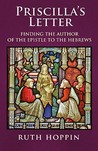
Priscilla's Letter: Finding the Author of the Epistle to the HebrewsPriscilla's Letter: Finding the Author of the Epistle to the Hebrews by Ruth Hoppin
My rating: 5 of 5 stars

Ruth Hoppin provides a compelling and convincing case that Priscilla is the author of the Epistle to the Hebrews. It is an engaging read. She presents the evidence as an attorney would in front of a jury, the readers functioning as the jury.

Ruth brings in evidence from within the letter, from related writings in the Bible, from other literature of the time, archaeology (in particular the Dead Sea Scrolls, Qumran, and the Essene sect), politics, sociology, history, anthropology, psychology, religious practices, literary analysis, and early church traditions. She argues persuasively, discussing and then countering arguments that might be made against Priscilla as the author.

When all the evidence is laid out, the only author that fits the profile is Priscilla.

Why was the identity of the author "lost?" The author was "lost accidentally on purpose." We don't have to go far in Christian history to understand why it was better, for the sake of broad acceptance of the letter, to hide the true identity of the author.

I truly enjoyed reading this book. I happen to accept Ms. Hoppin's arguments, but even if you ultimately do not, there is much in here in regards to the society and history around the latter half of the first century AD that I did not know before and should prove useful in reading and interpreting other New Testament texts.

View all my reviews

Wednesday, September 04, 2013

Another Look at the Upper Room—Part 5—Concluding Comments

This series began with the question of what Jesus' "example" in the Upper Room pointed to. Was the example the specific act of washing his disciples' feet? Or was it something else, of which washing feet was yet a smaller illustration?


In Part 1 I discussed my personal background as it relates to these questions, and then framed a broad trajectory that I saw in response to them.


In Part 2 I provided some Ancient Near East cultural background from Kenneth E. Bailey to help place the story of the Upper Room in better context to help us understand how surprising, radical, and truly disturbing Jesus' actions were to the disciples.


In Part 3 I discussed the actual event of Jesus washing his disciples' feet and how this action undermined all human concepts of hierarchies and power. I suggested that the point of washing feet wasn't merely about humble service but a lesson on how Jesus' friends are to continue his work of destroying all power structures that place one human being above another.


In Part 4 I discussed how Jesus reconstructs what true, God-sanctioned power looks like, in opposition to the false power that human beings crave and admire. God's power is not found in might, force, or threats, but in humble, self-sacrificing love that honors the choices each individual makes. (Note: honoring choice does not mean agreeing with or approval.) This power is "weak" in the eyes of humans because it cannot coerce or manipulate. It can only persuade through genuine actions founded in integrity of character.


The story of the Upper Room is about power, but not the kind that pops into our human minds. It is about the power of the gospel to redeem, restore, and transform individuals and communities. Part of the power of the gospel is the power to deconstruct and dismantle existing, human power structures. The other part of the gospel is the power to reconstruct communities based on mutual love and respect, without hierarchies, where no one is above another in authority or power. The only leader is Jesus, working through his Holy Spirit. Apostles, teachers, prophets, evangelists, etc. are not to be understood in terms of authority and leadership structure, but of function. There is no Jew or Gentile, male or female, slave or free.


All too quickly the Christian church derailed by setting up structures and systems. In our (limited human) minds we cannot conceive of a situation in which a mission can go forth and perpetuate without some kind of system in place. We set up committees and appoint leaders, all for very good reasons. But what if the miracle of the gospel's power and endurance, if humans had let it be, was that it didn't need any systems or structures to continue and finish its work?

Sunday, September 01, 2013

Book Review: Pastrix, by Nadia Bolz-Weber

Pastrix: The Cranky, Beautiful Faith of a Sinner & SaintPastrix: The Cranky, Beautiful Faith of a Sinner & Saint by Nadia Bolz-Weber
My rating: 5 of 5 stars

For all who are tired of trying to measure up to and maintain "standards of Christianity," whether these standards are couched in terms of behaviors or beliefs, Nadia has a word for you: the grace of God allows you to stop striving for perfection.

For all who are feel broken and unwanted, Nadia has a word for you: the grace of God says you are a precious child of God.

In this book, through her own life of addictions, brokenness, and subsequent redemption and restoration, Nadia recounts the grace of God at work in her life. In numerous examples of people she has encountered and works with, she reveals that the power of grace cannot be overcome by evil.

The strong current running through all the chapters is grace and redemption. It is about a surprising grace, a grace that works mysteriously and unexpectedly, working beyond the fences that Christianity so often builds around herself.

These are stories of power and defiance. The gospel is not a message of passivity and niceness, but one that stands ground against evil, tragedy, and despair. The power of the gospel is the power the redeems and transforms the ugliness of the world into God's new creation. The power of the gospel is power that defies the powers of evil by holding on to the promises of redemption and restoration in the midst suffering.

This book is likely to be a challenging read to those who lean toward conservative theology and evangelicalism. It will be a challenge to anyone who considers the use of profanity (of which there are plenty in this book) to be "sin."

Nadia challenges Christians to stop pretending to be people they are not. She challenges Christians to be who they are, with all the faults and blemishes, because the power of God working in the problems of real lives is the gospel that will be heard by many who have tuned out "traditional church as usual."

(This review is based on an advance review copy supplied by the publisher through NetGalley.)

View all my reviews

Thursday, August 29, 2013

Book Review: The Manga Bible

The Manga Bible: From Genesis to RevelationThe Manga Bible: From Genesis to Revelation by Siku
My rating: 2 of 5 stars

This treatment of the Bible and its contents is certainly different. It covers some of the major stories (and a few minor ones, too) to give the reader a sense of what is in the Bible. There are references back to the Bible sprinkled throughout so that readers who want to know more can find it.

It is an interpretation and an adaptation of the biblical text. Every page does contain numerous direct quotes from the Bible, often seen as excerpted phrases to describe what is happening in a cell.

It wasn't my style of reading and the manga (comic book) style isn't one that I really identify with, but it's possible that there is an audience for it. I'm just not sure someone who has little or no interest in Christianity picking this up, but I could be wrong.

View all my reviews