Thursday, November 07, 2013

Review: How to Talk to a Skeptic

How to Talk to a Skeptic: An Easy-To-Follow Guide for Natural Conversations and Effective ApologeticsHow to Talk to a Skeptic: An Easy-To-Follow Guide for Natural Conversations and Effective Apologetics by Donald J. Johnson
My rating: 3 of 5 stars

I remain skeptical.

Donald J. Johnson defines a skeptic rather broadly: from militant atheists to someone who is just beginning to question their (Christian) faith. Turning it around a non-skeptic, then, can only include those who have no questions about their faith… someone who is absolutely certain about matters of faith. Johnson is schooled in the field of apologetics so it is not surprising that he values certainty and holds in suspicion questioning, doubt, and skepticism. It is not surprising that he wants Christians to be certain about their faith and beliefs, to be confident that they really do hold answers to questions of ultimate reality and life meaning, and that apologetics is a highly effective mode of evangelism.

There was a time that I, too, was enamored with apologetics. I devoured books by Josh McDowell, David A. Noebel, Lee Strobel, etc. Then I started to critically engage other points of view and realized that certainty and answers were overrated. I saw how apologetics, even when presenting correct answers, destroys relationships because it communicates, usually unintentionally and subconsciously, arrogance, superiority, and patronization of the apologist toward those he is arguing. It's been quite a number of years since I've seriously taken a look at Christian apologetics and I was curious if How to Talk to a Skeptic approached the topic any differently.

First, I came away with the sense that Johnson's approach is a "softer" form of apologetics than . He reminds readers throughout the book that it does little good, and possibly harm, to react to objections from skeptics. He writes of the importance of first listening to understand where the skeptic is coming from, what he knows about his own worldview, and what he thinks he knows about Christianity.

Johnson then writes that apologists should not try to defend or "sell" religion, but to ask questions of the skeptic to guide them toward an understanding of worldviews. He writes that what is important is not about establishing which worldview is most useful or helpful, but which one best reflects reality. For Johnson, the Christian worldview is the one that best explains ultimate reality and is, obviously, the one he shows how to defend in this book.

Johnson spends a few chapters seeking to deal with some of the areas of Christianity with which skeptics have trouble. These include issues such as the nature of God (vindictive, capricious, or loving?), why so much (apparent) focus on rules and behaviors, why isn't ethics and morality enough, heaven and hell, the use and misuse of the Bible, parallels to pagan mythologies, hypocrisy, etc. In my opinion some of the arguments were better than others. There were some areas where his reasoning failed to convince me in any way. What I did appreciate is that in a few of the chapters at least, he began by acknowledging that traditional Christian positions and arguments were flawed, and that Christians bore at least some responsibility for contributing to skepticism.

On the positive side then, Johnson presents a framework of Christian apologetics that recognizes there is no one-size-fits-all approach in responding to skeptics, that Christians need to humbly acknowledge areas of failure, that the apologist must first learn before responding, and that she needs to argue worldviews rather than religions.

However, I encountered problems with Johnson's approaches. The main problem that I had is that it is based on the assumption that the Christian worldview has the answers. I don't object to this assumption, per se, but what leads out of it -- that is, it is possible for Christians to know the answers, and that there is a singular "Christian worldview" that can be apprehended by humans. Ask a representative sample of Christians from different denominations, cultures, and times, and there is no way a single "Christian worldview" will emerge. According to Johnson, only one worldview can be "right" meaning all the others are wrong. So who decides which one is right? His?

I also had issues with what to me seemed like circular reasoning. For example Johnson argues that it is God who provides meaning to life, so a person cannot really have life meaning without believing in (the Christian) God. But this reasoning only stands up if one first accepts that there is a God; ergo, circular reasoning. By this argument, Johnson also minimizes and dismisses all who so have a sense of meaning and purpose in life apart from the Christian God. He defends his position by stating that everyone has an emptiness, whether they realize it or not - again, another circular reasoning position.

Johnson takes a similar position with ethics and altruism, that it is not possible to be truly ethical and altruistic without a belief in God. He writes that humans are all born selfish and sinful. This may be in agreement with traditional Christian theology, but recent scientific data offers some contradictory evidence. Throughout the book Johnson repeats steps for engaging the skeptic: examine the data, offer the Christian explanation of the data, evaluate alternate explanations. He would do well to follow his own advice in some of these cases where science offers viable alternate views.

Johnson also suggests that subjective experience is a viable apologetics tool. He argues that the divine and supernatural can only be explained through subjective experience. Where I have a problem is that he then reaches the conclusion that all unexplainable phenomena must be of divine origin. He does not necessarily say so in direct words, but it is implied by his interpretation of the observation that people frequently ascribe unexplainable phenomena to Chance and Luck.

A statement that Johnson makes that really raised questions in my mind was when he writes that he thinks that sexual immorality (and for him this is defines as fornication, adultery, and homosexuality) is the major cause of skepticism today (chapter 13). He suggests that one of the main reasons people reject all kinds of theism is because they really want to live in immorality.

I felt that Johnson started out well in his book. He started out with the ideas that Christians need to listen better, to understand why people have objections to Christianity, before responding. His admission to problems and faults of Christianity is also a good start. But by the end it all seems to fall apart because of the underlying assumption and attitude that the Christian worldview has the answers and that Christians can know and articulate them. It ends up placing the apologist in a position of superiority above everyone who doesn't "know" exactly as she does, and treats everyone else in a patronizing manner, however unintentionally.

Johnson fails to engage the possibility that this very idolization of certainty and answers may be part of the reason why skepticism is increasing. I personally value uncertainty, skepticism, and cynicism. It offers an important counterbalance to unhealthy veneration of certainty and knowledge.

Overall, How to Talk to a Skeptic didn't excite me one way or the other. It has some interesting ideas that are worth thinking about, but for me there were some significant problems with it.

(This review is based on an advance review copy supplied by the publisher through NetGalley.)


View all my reviews

Review: Now You’re Speaking My Language

Now You're Speaking My Language: Honest Communication and Deeper Intimacy for a Stronger MarriageNow You're Speaking My Language: Honest Communication and Deeper Intimacy for a Stronger Marriage by Gary Chapman
My rating: 2 of 5 stars

Much helpful advice, but marred by a few significant and dangerous flaws.

In Now You're Speaking My Language, when Gary Chapman writes about ways couples can improve their communications skills, there is much helpful and useful advice. And this forms the bulk of the book. However, there is one significant issue (and a few smaller ones) that I came away with that I find troublesome and even dangerous.

Chapman's thesis revolves around the concept of covenant marriage. This is in contrast to a contract marriage. According to Chapman, a contract typically is of a limited period of time, often deals with specific actions, based on "if… then…" mentality, is motivated by desire to get something we want, and it is sometimes unspoken and implicit. On the other hand a covenant is initiated for the benefit of the other person, is unconditional in its promises, based on steadfast love, views commitments as permanent, and requires confrontation and forgiveness.

It is on this last point, "requires confrontation and forgiveness," that I have strong reservations. In my reading of Chapman's words in this book, he raises covenant marriage as an ideal to which every marriage can aspire and reach. He fails to address the realities of some marriages that involve spousal abuse (physical, emotional, spiritual) and domestic violence. Where he does touch on the possibility of abuse, he dismisses it lightly as mainly a communications issue; i.e., he writes that if the abused partner simply confronts her or his partner in an attitude of love and forgiveness, the abusive partner will recognize his or her sin, confess it, and come around to a healthy relationship. This is dangerous and harmful advice. It implicitly places the blame on the victim, making her or him share responsibility for the abuse. For this reason alone, I hesitate to recommend this book.

There are a few other quibbles I had with the book. Where Chapman employs examples of household tasks, nearly in every case the wives are given domestic duties such as cleaning, cooking, and childcare, and the husbands are given yard work and mechanical work. Can he at least mix it up a bit and break the stereotyping?

Chapman never comes around to address the case where one of the partners doesn't want to work with the idea of a covenant marriage. What then? He does not offer any advice.

This book is clearly intended for a certain segment of the Christian audience. Due to its strong basis in covenant theology derived from the Christian Bible, I suspect it will not find much appeal to the non-Christian audience. Because of certain interpretive biases, it will not appeal to many Christians, either.

There is a conspicuous lack of endnotes and references. From this I conclude that much of what Chapman writes is from his own experience. I am not dismissing the validity of his experience, but how applicable is it to the broader population that is not representative of his work? He bases this book on a statistic that 86% of all divorced couples report that "deficient communication" was the primary factor in the divorce. There is not attribution to this statistic. Is it from his practice, or does it come from somewhere else? Is it from a representative sample?

Each chapter ends with questions that the reader is encouraged to answer for himself or herself. This is followed by activities that Chapman encourages each couple to take part in together.

As I stated at the beginning, Chapman offers some very good advice when he is dealing strictly in the areas of communication. If he kept to those things, I could recommend this book. But as I have detailed, although the flaws are few, at least one is too dangerous for me to recommend this book. I don't say a person shouldn't read it, but to be fully aware of the problems and to go through it with a critical mind.

(This review is based on an advance review copy supplied by the publisher through NetGalley.)


View all my reviews

Monday, November 04, 2013

Review: When We Were on Fire

When We Were on Fire: A Memoir of Consuming Faith, Tangled Love, and Starting OverWhen We Were on Fire: A Memoir of Consuming Faith, Tangled Love, and Starting Over by Addie Zierman
My rating: 5 of 5 stars

Balancing devotion and cynicism (both required!)

When preparing charcoal for cooking in an outdoor grill, you can light it by pouring lighter fluid all over it, starting with a flaming inferno (more fluid, more excitement!). Often some pieces are better lit than others. Or you can use a chimney starter and light the charcoal in a "less exciting" fashion but more controlled and even manner. The goal for both methods is to eventually get the coals to a glowing phase, when they're actually useful to cook over. The chimney starter is generally considered the superior method.

The beginning of a Christian life (especially in youth ministry) often resembles the lighter fluid method rather than a chimney starter. Programs and events are designed to get participants excited, "on fire" for God, and pumped up to evangelize the world. But as statistics show to church leaders' dismay, churches are more often shrinking than growing and young people don't "stay in the faith."

In When We Were on Fire, Addie Zierman recounts her faith journey from childhood to motherhood; from an on-fire youth, to a disillusioned young adult, to a wife, mother, and writer who is tentatively rediscovering the joy of faith in Jesus; from the certainty of conservative evangelicalism, to rebellion against it, to living in the tension between devotion and cynicism.

I am about a half-generation ahead of Addie. Which means the specifics of my religious experiences and her experiences aren't exactly the same. But there are familiar themes: rigidness, absolute certainty, keeping rules and maintaining standards, subtle idolization of suffering and persecution, emphasis on overseas missions, emphasis on practicing spiritual disciplines such as prayer and bible studies… Like Addie, by the end of college I found myself nearly burnt out from religion. And like Addie with the arrival of my first child, I began my slow, cautious, tentative steps back toward God. And like Addie, I still continue to try to live on the razor's edge between devotion and cynicism.

Like Addie, I went through a period of intense depression and anxiety. That's why for me, chapter 16 was the most powerful in this book. In this chapter Addie opens up to the descent into depression, becoming overwhelmed by it, seeking treatment, and making the slow ascent out of the pit of darkness. This book is worth just this chapter alone. I read a recent statistic that 60% of all Americans believe prayer alone can solve depression. The number is higher for Christians. This chapter is a wakeup call to Christians that prayer alone is usually not enough, that God works his healing through mental health counselors, psychologists, and psychiatrists.

This book is also a memoir about friendships. A handful of individuals make their way into Addie's stories as important parts of her life. Some leave somewhere along the way. Others enter midway. A couple of them stand by her from beginning to end, through all her ups and downs, and through all the changes she has undergone. The relationship of these three was "church" as it was meant to be. "Everything had been changed. But they were still my best friends: Kim. Alissa. They were my deepest community. My church… We didn't talk directly about our faith as much anymore, but it was always there. It was the thing we were really discussing when we asked about one another's lives" (Kindle ed., location 3236).

I recommend this book to all pastors and youth leaders. Yes, it is the story of just one person, but judging from the responses to it, I think it is representative of the many things that can go wrong in teaching, mentoring, and discipling Christians. Addie writes, "… Even the best goals and intentions can be corrupted" (location 3262). What we want is devotion that is sustainable and helpful, not flashy and harmful. Effective ministry does less telling about what is right or wrong, and more about how to evaluate something and whether or not it is true. Effective ministry is less about teaching faith and more about loving people. Effective ministry is less about scheduled services and programs and more about simply getting together to share in one another's lives.

This book will appeal to anyone who has been burned by Christianity. You will find that you are not alone in your struggles. For some it may be just an interesting read with which they can identify and see themselves. For other it may be one of the steps toward healing and recovery from spiritual burnout and/or abuse.

"Cults don't have to be groups necessarily. There is such a thing as a 'cultic relationship.' And it's not about beliefs or values; it's about the method they use to convince you to follow" (location 3079).
This book is Addie's testimony. It's far more than 3-minutes long. It's mostly about the messiness that happens after coming to Christ. And that's why I believe it is so powerful. Too many Christian testimonies seem to be about "How my life was before I accepted Christ, how I came to him, and now things are great." We need more testimonies that say, "I accepted Christ, (my life got worse) and here are my struggles that I am working through with him."

"The future will be a mix of both of these things: the devotion and the cynicism. You have to find a way for them to coexist within you. Let them destroy each other, and your fragile faith may shatter entirely" (location 3334).
View all my reviews

Thursday, October 31, 2013

Review: The Question That Never Goes Away

The Question That Never Goes AwayThe Question That Never Goes Away by Philip Yancey
My rating: 4 of 5 stars

Where can we find comfort and healing?

When tragedy and violence strikes, victims and the rest of the world want to know "why." We think that if we can just figure out the reasons why bad and evil things happen, we will find solace and comfort. Those who specialize in grief know otherwise. Answers to the "why" question may satisfy our intellectual curiosity and perhaps offer some place to lay blame and anger, but it does not offer comfort or healing.

Philip Yancey, in The Question That Never Goes Away, states flat out that the Bible does not pretend to answer the "why" question related to suffering, violence, and evil. For Christians to try to answer this question, with or without the Bible, is misguided and frequently results in more harm than good. Rather, Yancey suggests that what the Bible does describe is a God incarnate who suffers with us, who walks with us in our pain, and who promises that the results of evil will someday be redeemed toward good. Yancey writes that the Church is part of God's person in the world today whose work is to be with those who are suffering.

Yancey suggests that God does not provide answers to "why" because to do so would turn focus away from the affected peoples to the situation. When things go wrong (not necessarily tragic events), governments, businesses, and other organizations want answers to "why" so they can prevent future problems. We want to fix life so that it is safe and secure. Perhaps God does not give the "why" because part of the reason is that life cannot be "fixed" in the manner we would like.

Yancey is very clear in his writing that he does not believe in God's agency in tragic events; i.e., God does not cause or desire bad things to happen. In other words, "God is not in control" as opposed to the way popular Christianity often portrays God and his (assumed) sovereignty. According to Yancey, God values freedom so much that he does not overwhelm and overrule human freedom to do evil. God's sovereignty is not found in his power and might, but in his love. Love cannot exist without freedom to reject love and work against it. Thus God values freedom over control.

Yancey does not present any new, groundbreaking material in this book. What he does is incorporate his experiences working with survivors and victims from recent tragic events such as the tsunami that hit northeast Japan, the Sandy Hook Elementary shooting, and others. He updates his earlier insights in light of these new experiences.

God does not provide answers to "why" but he has provided for "where" the world can find comfort, healing, and redemption. This book will likely not satisfy our intellectual desires. What it does is encourage us to become agents of love in a world that hurts, and thus be part of God's redeeming and transforming process in the world.

(This review is based on an advance review copy provided by the publisher through NetGalley.)

View all my reviews

Monday, October 21, 2013

Review: The Art of Storytelling

The Art of Storytelling: Easy Steps to Presenting an Unforgettable StoryThe Art of Storytelling: Easy Steps to Presenting an Unforgettable Story by John D. Walsh
My rating: 5 of 5 stars

Making Stories the Point of Storytelling

People of all ages enjoy listening to a good story told. Stories are often a more effective means of conveying instruction and truths than didactic, analytical teaching. John D. Walsh, in The Art of Storytelling: Easy Steps to Presenting an Unforgettable Story gives readers, whether new to the art or are already experienced public speakers, tips and tools for improving their craft. Through numerous exercises and activities, the reader is encouraged to participate and practice honing skills that are introduced in each chapter.

John wants stories to become the point of telling stories. Too often in modern public speaking, stories are relegated to "spice up" sermons and presentations and to illustrate some points in them. The modern mindset has been conditioned to accept that stories are for children (and must have a stated application or moral), that "real teaching" happens in didactic lectures. John discusses how people relate to and recall stories far better than didactic teaching - lectures and sermons with "the big idea" or "here are three points."

The book itself is divided into three sections. Part one, the longest section, teaches the aspiring storyteller fourteen steps in preparing to tell a story. John further subdivides these steps into ten essential steps toward telling a good story, and four optional steps that may be taken to raise a good story to a great one.

Part two covers seven tools that the storyteller should be cognizant while telling a story. These tools cover the "how to tell" aspects when actually in front of an audience. These considerations include things such as gestures, voice, facial expressions, and nervousness.

The final section of the book focuses more narrowly on retelling Bible stories. John discusses why churches ought to be telling more stories instead of preaching more sermons and making people sit through lectures. He discusses how the storyteller, the listener, and the Bible stories interact. He refers to two resources, available on the web, in which he has taken part developing. (www.bibletelling.org, www.btstories.com) He relates his experience teaching skeptical adults on the values of stories.

Right near the end of the book John ponders the conventional wisdom in many churches about evangelism and faith. This conventional wisdom states that if a person doesn't accept Christ by the time he or she is twelve years old, the chance that they will later is almost minuscule. He writes how the stories of Acts goes completely against the conventional wisdom. In Acts, all the conversions are of adults. As he thought about he, he writes how he realized that in modern churches, age twelve is about the time stories stop being told (because stories are for children) and so-called "solid food" of doctrine and ethics start being taught didactically. John suggests that if churches continued to use stories as the primary vehicle of communicating faith, adolescents and adults would come in to the church and stay.

This book is written by a Christian with the Christian audience in mind, but it can be valuable to anyone who speaks to an audience, whether to one or a million or anywhere in-between. Particularly, sections one and two are applicable to all public storytelling engagements. Even the third section can be valuable as case studies on how to turn written materials that may not initially strike the reader as a story, into an engaging story that can be told to an audience.

I highly recommend this book for all public speakers, but especially for pastors and church teaching staff.


View all my reviews

Thursday, October 17, 2013

Book Review–Confidence: Overcoming Low Self-Esteem, Insecurity, and Self-Doubt

Confidence: Overcoming Low Self-Esteem, Insecurity, and Self-DoubtConfidence: Overcoming Low Self-Esteem, Insecurity, and Self-Doubt by Tomas Chamorro-Premuzic
My rating: 5 of 5 stars

Debunks conventional ideas surrounding self-confidence.

Western culture, and particularly the American subculture, emphasizes the value and need for individuals to have a high self-confidence if they are to perform well and achieve success. Tomas Chamorro-Premuzic, in Confidence: Overcoming Low Self-Esteem, Insecurity, and Self-Doubt, argues that high self-confidence is mostly a liability and that a low self-confidence is more positively correlated with successful individuals.

Through research data, discussions of studies, and anecdotes Dr. Chamorro-Premuzic argues forcefully and persuasively that modern society has confused, to its significant detriment, confidence with competence. In the eyes of many people, highly confident people are thought to be competent, but there is no correlation between the two. Yet at the same time we tend to view negatively those who are extremely self-confident and narcissistic. Modern society rewards the highly confident because competition is rarely about competence, but rather, confidence. (E.g., We elect high-confidence individuals to political office and then complain about their incompetence.)

In this book, Dr. Chamorro-Premuzic shows that it's okay to have low self-confidence and that there are many advantages to it. Individuals with lower self-confidence actually are more competent, they make fewer mistakes, they are better judges of themselves and others, and they are more able to learn from their stumbles. The idea that low-confidence is an obstacle to success and achievement has no basis in reality. People without a high view of themselves have just as good an opportunity to achieve success in their careers, in social relationships, and in health as those who do have high self-confidence in these areas.

In the area of careers Dr. Chamorro-Premuzic writes that success is 90% preparation and 10% execution. Low self-confidence individuals, because they tend to worry and are anxious about their competence, excel in preparation. High self-confidence individuals, on the other hand, because they believe in their unfounded competence, fail to prepare.

In the area of social interactions low-confidence individuals worry about how others view them. Dr. Chamorro-Premuzic writes that this is a good and positive characteristic. It leads them to be cautious and careful, to be more empathetic. On the other hand high-confidence individuals tend to not care about what others think and thus come off as brash, boorish, arrogant, and narcissistic.

In the area of health low-confidence is also an asset. Dr. Chamorro-Premuzic writes that many people think they are healthy when they are actually not. Low-confidence individuals with their worries and anxieties are better able to see signs of unhealthiness than high-confidence individuals who falsely believe in their health. Low-confidence individuals, again, are more cautious and careful and tend to avoid risky behaviors, whereas high-confidence individuals tend toward risky behaviors believing in their unfounded invincibility.

In the final chapter Dr. Chamorro-Premuzic argues for a less-confident world. He believes that such a world would be less corrupt, safer, more peaceful, and a generally better place to live.

I see the chapters of this book divided into three major sections. The first three chapters lay out the thesis and provide the theoretical framework that supports it. The next four chapters apply the thesis to the areas of career, social relationships, dating, and health. The final chapter provides a summary.

I found this book engaging and interesting. It was very thought-provoking in the ways it challenges conventional attitudes toward confidence. This book should be particularly helpful to the many people who do "suffer" from low self-confidence. But it might be even more valuable to those who pride themselves in their self-confidence, if they allow themselves some time for self-examination.

(This review is based on an advance review copy provided through NetGalley by the publisher.)


View all my reviews

Wednesday, October 16, 2013

Book Review: Feasting on the Gospels-Matthew, Volume 1

Feasting on the Gospels--Matthew, Volume 1: A Feasting on the Word CommentaryFeasting on the Gospels--Matthew, Volume 1: A Feasting on the Word Commentary by Cynthia A. Jarvis
My rating: 5 of 5 stars

A practical commentary for practicing preachers.

This may be one of the most user-friendly commentaries I've encountered. It takes a passage-by-passage (pericope) approach rather than verse-by-verse. Its foremost concern is to provide the reader with practical insights and suggestions on preaching the passage to his or her congregation. (This volume covers Matthew 1-13.)

The format of this commentary is as follows: The text of the passage is given on the left page, which is followed by four columns spanning both the left and right pages. These columns continue for two more spreads (so six total pages for each passage). The layout is most easily read in a printed form. (Review copy was en e-book form and the reading didn't flow nearly as smoothly, in my opinion.)

The four columns provide four different perspectives of the text. 1) Theological, 2) Pastoral, 3) Exegetical, 4) Homiletical. Respectively they roughly answer the following questions a preacher may pose to the text:

* Theological: what does this passage reveal about God? What questions does this passage raise about God? How does this passage fit into the overall narrative of scripture about God?
* Pastoral: In what ways might this passage apply to daily lives of 21st century people? What questions does it raise about how we live our lives as members of God's community?
* Exegetical: How do we interpret this passage in light of literary, rhetorical, historical, cultural, social, political, and religious contexts?
* Homiletical: What are some suggested approaches to preaching this passage?

In my reading I found myself seeing text in ways that I hadn't considered before. The suggestions in the homiletical perspectives looked to be particularly useful, especially for passages that are preached more often, for preaching the text in new ways.

Potential purchasers of this commentary may be concerned with what theological biases might be present. I found it to be well-balanced. The editors and contributors are predominantly from mainline Protestant denominations. It is most certainly not from a decidedly evangelical perspective. But it does treat the text and the Bible seriously and authoritatively. For those worried about liberalism, I found nothing to warrant such fears. I would classify this commentary as being right in the middle, treating both the text and contexts seriously.

I highly recommend this commentary to anyone who is called upon to preach, whether regularly or not. I look forward to the forthcoming volumes in this series.

(This review is based on an Advance Review Copy supplied through NetGalley by the publisher.)


View all my reviews

Fall High School Concert

Last night the Petersburg High School performed their Fall concert. Amy is in the choir and performed two pieces.

Here is a video of the concert. Band and jazz band pieces are excerpts. Choir pieces are presented in full.

Thursday, October 10, 2013

Review: Church History–Volume One

Church History, Volume One: From Christ to the Pre-Reformation: The Rise and Growth of the Church in Its Cultural, Intellectual, and Political ContextChurch History, Volume One: From Christ to the Pre-Reformation: The Rise and Growth of the Church in Its Cultural, Intellectual, and Political Context by Everett Ferguson
My rating: 4 of 5 stars

A good, comprehensive overview

This work of history by Everett Ferguson provides a good balance. It is comprehensive enough and provides enough details without become bogged down in minutiae that only academics would likely find interest. Rather than descriptions of historical events in isolation, they are placed within a narrative framework that includes how the past has influenced it and how the event influences the future. The events are described in the context of surrounding cultural, social, political, and other historical events. Even though ultimately the work describes the Western church, its connection to the Eastern church and other less known areas of the world are incorporated.

This book is written foremost as history. It describes both the good and bad of the church's history. It does not seek to defend negative actions, but seeks to explain how and why they happened.

The history of the church is the story of conflicts: doctrinal, ecclesiastical, political, philosophical. It gives credence to the saying, "There is nothing new under the sun." Nearly all church conflicts being experienced in the 21st century have similarities with past conflicts.

Some of the earlier chapters dealing with the first and second generations of the church provide context that help with interpretation of New Testament text.

The writing is very readable and accessible. I think every Christian ought to read it. This would be a good reference work for every church leader to own.

(This review is based on an advance review copy supplied through NetGalley and provided by the publisher.)

View all my reviews

Monday, October 07, 2013

Review: Evolving in Monkey Town

Evolving in Monkey Town: How a Girl Who Knew All the Answers Learned to Ask the QuestionsEvolving in Monkey Town: How a Girl Who Knew All the Answers Learned to Ask the Questions by Rachel Held Evans
My rating: 5 of 5 stars

Hold on to convictions loosely

With humor and wit, Rachel Held Evans writes of her Christian journey from rigid belief to flexible faith. She speaks of herself as beginning the journey as a fundamentalist, defining this as "salvation means having the right opinions about God... [and] my security and self-worth and sense of purpose in life were all wrapped up in getting God right -- in believing the right things about him, saying the right things about him, and convincing others to embrace the right things about him too."

Rachel tells how the fundamentalist outlook failed to match real-world experience. When exposed to experiences outside her insular evangelical world, she discovered that she didn't have all the answers, the answers she was taught applied badly, and people weren't asking the questions for which she had answers.

Rachel's journey from certainty, to doubt, and to a reborn faith that values questions and uncertainty is one that many Christians have undertaken, myself included. Even as details of the journey differ, I recognized myself, the world that I inhabited, and the journey that I've taken, in her story.

I sensed the concept around "false fundamentals" to be one of the central themes in Rachel's writing. The phrase appears early in the book and the last few pages closes with a discussion around this idea. False fundamentals are those teachings and beliefs that people and groups hold to be unchangeable, but are in reality, not so essential to Christian faith and life. My summary of the book in one sentence would be: Questioning things and embracing uncertainties are what Christians need to do more in order to protect against succumbing to false fundamentals. A phrase that I've used to describe this idea is, "Hold on to convictions loosely."

The greatest value of this book is probably to be found by those who are uncomfortable with fundamentalism, in whatever manifestation they find themselves. It gives permission to embark on the journey to questions and doubt, and back to a stronger faith. Those who are currently on this journey should also find this book helpful, to know that there are many who have traveled the path before them, and many who are with them now. Finally it is helpful to those who have undergone this path because they might be able to see ways in which to compassionately guide those who follow.

Staunch fundamentalists may find this book upsetting, but if they are able to work through it, I hope that they will come to understand that those of us who question things, who interpret and believe things differently, are sincerely living out what we have come to understand as faithfully living the Christian life.

View all my reviews

Wednesday, September 11, 2013

Book Review: When the Church Hid the Author of Hebrews

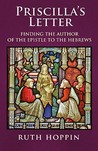
Priscilla's Letter: Finding the Author of the Epistle to the HebrewsPriscilla's Letter: Finding the Author of the Epistle to the Hebrews by Ruth Hoppin
My rating: 5 of 5 stars

Ruth Hoppin provides a compelling and convincing case that Priscilla is the author of the Epistle to the Hebrews. It is an engaging read. She presents the evidence as an attorney would in front of a jury, the readers functioning as the jury.

Ruth brings in evidence from within the letter, from related writings in the Bible, from other literature of the time, archaeology (in particular the Dead Sea Scrolls, Qumran, and the Essene sect), politics, sociology, history, anthropology, psychology, religious practices, literary analysis, and early church traditions. She argues persuasively, discussing and then countering arguments that might be made against Priscilla as the author.

When all the evidence is laid out, the only author that fits the profile is Priscilla.

Why was the identity of the author "lost?" The author was "lost accidentally on purpose." We don't have to go far in Christian history to understand why it was better, for the sake of broad acceptance of the letter, to hide the true identity of the author.

I truly enjoyed reading this book. I happen to accept Ms. Hoppin's arguments, but even if you ultimately do not, there is much in here in regards to the society and history around the latter half of the first century AD that I did not know before and should prove useful in reading and interpreting other New Testament texts.

View all my reviews

Wednesday, September 04, 2013

Another Look at the Upper Room—Part 5—Concluding Comments

This series began with the question of what Jesus' "example" in the Upper Room pointed to. Was the example the specific act of washing his disciples' feet? Or was it something else, of which washing feet was yet a smaller illustration?


In Part 1 I discussed my personal background as it relates to these questions, and then framed a broad trajectory that I saw in response to them.


In Part 2 I provided some Ancient Near East cultural background from Kenneth E. Bailey to help place the story of the Upper Room in better context to help us understand how surprising, radical, and truly disturbing Jesus' actions were to the disciples.


In Part 3 I discussed the actual event of Jesus washing his disciples' feet and how this action undermined all human concepts of hierarchies and power. I suggested that the point of washing feet wasn't merely about humble service but a lesson on how Jesus' friends are to continue his work of destroying all power structures that place one human being above another.


In Part 4 I discussed how Jesus reconstructs what true, God-sanctioned power looks like, in opposition to the false power that human beings crave and admire. God's power is not found in might, force, or threats, but in humble, self-sacrificing love that honors the choices each individual makes. (Note: honoring choice does not mean agreeing with or approval.) This power is "weak" in the eyes of humans because it cannot coerce or manipulate. It can only persuade through genuine actions founded in integrity of character.


The story of the Upper Room is about power, but not the kind that pops into our human minds. It is about the power of the gospel to redeem, restore, and transform individuals and communities. Part of the power of the gospel is the power to deconstruct and dismantle existing, human power structures. The other part of the gospel is the power to reconstruct communities based on mutual love and respect, without hierarchies, where no one is above another in authority or power. The only leader is Jesus, working through his Holy Spirit. Apostles, teachers, prophets, evangelists, etc. are not to be understood in terms of authority and leadership structure, but of function. There is no Jew or Gentile, male or female, slave or free.


All too quickly the Christian church derailed by setting up structures and systems. In our (limited human) minds we cannot conceive of a situation in which a mission can go forth and perpetuate without some kind of system in place. We set up committees and appoint leaders, all for very good reasons. But what if the miracle of the gospel's power and endurance, if humans had let it be, was that it didn't need any systems or structures to continue and finish its work?

Sunday, September 01, 2013

Book Review: Pastrix, by Nadia Bolz-Weber

Pastrix: The Cranky, Beautiful Faith of a Sinner & SaintPastrix: The Cranky, Beautiful Faith of a Sinner & Saint by Nadia Bolz-Weber
My rating: 5 of 5 stars

For all who are tired of trying to measure up to and maintain "standards of Christianity," whether these standards are couched in terms of behaviors or beliefs, Nadia has a word for you: the grace of God allows you to stop striving for perfection.

For all who are feel broken and unwanted, Nadia has a word for you: the grace of God says you are a precious child of God.

In this book, through her own life of addictions, brokenness, and subsequent redemption and restoration, Nadia recounts the grace of God at work in her life. In numerous examples of people she has encountered and works with, she reveals that the power of grace cannot be overcome by evil.

The strong current running through all the chapters is grace and redemption. It is about a surprising grace, a grace that works mysteriously and unexpectedly, working beyond the fences that Christianity so often builds around herself.

These are stories of power and defiance. The gospel is not a message of passivity and niceness, but one that stands ground against evil, tragedy, and despair. The power of the gospel is the power the redeems and transforms the ugliness of the world into God's new creation. The power of the gospel is power that defies the powers of evil by holding on to the promises of redemption and restoration in the midst suffering.

This book is likely to be a challenging read to those who lean toward conservative theology and evangelicalism. It will be a challenge to anyone who considers the use of profanity (of which there are plenty in this book) to be "sin."

Nadia challenges Christians to stop pretending to be people they are not. She challenges Christians to be who they are, with all the faults and blemishes, because the power of God working in the problems of real lives is the gospel that will be heard by many who have tuned out "traditional church as usual."

(This review is based on an advance review copy supplied by the publisher through NetGalley.)

View all my reviews

Thursday, August 29, 2013

Book Review: The Manga Bible

The Manga Bible: From Genesis to RevelationThe Manga Bible: From Genesis to Revelation by Siku
My rating: 2 of 5 stars

This treatment of the Bible and its contents is certainly different. It covers some of the major stories (and a few minor ones, too) to give the reader a sense of what is in the Bible. There are references back to the Bible sprinkled throughout so that readers who want to know more can find it.

It is an interpretation and an adaptation of the biblical text. Every page does contain numerous direct quotes from the Bible, often seen as excerpted phrases to describe what is happening in a cell.

It wasn't my style of reading and the manga (comic book) style isn't one that I really identify with, but it's possible that there is an audience for it. I'm just not sure someone who has little or no interest in Christianity picking this up, but I could be wrong.

View all my reviews

Wednesday, August 28, 2013

A perspective on “Speaking the truth in love” (Ephesians 4:15)

ἀληθεύοντες δὲ ἐν ἀγάπῃ (SBL GNT)
(alētheuontes de en agapē)

This phrase has often been used by one Christian as a hammer against another. It is the Christian equivalent of, “With all due respect…” Whenever someone is at the receiving end of this phrase, they know that what follows is usually going to be anything but loving or respectful. It is a phrase frequently used to justify condemnation and abuse.

How do some English translations render this phrase?

AMP Rather, let our lives lovingly express truth
CEB Instead, by speaking the truth with love
CEV Love should always make us tell the truth
ESV Rather, speaking the truth in love
GNT Instead, by speaking the truth in a spirit of love
HCSB But speaking the truth in love
KJV But speaking the truth in love
NIV Instead, speaking the truth in love
NCV No! Speaking the truth with love
NET But practicing the truth in love
NLT Instead, we will speak the truth in love
RSV Rather, speaking the truth in love
YLT And, being true in love

Looking at this sampling of thirteen commonly used English translation of the Bible and how they render the opening of the Ephesians 4:15 text, we observe that the overwhelming majority render the word alētheuontes as “speaking the truth.” The strong connotation given is that toward the act of speaking, that of verbalizing words to another person. A small minority (in boldface) take an alternate view, that alētheuontes is about the act of living, about practices, and not necessarily requiring verbal proclamation.

Another potential issue with most translation involve the “the” in “the truth.” The Greek text does not contain a definite article. The AMP and YTL above provide the better translation by omitting the definite article. The problem with “the truth” is that it can lead to a view that there is a singular manifestation of truth and that it can be codified and proclaimed. It leads to division: all who believe my way are following “the truth” but I need to “speak the truth” to those who don’t see it my way.

How did the preference for translating the phrase into “speaking the truth” arise?

The immediate context (Ephesians 4:1-16) seems to provide at least one possibility. This set of verses discusses gifts of grace, spiritual gifts, and their use in “building up the body of Christ” (v.12) into unity (vv.3-6, 13). The list of specific gifts includes “the apostles, the prophets, the evangelists, the shepherds and teachers” (v.11). Notice that all the gifts mentioned here are proclamation and teaching gifts. So it makes logical sense to translate alētheuontes into “speaking [the] truth.”

Verse 25 which explicitly uses the term “to speak” may have also influenced the translation of verse 15 in order to maintain consistency. But is strict consistency necessary? At least a few translations disagree.

Alētheuontes can also be translated as “teach truth,” “profess truth,” or “act truly or sincerely.” Teaching, professing, and acting does not have to involve speaking (though speaking should not be excluded completely).

The preposition en immediately before agapē is most frequently translated as “in” but can also be understood to mean “with,” “through,” and “by” – with love, through love, and by love.

There is a conjunction de following alētheuontes. This is seen as adversarial, meaning “truth-love” is in opposition to something that came before or will follow. Translators generally place this word before “truth” to contrast “truth-love” to what came before, and translate it into words such as “but,” “instead,” and “rather.” This further helps the reader place context around “speaking truth in love.”

Verse 14 reads, “So we are no longer to be children, tossed back and forth by waves and carried about by every wind of teaching by the trickery of people who craftily carry out their deceitful schemes” (NET). This verse does not limit falsehood and deceit to merely speech, but includes activities. In contrast then, Christians are to speak, teach, and practice truth by/through/with their love (my translation of the first phrase of verse 15). When love is the rule and practice, unity in Christ will naturally follow (my paraphrase of the second half of verse 15).

I am reminded of St. Francis of Assisi who said, “Preach the Gospel at all times and when necessary use words.”

Ironically the way the phrase “speaking the truth in love” is often used within Christian circles today is the exact opposite of what was intended by the author of Ephesians. Instead of mutual respect and honor, with and in love, the phrase is used in a “my way or the highway” kind of self-aggrandizing attitude against others. Instead of bringing together, the phrase too often divides.

May we today begin to recover the original intents of the phrase.

Tuesday, August 27, 2013

Another Look at the Upper Room—Part 4—What Is Glory?

What images come to your mind when you hear the phrase "God's glory?" Power, might, majesty? Maybe it's more literal: brightness, shining, blinding light?


John 13:31-32 records Jesus' words:


31 When he had gone out, Jesus said, "Now is the Son of Man glorified, and God is glorified in him. 32 If God is glorified in him, God will also glorify him in himself, and glorify him at once." (ESV)


This is the prelude to Jesus giving the command to his disciples -- gathered in the Upper Room -- to love one another, and by doing so to reveal to the world that they are his disciples. From this a conclusion can be inferred that God's glory and love are somehow related. The narrative surrounding these verses provide the rest of the context that we need to determine "God's glory" of which Jesus speaks here.


First I find the double occurrence of the phrase "truly, truly" within this section to function as sort of bookends: one at the beginning and one at the end. The first text deals with Jesus' knowledge of Judas. The latter text, with Jesus' knowledge of Peter. The first is betrayal, the second is denial; but for the purposes of this text, the actions should be seen as equivalent -- a failure to keep trust in Jesus' way of doing things.


The reader of the story, of course, would only find this out about Peter at the end of the narrative. In the first part of the Upper Room story, Jesus loves and serves Peter. In the second part, Jesus loves and serves Judas. Both will turn their backs on him, and he knows it, but that knowledge doesn't change his attitude nor actions toward them.


In verse 27 we find the words, "Then after he had taken the morsel, Satan entered into him." Judas takes Communion. He takes the Bread of Life. But in him this morsel has a different effect than is expected. Instead of giving life, it ultimately takes life. What are we to do with this text?


First, it speaks out against ritual having any kind of saving grace. If participation conferred any kind of salvation, receiving bread directly from Jesus' hand ought to have been it. But we are clearly told that was not the case. Rather, it had the exact opposite effect.


That brings us to the second point to consider. The gospel writer of John speaks quite a bit about judgment, but does not spell out exactly what that looks like. Readers are left to their own preconceived ideas, perhaps based on other parts of the Bible. I believe verse 27 illustrates that kind of judgment that is spoken of in John. It is not about Jesus or God coming down in might, power and authority to condemn and punish, but rather, judgment is about a decision for or against the "way of love" that Jesus trail-blazed. For Judas, taking in (a metaphorical consumption of the bread) Jesus' acts of love in the Upper Room resulted in his rendering judgment against Jesus. Thus the gospel author writes, "So, after receiving the morsel of bread, he immediately went out. And it was night" (verse 30). Jesus did not cast Judas out into the night. Jesus did not judge. Judas cast himself out. Judas judged himself.


It is after Judas leave the room that Jesus speaks of his glory. The Jews, including the disciples, expected the power and might kind of glory. It's the kind of glory that people today often want to see from God. We want a God who will use force to overcome evil, to forcibly bring about righteousness and justice. This picture of God infects how we relate to others socially, religiously, and politically.


The message of Jesus in the Upper Room remains just as undesired and unheard today as it was then. God's glory, made flesh in Jesus, is not about power, might, force, coercion, but about a kind of love that is "weak" according to the world's standards. Jesus tries to redefine "glory" for his disciples. He tells them that God's glory is found in self-sacrifice, in serving one's enemies, and in treating even the very ones who would murder you as human beings worthy of respect. God's glory is found in the kind of love that sees the good in every being, in hoping for redemption of even those that might appear beyond redemption, and acting in ways that will bring about redemption. God's glory is found in the kind of love that respects the freedom of all to reject love.


Jesus tells his disciples that "they cannot come" (verse 33). This is often interpreted as pointing to Jesus' ascension and the inability for his disciples to go to heaven with Jesus at the present time. But I believe it is pointing to the "way of love". I think this is the better interpretation because of 13:7 where we find, "Afterward you will understand", and 13:36, "You will follow afterward." In the washing of feet Jesus was attempting to demonstrate the way of love. In his explanation immediately afterwards, he was trying to explain love. In this current part of the chapter, Jesus explicitly instructs on the way of love. I also believe this is the basis for 14:6, "I am the way." It is not Jesus, the historical person, who is the way, but his nature that is "the way." After declaring, "I am the way," Jesus explains his oneness with the Father as the way. Then Philip asks to be shown the Father. In response Jesus points to his actions as revealing the Father.


It is at this point that Jesus gives his disciples the roadmap to his kingdom.


34 "A new commandment I give to you, that you love one another: just as I have loved you, you also are to love one another."


Jesus continues,


35 "By this all people will know that you are my disciples, if you have love for one another."


I think we need to read this in conjunction with verse 20,


"Truly, truly, I say to you, whoever receives the one I send receives me, and whoever receives me receives the one who sent me."


Taken together verses 20 and 35 speak of how Jesus' authority will be manifest in his disciples. It is not about power or might, or about force and coercion. Jesus' authority is found in how his disciples look after one another, how they handle differences, in how they respond to difficulties, trials, and even betrayals.


At the end of the Upper Room narrative Peter once more takes center stage.


36 Simon Peter said to him, "Lord, where are you going?" Jesus answered him, "Where I am going you cannot follow me now, but you will follow afterward."


This has usually been taken to mean that Peter cannot follow Jesus to the cross at this time, but he will end his life in that manner. That works, but Jesus has been speaking metaphorically throughout this story. Why suddenly switch to historical literalism now? I think Jesus' statement can be seen as saying to Peter (though he doesn't understand it), "You don't yet understand the path of self-sacrificing love. You will even reject it for the moment. But (unlike Judas) you will discover that the glory of God is found in this path, and you will come to embrace it."


Peter is thinking in literal terms and objects to Jesus' statement.


37 Peter said to him, "Lord, why can I not follow you now? I will lay down my life for you." 38 Jesus answered, "Will you lay down your life for me? Truly, truly, I say to you, the rooster will not crow till you have denied me three times."


Why can't Peter follow now? Because he doesn't yet get that Jesus' glory is about self-sacrificing love. Peter's concept of "glory" is the same as Judas' - power that will forcibly work its purposes. There is no doubt Peter is willing to die for Jesus (c.f., 18:10). As long as it appears Jesus will be victorious as Peter imagines it, Peter will stick with Jesus to the end. But as soon as Jesus makes it clear that his way is not the way of forcible strength, Peter loses faith in Jesus' mission and loses his motivation to die for Jesus. The twist of this chapter is that all throughout, Peter has been depicted as zealous and strong for Jesus, but in the end it is revealed Jesus knows Peter will respond much like Judas, to the readers' surprise.


If God fails to meet your expectations and desires of Jesus as a conquering king, will you still trust and follow him?

Thursday, August 22, 2013

When the offense is against the marginalized

The speed and reach of communications is vastly different today than it was in the first century C.E. Opinions voiced circle the globe in a matter of seconds. The default assumption needs to change from “everything is private” to “everything is potentially public.”

When controversy arises within the Christian community it is known publicly almost instantly. This would not have been the case even a couple of decades ago. Opinions and voices, pro and con, quickly fly in all directions.

Then a well meaning Christian raises his hand and suggests, “Why are you fighting publicly? Shouldn’t this be a private matter? Shouldn’t we follow Matthew 18 and resolve this amongst those concerned?”

That is all and well, but the question I believe needs to be asked is, “Does Matthew 18 apply to all situations involving Christian conflict, and more importantly, does it apply to this specific case?” Perhaps Matthew 18 describes the ideal situation in which only a few people, perhaps just the one who is offended and her sole offender, are involved. Then there is the massively large, grey area between the strictly private offense and intentional, explicit, public offense.

As a counterexample to Matthew 18 I point to Paul’s public denunciation and shaming of Peter, described in Galatians 2:11-14. Likely, Peter’s actions were not intentional, but it was most certainly explicit and public in shaming the Gentiles believers at Antioch. The offender, Peter, was in a position of power and authority over the offended. He also belonged to the group which tended to believe that they were spiritually superior (e.g., circumcision) to the offended. It is in this context that Paul “opposed him [Peter] to his face.”

When the marginalized, the weak, and the oppressed are sinned against and shamed publicly by the more powerful and privileged, by those who claim to be “more right,” others within the community who see this happening have the responsibility to public denounce the offense and call out the offender to account, publicly.

Friday, August 02, 2013

Another Look at the Upper Room—Part 3—Washing Feet

In Part 2 we examined the Lucan parable of the serving master. We identified some of the parallels it has with the story of the Upper Room found in John 13. As we return to the Upper Room I think it is important to keep in mind the unprecedented nature of Jesus' actions. In the modern society, as much as there are divisions of wealth, privilege and status, it is not altogether astonishing when we hear of people high in human-based hierarchies to serve those lower in rank; we expect a type of human equality at some level. Not so in the time and place where Jesus walked. Kenneth Bailey writes, "I know of no incident in contemporary life or in story out of the past in the Middle East where such an incredible reversal of status appears." (Jesus Through Middle Eastern Eyes, 373) Where appearances counted for everything in order to maintain status and honor, Jesus' actions could be interpreted to bring shame not only to himself but also to his disciples - his community - whom he served.


John 13 begins:


13:1 Now before the Feast of the Passover, when Jesus knew that his hour had come to depart out of this world to the Father, having loved his own who were in the world, he loved them to the end. (ESV)


In John the phrase "to depart out of this world" includes Jesus' passion, crucifixion, resurrection, and ascension. In other words I see this verse as setting the theme for the rest of this gospel account. And what is the theme? It is the second half, "Having loved his own who were in the world, he loved them to the end." The stories, the prayers, the instructions - all can be seen as different ways in which Jesus "loved them to the end." The washing of feet and breaking of bread are merely two of the examples of Jesus' love.


I also want to pause to examine the word translated as "to the end." This comes from telos which has the connotations of fulfillment and completion. What John is telling his readers is not only that Jesus loved his disciples to the end of his time here on earth, but he fulfilled all that love means and completed the demonstration of love.


In present day use, love often has much to do with feelings: romantic, filial, brotherly/sisterly, kindness. Even when the term is expanded beyond feelings, it often stops at "being nice to one another." The examples that Jesus gives, as John describes them in chapter 13ff is much more than just being nice, even to one's enemies. I can "be nice" to people I don't like because it's what I'm supposed to do and in the hopes that they will eventually go away and leave me alone. But that isn't love. Love is genuine concern for the well-being of others, even for people who I don't like and who might turn around and betray me and stab me in the back. And not just concern, but actions that genuinely improve the lot of the other.


I read the next four verses as a summary of the Upper Room story:


13:2 During supper, when the devil had already put it into the heart of Judas Iscariot, Simon's son, to betray him, 3 Jesus, knowing that the Father had given all things into his hands, and that he had come from God and was going back to God, 4 rose from supper. He laid aside his outer garments, and taking a towel, tied it around his waist. 5 Then he poured water into a basin and began to wash the disciples' feet and to wipe them with the towel that was wrapped around him.


Verse 2 reveals a critical piece of information for the readers. Jesus already knows who will betray him (c.f., verse 11). Why Judas betrays Jesus is not made clear, but given the cultural norms of honor and shame, I concur with other scholars who conclude that Judas became disillusioned with Jesus because he refused to act the expected part of the Messiah. What would transpire in the next few minutes would cement his betrayal. But that knowledge does not change Jesus' actions. His kingdom is not based on position and power, but on love and service, even if that means one of his own will betray him.


Verse 3 gives the readers reasons why Jesus could ignore status, honor, and shame originating from men. Jesus knew the hearts of men but he also knew something far greater - his belonging to God and all belonging to him. A single betrayal would not break the community and fellowship he has with his Father and with "his own."


Jesus is setting up a different kind of community - not one based on status or honor, but on love and service. So Jesus rises from his place, sets aside his cumbersome outer garments, girds his loose-fitting undergarment with a towel around his waist and gets ready to go to work. He fills a basin and goes to the first disciple and begins washing his feet.


As noted earlier, an act like this is unprecedented. There is nothing like it in the disciples' memory. Perhaps later, with clearer thought, they will be reminded of the Lucan parable. Their first thought is astonishment which quickly gives way to horror. More than one probably is trying to figure a way to stop Jesus. He is the master so he, theoretically, is allowed to do anything to them. But this? They could protest, but that would shame Jesus, even more than he is doing to himself. So they keep silent.


Until Jesus gets to Peter. Quite likely to be about midway around the table.


Jesus must be stopped. Peter indirectly protests by asking Jesus a question, "Lord, do you wash my feet?" (v6) Maybe Jesus will take the hint and at least pass him by and stop this whole business. Both can still save face.


But Jesus will not be deterred. Jesus tries to allow Peter the choice to continue with the washing. "What I am doing you do not understand now, but afterward you will understand." (v7)


Peter think Jesus didn't get the hint. He must resort to open and direct protest. "You shall never wash my feet!" (v8) There, what needs to be said has been said. There is no ambiguity; no question. His position is firm. The Greek is even more emphatic: "You will never wash my feet forever."


Jesus' reply to Peter is just as emphatic. "If I do not wash you, you have no share with me." (v8)


Peter doesn't understand what is happening, but there is one thing he cannot fathom: to be separated from Jesus when his kingdom is inaugurated. That's what he hears Jesus saying. Peter becomes emphatic in the exact opposite position now. "Lord, not my feet only but also my hands and my head!" (v9)


13:10 Jesus said to him, “The one who has bathed does not need to wash, except for his feet, but is completely clean. And you are clean, but not every one of you.” 11 For he knew who was to betray him; that was why he said, “Not all of you are clean.”


At this point we can begin to discover the significance and meaning of the washing of feet. Some opinions see the washing of feet as a disgusting act that requires abject humility. In this line of thought the streets of Jerusalem were filthy with dirt, mud, and animal droppings. To wash feet was a physically disgusting task; therefore, only slaves at the lowest rung of the social ladder would perform it. For Jesus to do that was to do a truly disgusting task and likewise his disciples ought to be willing to do the most menial and disgusting tasks. It's a line of thought that seems to make sense and is quite pious.


Except that it isn't entirely accurate. Many excellent commentaries today make it a point to note that the streets of Jerusalem weren't filthy and disgusting in the matter described above. Especially for Passover, the high Sabbath of the Jewish year. Sure, feet would get dusty, but truly dirty in a disgusting way? No.


In fact the Greek text of verse 10 does not contain the phrase, "does not need to wash, except for his feet." In other words, the significance of Jesus washing the feet is not about washing the feet. The service is not in how disgusting or menial the task is. Many commentaries note that the disciples would have come to the Upper Room only after properly bathing to cleanse themselves to be ritually purified to celebrate Passover. There was no essential need for the disciples' feet to be washed. It was, however, an expected gesture of hospitality (c.f., Luke 7:44). And all except Judas were already spiritually clean, whether or not their feet were washed (particularly if Peter was seated about halfway around the table, half the disciples' feet wouldn't be washed). The washing isn't representative of some type of cleansing of sins after initial conversion. (Don't laugh or roll your eyes. In my childhood, I recall being taught that the ritual of washing feet was a kind of "mini-baptism" whereby sins committed after baptism and after the last feet washing would be washed away with this most recent washing. So to skip the ritual--very, very bad and dangerous for one's eternity.)


It isn't the washing that is significant, but what this act means. The act isn't a mere act of humility or service, though we shouldn't dismiss those application. I see something much more revolutionary and one that Christians and our churches need reminding. Jesus explains his actions over the course of the next verses.


After washing Peter's feet, Jesus continues with the rest of the disciples. With the washing complete, Jesus removes the towel girding his undergarment, places his outer garment back on himself, and returns to his place at the table.


13:12b … he said to them, "Do you understand what I have done to you? 13 You call me Teacher and Lord, and you are right, for so I am. 14 If I then, your Lord and Teacher, have washed your feet, you also ought to wash one another 's feet. 15 For I have given you an example, that you also should do just as I have done to you. 16 Truly, truly, I say to you, a servant is not greater than his master, nor is a messenger greater than the one who sent him. 17 If you know these things, blessed are you if you do them. 18 I am not speaking of all of you; I know whom I have chosen. But the Scripture will be fulfilled, 'He who ate my bread has lifted his heel against me. ' 19 I am telling you this now, before it takes place, that when it does take place you may believe that I am he. 20 Truly, truly, I say to you, whoever receives the one I send receives me, and whoever receives me receives the one who sent me."


And some of us get hung up on verses 13-14, reading them as a command to literally wash one another's feet.


Surrounding this command is teachings, not specifically about humility or service, or of sin and salvation, but of hierarchy, positions, and responsibilities. In the middle of all this is another reminder of Judas and his problem.


The crux of the mystery of meaning of the washing of feet is around Judas and Peter. The entire social fabric of the time was built around hierarchies of privilege, power, roles, wealth, and position. Permeating the hierarchies was the concept of honor and shame. Appearances mattered. A lot. More than a lot.


As I wrote toward the beginning, Jesus' actions in the Upper Room destroyed all of that. Jesus was telling his disciples that hierarchies and the game of shame and honor meant nothing in his kingdom. In Jesus' kingdom all will belong to God and God will belong to all. No one will have "more of God" and God will not favor one person over another. Appearances don't matter. Position, wealth, birthright… all of that goes away.


Peter may not have understood it at this time, but his heart and mind was malleable to begin learning the lesson. So Jesus could declare Peter clean.


Judas, unfortunately, was hardened in his tradition. Judas was not clean and could not be cleansed, because he would not let go of the cultural and religious traditions that taught something different about God than what Jesus was demonstrating.


All the disciples wanted a God who would come in power to change the world by force. Peter represents the eleven who were open to at least contemplating a God who failed to meet that expectation. Judas could not even imagine a God who would not force his ways, however righteous, onto people.


We become like the God we picture an think about. If our image of God is one who employs power to subdue and control, we will feel justified in forcing our ways on others. If instead our image is of one who would allow himself to be betrayed, reviled, despised, tortured, and killed, we will never collaborate with the powers of manipulation and coercion; the end will never justify wrong means.


Jesus' command is not to literally wash one another's feet, but for his people to continue the work he started of destroying hierarchies and systems that keep people enslaved to one another--both the controllers and those who would submit for promises of power and status; or submitting through appeals to tradition, propriety, shame, and guilt.


To wash one another's feet means the destruction of systems of oppression that prevent people from becoming the human beings that God has made each of us to be.

Saturday, July 27, 2013

Peet’s vs. Intelligentsia

Upon recommendation by a friend I ordered a couple bags of Intelligentsia coffee. I couldn’t order it direct because they only ship UPS now and, uh, shipping for a single bag was $55…! (They had a USPS option that seemed to work, too, but even that was $12.) Anyhow, a few selections were available on Amazon so I ordered two, 12 oz. bags (to get their free shipping) of the House Blend ($27 total).

For the past decade or so, I’ve almost exclusively used Peet’s. I’ve personally found this brand the best of the widely available brands. Even so I have to get it shipped since the groceries here don’t carry Peet’s. The cost is usually around $35 (with shipping) for two 1 lb. bags.

From a cost perspective then, the two brands are comparable at around $1.10/oz.

I had a taste test this morning. I ground up a cup’s worth of each, placed them into a cup, and boiled some water in a pot.

The Intelligentsia House Blend (IHB) looks like a medium-light roast. The Peet’s Café Domingo (PCD) is a medium roast.

I found that the IHB has a much more lively, fruity and floral aroma with hints of nuts and chocolate. The PCD just couldn’t compare in this regard. There just wasn’t much there beyond the “coffee” aroma.

I added a bit of water to the grounds to let them “bloom.” The IHB continued to develop its aromas. The PCD remained flat in comparison.

I poured in more hot water to continue the brewing and then gave each a taste. The IHB had a more lively taste to it. The PCD was darker and more mellow. I ran each through a filter into a mug to continue sampling. The IHB definitely is a lighter, more lively coffee with a definite acidity to it. The PCD is smooth and mellow with virtually no acidity.

My verdict is that they are both very good in their own ways. They are so different it is difficult for me to say which one is better. I’m not a huge fan of coffees with acidity so in this regard the Peet’s wins out. But I do like the more complex aromas and flavors that the IHB offers. For me the contest ended up more or less a draw.

Thursday, July 25, 2013

Assuming identification with the good guys

While reading the New Testament stories, when was the last time you identified with the Jewish leaders: the priests, the Sadducees, the Pharisees, the Scribes? When was the last time you pictured yourself as belonging to a group set to discredit Jesus and his apostles?

Through preaching, teaching, and reading we are conditioned to identify with the disciples and the apostles. With Jesus, too, though maybe not quite so explicitly as with the disciples. We are conditioned to view the Jewish leadership personas as the Evil Empire out to destroy Good. We are conditioned to assume that we are the persecuted and never the persecutor. Which is why, I believe, there is hardly ever a sermon or discussion where Christians are challenged to view themselves as ones who may be working against God’s will, who may be persecuting his true followers (who certainly don’t belong to my particular branch of Christianity or may not even go by the name “Christian”).

We are conditioned to believe that the Jewish leadership should have known better in regards to Jesus, the gospel message, and the apostles that taught the gospel. We are conditioned to assume the Jewish leaders realized and knew that their positions were all wrong and that Jesus and the apostles were right. We have been taught that the leadership were in knowing rebellion against the truth. But what if our assumptions are inaccurate and wrong?

But doesn’t the New Testament portray the Jewish leadership in opposition to Jesus and the truth? Yes. But the New Testament is not history – at least not history in the modern, academic sense of the word. It is more catechism, Christian propaganda, and at best a biased recollection of events flavored with strong overt purposes and agendas. As with any ideological movement, the early material that is produced must strongly differentiate between us vs. them (see any early writings of denominations to see this effect). These materials have to exaggerate the differences and keep silent where the opposition might gain sympathy.

Actual historical work paints a far more nuanced picture of the New Testament stories. The Jewish leadership believed they were right, and the holders and defenders of truth. They believed they had the correct picture of God. They believed that relationship with God was through their understandings, their doctrines, their traditions, their beliefs.

And then a splinter group comes along and beings telling them that their understanding is wrong, that God is far bigger and accepting than they had assumed and taught.

They are not fighting for their honor, but for God’s. They honestly believe that the splinter group is teaching lies about God. The splinter group is too liberal. This group is out to destroy the moral fabric of society with its new teachings. The TRUTH must be defended at all costs. Phinehas of the Old Testament (Numbers 25:10ff) was commended by God for personally going out and executing those who would bring lies, falsehood, and immorality into God’s community of Israel. Why shouldn’t the Jewish leaders do the same in regards to the splinter group who appear to be having the same effect in their contemporary Jewish society? God would be pleased, they believe.

So they seek to destroy Jesus and the apostles. All in the name of God, in the name of defending his name, his honor, his laws, his will, his morality.

Do you see any parallels with Christians – with us – today?