Sunday, March 15, 2015
Finding Jesus (TV): Judas Iscariot (ep. 3/6)
Sermon: Snakes!
The following is the sermon I preached at First Presbyterian Church in Petersburg on March 15, 2014.
- Lectionary: Year B, Lent 4
- Text: Numbers 21:4-9; John 3:(10-) 14-21
- Audio as it was preached (30 minutes)
Introduction
The Bible is full of different kinds of stories. Some are feel-good, others are more challenging. Some are peculiar, and a few are quite bizarre. Today’s story about the snakes attacking the Israelites falls into the bizarre. Not only bizarre, but also quite challenging because the picture of God is not particularly flattering; and it wouldn’t be at all irresponsible to say that the God here resembles a petty, vengeful, and capricious deity of the nations surrounding Israel.
What do we do with this story? It’s in the Bible. Two common ways of dealing with this text are: We can ignore it – that’s an option. Or, we can take it as a factual description of God – that’s another option. Neither is particularly appealing.
Another option is to ignore the details found in Numbers 21 and rather go straight to John 3 where Jesus takes this story and applies it to himself. But that too, on the surface raises some problematic questions. One is that it completely ignores that Numbers speaks of God causing death. Another is that the snake and Jesus appear equated to one another.
Yet another option is to read it strictly as something that happened in the past with no bearing upon our present-day view of God and on our lives. There is value in this method. For example, the Hebrews – the Israelites – were a strict monotheist, where the only heavenly power was YHWH. In a setting where all events, particularly unexplainable ones, were attributable to a deity, the Israelites had no choice other than to attribute both good and evil to YHWH. The other nations and peoples had multiple gods and spirits who could be responsible for a subset of acts, but the Israelites did not. It was only late in Hebrew history, perhaps as late as after the Jewish exile, in which the concept of a devil or Satan first appears in concrete form.
But what about the serpent in Genesis that caused the Fall of Adam and Eve? Good question. In ancient mythologies, serpents were ambiguous creatures. They could be both good and evil, a bringer of life as well as a source of death, they could be wise but also cunning. Even during Jesus’ time, the “good” aspects of serpents were recognized, with him making a statement, “Be wise as serpents and as harmless as doves.” In later times including ours, the symbol of the medical profession is that of a serpent wrapped around a pole. The point here is that the serpent found in Genesis 3, as it would have been seen from the ancients’ eyes, could not be considered unambiguously evil and the connection with Satan certainly was not present. It was only in the Christian era that the connection was finally made as fact.
But I noticed something interesting when I re-read the story of the Fall in conjunction with the story of the attack of the serpents in Numbers. They seem to have a number of characteristics of being parallel accounts. Genesis tells the story from a broad perspective that includes all humankind. The Numbers account reads like a similar story, but told in a context specific to the Israelites.
The Fall, Revisited
In our modernist, individualistic, Western minds, Adam and Eve represent two individuals. But they are actually archetypes, or symbols that represent the beginnings of humankind. They may have been individuals, but that is not the point of the Genesis account. The points of the Genesis account is that humankind is responsible for their own troubles, because they sought to take control of their own destinies. To us it doesn’t seem fair that the decisions of individuals so long ago affect us today. But this wouldn’t have troubled the original tellers and readers of Genesis because all humankind continue to succumb to the desire to be in control of themselves.
Likewise the story of the Israelites complaining in the wilderness is a story about them wanting to wrest control away from God. They were tired of the provisions from God – the manna. Not only tired, but they detested it; they called it worthless. They wanted to return to Egypt, the thing that was forbidden to them. This is similar to Adam and Eve rejecting their God-given food and desiring the one thing that was prohibited to them. Notice too, that both stories revolve around what God has given to the people for their food.
As in the Genesis story, was it literally everyone that complained and asked to return to Egypt? Perhaps, but even if not, in the collectivist, group culture of the ancients, the idea that a select few’s actions negatively impact the entire tribe or nation was not a problematic concept. We see this concept illustrated many times in the Old Testament – e.g., Achan’s sin at Jericho, David’s sin in taking a census. This is similar to the idea that Adam and Eve’s sin infected all humankind for all history.
What happens when the people decide that they no longer want God’s directions and provisions? They encounter serpents. In both cases the results of their encounters are given as death. In the Genesis account, physical death is not immediate, but their ultimate destiny becomes certain. In the Numbers account, physical death comes swiftly for those bitten by the vipers.
In both cases life is forfeited and there is no way back. The curse of death falls and envelops humankind and the Israelites.
God Intervenes
However, God’s love compels him to reverse the curse.
The details are different in each story. In Genesis, it is God who takes the initiative. In Numbers, it is the people who ask Moses to intervene with God on their behalf. But in both cases, it is God who provides the means to break and reverse the curse of death. And in both cases, just as the curse was brought on by a serpent, the curse will be broken through a serpent.
In Genesis, God curses the serpent. Its status will be lower than that of all the other creatures. God also describes how humankind will continue to struggle against sin and its effects, but gives hope by giving them the possibility of defending themselves against the curse of sin and death. This is the most appropriate reading of Genesis 3:14-15. The idea that the serpent represents the devil and the striking of the serpent’s head represents Christ’s defeat over Satan, is a late interpretation; one that is not present in the text of Genesis. In fact, the word “crush” so often seen in translations is not in the text; rather the word is “strike” or “bruise” in both lines of 3:15b – hardly a fatal blow. So at this point, Adam and Eve are not given a prophetic vision into the future destruction of evil, but are given a picture of an ongoing battle between humankind and the curse. They are given enough hope so that they can continue on with their immediate lives.
Likewise in the wilderness, the Israelites receive a hope of reversal of their curse of death. But the curse itself is not removed – the vipers remain to trouble them. God commands Moses to create a bronze serpent, put it on a pole, and raise it up so that anyone bitten by a viper can look upon it and have the curse reversed. This is almost a magical action because people of this time believed that in some cases a representation of their problem could be the cure or solution. It shows how God is willing to accommodate misunderstandings that people have, in order to be merciful.
It is interesting that the word that is often translated as serpent in Number 21:8 is literally, seraph, meaning “fiery” and a word that is found elsewhere (Isaiah 6) in the Old Testament to represent an angelic being. Perhaps it isn’t coincidence that seraph appears in Numbers and cherubim (kerub), which can be translated “winged creatures wielding flaming swords” (CEB) appears in Genesis 3:24.
In both cases then, the curse falls upon the people but God intervenes to make a way to reverse the curse and bring hope. But will the curse always remain with humankind and with the Israelites?
Jesus becomes the curse to destroy it forever
I think that what I discussed so far is the appropriate context in which to finally understand Jesus’ statement to Nicodemus that is found in John 3:10-15 and Paul’s exposition found in Galatians 3:10-13.
John 3:10 "Jesus answered, "You are a teacher of Israel and you don't know these things? 11 I assure you that we speak about what we know and testify about what we have seen, but you don't receive our testimony. 12 If I have told you about earthly things and you don't believe, how will you believe if I tell you about heavenly things? 13 No one has gone up to heaven except the one who came down from heaven, the Human One. 14 Just as Moses lifted up the snake in the wilderness, so must the Human One be lifted up 15 so that everyone who believes in him will have eternal life. (CEB)
Galatians 3:10 All those who rely on the works of the Law are under a curse, because it is written, Everyone is cursed who does not keep on doing all the things that have been written in the Law scroll. [Deut. 27:26] 11 But since no one is made righteous by the Law as far as God is concerned, it is clear that the righteous one will live on the basis of faith. [Hab. 2:4] 12 The Law isn't based on faith; rather, the one doing these things will live by them. [Lev. 18:5] 13 Christ redeemed us from the curse of the Law by becoming a curse for us—because it is written, Everyone who is hung on a tree is cursed. [Deut. 21:23] (CEB)
Just as Adam and Eve are archetypes that represent the entirety of humankind, Jesus is the new archetype that represents all of humankind. It is, in this sense that Jesus Christ is our substitute. Jesus did not go to the cross to satisfy some kind of God’s wrath or to intervene in some supposed penalty imposed by God. Rather, Jesus willingly took upon himself all that the curse of sin and death represents, and destroyed it by becoming the archetypal curse itself and taking it into the realm of death. Through his resurrection, Jesus Christ demonstrated that the power of sin and death would remain in the grave, and that the power of love and sacrifice survives. This power of love is the power to restore and redeem all humankind from the curse that has infected them.
Thus we can see now how it is appropriate that Jesus represents himself as a serpent. The serpent represents the curse, and Jesus becomes the curse. In physics when matter and antimatter collide, both particles are annihilated and great energy is released. When Jesus, the source of life, took upon himself the curse, the very opposite of who he is, could a similar thing have happened? Both the man Jesus and the curse of death, as they were before, are annihilated and no longer exist. In its place a new archetypal man, Jesus Christ, is resurrected with the unlimited energy to restore, heal, and re-create all who come to him and trust him. (The details of the metaphor aren’t perfect, but I hope the illustration suffices.)
Summary: We are Part of the New Creation
I think 2 Corinthians 5:14-21 provides a fitting summary and conclusion.
2 Corinthians 5:14 The love of Christ controls us, because we have concluded this: one died for the sake of all; therefore, all died. 15 He died for the sake of all so that those who are alive should live not for themselves but for the one who died for them and was raised.
16 So then, from this point on we won't recognize people by human standards. Even though we used to know Christ by human standards, that isn't how we know him now. 17 So then, if anyone is in Christ, that person is part of the new creation. The old things have gone away, and look, new things have arrived!
18 All of these new things are from God, who reconciled us to himself through Christ and who gave us the ministry of reconciliation. 19 In other words, God was reconciling the world to himself through Christ, by not counting people's sins against them. He has trusted us with this message of reconciliation.
20 So we are ambassadors who represent Christ. God is negotiating with you through us. We beg you as Christ's representatives, "Be reconciled to God!" 21 God caused the one who didn't know sin to be sin for our sake so that through him we could become the righteousness of God. (CEB)
We are no longer captives to the curse of sin and death. We are part of the new creation. We have this message to spread to the world: that God’s love compelled him to take sin and death upon himself so that all humankind could be rescued from it. If God is like that, who or what do we have to fear? What is stopping you from trusting God and being reconciled to him?
Let us pray…
Thursday, March 12, 2015
Book Review: Disarming Scripture
Disarming Scripture: Cherry-Picking Liberals, Violence-Loving Conservatives, and Why We All Need to Learn to Read the Bible Like Jesus Did by Derek FloodMy rating: 5 of 5 stars
Unquestioning obedience, or faithful questioning? Which hermeneutic a reader of the Bible uses can either lead to violence or love.
The above is, in a nutshell, the thesis of this book by Derek Flood. Christians have frequently struggled with the amount of violence in the Bible, especially in the Old Testament, though there is still plenty to be troubled about in the New Testament. Two common options for dealing with these is to skip it altogether (common in liberal Christianity); or, justify violence and maintain it is still applicable today (conservative and fundamentalist Christianity).
Derek proposes a third option: to accept it as reality of how the culture and the times saw God and violence, but to question if it is really ever was representative of God's ways. Ask the question, how does the text fit into the overall trajectory of the Bible which culminates with the command for enemy-love that Jesus gives? This is the hermeneutic of faithful questioning that Derek proposes as the most appropriate way to read the Bible. He suggests that this is how Progressive Christians ought to read it.
Derek highlights some of the most problematic passages in both the Old and New Testaments to argue his case. He shows how the Hebrews and Jews did not have issues with conflicting views of God in scripture, but rather used them as springboards to argue and dialog about the nature of God; that for them, scripture is not the final authority, but a tool to lead them to greater understanding. Derek shows how Jesus and Paul used scripture in this way: not as the final say, but as starting points; and that they had no difficulties in intentionally changing or omitting portions of texts in their interpretations.
Derek also discusses the common arguments raised by inerrantists, infallibists, and literalists (i.e., conservative and fundamentalist Christians) against this kind of hermeneutic. His key argument is that Jesus spoke about leaving the Holy Spirit to guide future Christians into greater truth. His next argument is a corollary: that Paul writes about how "we have the mind of Christ" and because of that, no static text can be the final authority. Inspiration is found in the act of reading; not inherently in the words.
Derek's conclusion is that in order to defend the authority of a static text, force and violence must eventually be used. When a person or a religious group sees the Bible in this way, they must defend their "rightness" and the violence found in the Bible is justification for their means. In order to disarm violence and embrace enemy-love taught by Jesus, this static reading of the text must be abandoned to a more robust and flexible hermeneutic.
This book will appeal to many Progressive Christians and questioning believers. It provides a way out of the rigidness of traditional ways of reading and interpreting scripture while still maintaining faithfulness (Derek would say it is more faithful ) to God and his inspiration of scripture. This book will help liberal Christians take another look at the problematic parts of the Bible. And hopefully for those who hold to a conservative position on scripture, it will at least help explain how Progressives can claim faithfulness while rejecting inerrancy, infallibility, and literalism.
View all my reviews
Sunday, March 08, 2015
Finding Jesus (TV) – Relics of John the Baptist (ep. 2/6)
Monday, March 02, 2015
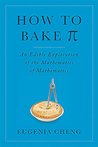
Book Review: How to Bake Pi
How to Bake Pi: An Edible Exploration of the Mathematics of Mathematics by Eugenia ChengMy rating: 4 of 5 stars
How to Bake Pi by Eugenia Cheng is a fascinating look at mathematics from an atypical perspective. In this work Eugenia shows how math is far larger, varied, and more encompassing than merely solving equations. She introduces each of her chapters with a "recipe" involving real food as an analogy to illustrate the points she makes.
In the early part of the book Eugenia describes how many people find math difficult and drop away at different stages. For some, arithmetic is hard. For other algebra or geometry is where they drop away. For some it might be trigonometry. For others calculus. And so on.
In my own personal experience, I found that I could not get past the plateau of calculus. This book finally gave me insight into why: up to calculus, math was still primarily about solving problems/equations and finding the "right" answer. Starting with calculus and going further into advance mathematics, problem-solving and finding the "right" answer is no longer the goal. My belief was that math was about solving problems, and so calculus increasingly made little sense in my mind. Perhaps if I had known what this book describes about math, I may have had a chance to get past the wall of calculus.
The first part of the book discusses abstractions and generalizations as one of the key goals of math. The second part of the book discusses Eugenia's field of specialty: Category Theory, and how the purpose of this meta-math (or math of math) is to simply math.
The final chapter brings all the earlier pages together as Eugenia summarizes the knowledge and makes a case to have her readers come away with the belief that math isn't hard. She does so by applying in her literary work the principles she discusses in this very chapter: she uses her discussions to bridge the knowledge and belief through understanding. So in the end I find that her math "principles" apply to not just math, but to cooking and to writing.
What is contained in this book is probably of most interest to someone familiar with high school math and onward. Many of the examples given assume a basic knowledge of algebra and geometry.
Eugenia alludes to math education a number of times in her book. Although this is not a book about math education, I believe that the reader can discover a vision for math education that she would like her readers to leave with. I think that this book will be an interesting and helpful volume for aspiring teachers and math educators, from elementary through high school and even into higher ed.
(This review is based on ARC supplied by the publisher through NetGalley.)
View all my reviews
Sunday, March 01, 2015
Finding Jesus (TV) – The Shroud of Turin (ep. 1/6)
Friday, February 27, 2015
The Gospel Formulation: Simple or Simplistic?
The gospel is the simple truth that God is holy, we are sinners, and Jesus is our Savior.
— The Gospel Project (@Gospel_Project) February 28, 2015 It is certainly simple (I mean, it fits into a 140-character tweet). But is it simplistic? Is this an accurate definition of “the gospel”?
There are three subparts to the statement, and each one is correct. But just because there are no errors in fact does not necessarily follow that the composed statement is the best representation of what is true. To be fair, the statement does not explicitly state the relationships between the elements, but I think it is clear that the assumptions being made are that (italics are unstated assumptions required to make the statement work):
- A (God is holy) –>
- B (and we are sinners) –>
- C (and we need a Savior and Jesus is our Savior) =
- D (therefore, this is the gospel).
Again, I don’t see anything wrong with the stated parts of A, B, and C. But does D necessarily follow A, B, and C? I realize this is a very common formulation, especially in evangelical and neo-Reformed circles.
But where is “love” in the gospel? The same circles that formulate the above are also very fond of John 3:16. But many also hold that God’s holiness is his supreme attribute (hence the “A” above) and that love is merely a manifestation of his holiness (or something along these lines).
So what I see is that this “simple” formulation of the gospel is in fact, not generally applicable to all groups who are defined as Christian (and who, by the way, defines who is and isn’t “Christian”?). This formulation is based on a priori theological axioms that may or may not be agreed upon by all Christians, and makes many relational assumptions between the elements.
As a Progressive Arminian/Wesleyan with leanings toward aspects of open and process theologies, my theological foundation is that:
- God is primarily defined by his love,
- And that love requires that there can be no force or coercion,
- Therefore, humans must be free to choose in an absolute sense;
- Because of that, God knows all possibilities but does not fully know which choices creation will take.
I also accept for myself that the best explanation for Jesus Christ’s incarnation and atonement work is described by the Christus Victor metaphor where the birth, life, death, and resurrection of Jesus Christ is a dramatic event (as opposed to the more common forensic/legal/penal-substitution theory from Anselm) that defeated sin and death.
So my formulation is that:
- M: God is love
- N: Love demands creation be given freedom
- O: Love compelled God to act when creation fell
- P: Jesus Christ (his whole life, death, and resurrection) shows the natural consequences of sin
- Q: Christ defeated sin and death by destroying its power through his death and resurrection
- R: Creation is restored through the power of life, evidenced in the resurrection
- S: Therefore, the entirety of creation has hope for new life; and this is the gospel.
It isn’t as short and concise, but it isn’t simplistic either. And I believe it offers better hope than the more simplistic formulation that is more commonly seen and heard.
There is more than one way to explain and define “the gospel.” Some, I think, are better than others.
Wednesday, February 25, 2015
Video: Origins Today–Genesis 1-3 Through Ancient Eyes by John H. Walton
How should modern Christians interpret and understand the creation accounts of Genesis 1-3?
My notes follow.
Notes
- What does the Bible reveal? How does the Bible reveal what it reveals?
- God reveals his purpose through human communicators. This communication is limited to human means, culture, time, language.
- Bible is written “for us, but not to us. Message transcends culture, but form is culture-bound.” We are reading someone else’s mail.
- We have to learn to see the world as the original writers of the text saw the world. What was their view of cosmology? (E.g., they didn’t see the world as a globe/sphere.)
- What we see today as “mythology” was the ancients’ truth.
- The Israelites/Hebrews had their particular cosmological view that does not look like anything like our modern scientific one.
- If God is going communicate into the ancient culture, which cosmology would he use? Theirs or ours? God uses what is familiar, but by his communication he is not endorsing the cosmological viewpoint.
- The human view of cosmology is always in flux. Much has changed even in the last century about how we see the universe.
- “We must see the text the way the ancient Israelites saw the text.” The definition and meaning of words in the Bible must be what they understood. We must not impose our definitions onto the text.
- The Bible does not provide new scientific revelation – it is a theological text.
- When the Bible speaks about “thinking or feeling” in the heart, we know what that means. We don’t feel the need to “defend” the Bible’s “physiological” and “neurological” perspective of thought, mind, and emotions. So we should extend this to other “science claims” in the Bible.
- The Bible is not teaching or revealing science. It is making certain historical claims. But it’s primary intent is theological.
- The Creation account of Genesis is not about material origins, but about functional origins. Ancients did not consider “existence” to be about material origins, but about something being given a “function.”
- “Naming and separating are acts of creation.”
- Genesis 1 is “not about building a house, but making a house a home.”
- Days 1-3: functions proclaimed (no material creation)
- Basis for 1) time, 2) weather and space, 3) food provision
- Days 4-6: functionaries installed
- 4) Lights (not objects) for signs, celebrations, days, years; 5) fish and birds to fill the world; 6) animals to fill the world and people to subdue and rule
- The Israelites saw sun, moon, and stars as “lights,” not objects. (The other peoples in ANE saw these as both lights and gods.)
- The world is thus a home. Whose home?
- The world is a cosmic temple. The Creation account is the arrival and enthroning of God in his home. It is a cosmological account; not a material account.
- The Sabbath is the day in which God arrives.
- In the ancient world, gods “rest” in temples
- “Rest” is the main goal of creation and the creation account
- Resting expresses having control over an ordered system
- It is from where God governs the world
- “Rest” in the Bible is not about downtime. It is about order and stability.
- When the book of Hebrews talks about “not yet having achieved rest” it means that there is yet another level of order and stability that has not yet been seen.
- Rest is not about activity/inactivity
- Biblical rest is about engagement
- The opposite of rest is unrest
- Creation account
- The days are 24-hour periods – but it’s not about material creation
- Therefore, it is not making a claim about the age of the earth of how it was created
- Second account of creation: Genesis 2
- It is not about an expansion of Day 6
- There is a sequence problem if we try to fit it into Day 6
- Synoptic (doubling back, restating) vs. Sequel (moving forward, a different account)
- All Genesis synoptic relationships concern brothers
- Genesis 2 does not involve brothers
- Genesis 1 speaks of a large multitude of human beings created
- Genesis 2 speaks of two distinct individuals: Adam and Eve
- If Genesis 2 is a sequel account, it is a later time period than Genesis 1
- Solves the problem of Cain and a large population that is assumed to exist
- Genesis 2 – an account of archetypal function of humans
- Adam and Eve may be historical individuals, but Genesis 2 is more about their forming as archetypes
- If the text is making statements that is true about all humanity, it is most likely archetypal
- If the text is making statements that cannot be true for all humanity, it is about individuals
- The “forming” account of humans
- Not about chemistry or sculpting
- Dust cannot be formed (clay works better)
- Dust represents mortality (Gen. 3:19)
- Genesis 2 is making a statement about human mortality
- Humans were created mortal (otherwise there would have been no need for the tree of life)
- What about Paul’s statement that sin brought death? Doesn’t that mean humans were originally immortal?
- No. Sin caused humans to lose access to the tree of life. Thus sin brought death.
- Paul’s statement says nothing about the original immortality of human beings
- When the Bible speaks of “forming” people, it is about functions and identity – not material origins
- E.g., Psalm 103:14; 1 Cor. 15:47-48
- Genesis 1 – functional creation of the world and all its inhabitants. Genesis 2 – a “choosing” of some subset of humans for a specific purpose.
- What about the creation of woman?
- More than just rib – bone and flesh
- “Rib” – never used anatomically again. Used architecturally to mean “one side of a pair.”
- Not about surgery.
- “Deep sleep” – a visionary state. Adam is “seeing” something in a vision; something that is deeply theological.
- The collective human race is only complete when both men and women come together (not specifically about marriage or sex).
- This is another archetypal statement.
- Both men and women designed and commissioned to serve as priests (Gen. 2:15)
- “Helpmeet” – Eve to help Adam in sacred task
- Genesis contains no information about the “forming” of individuals
- There is no biblical account of material/biological human origins
- The Bible says nothing on whether evolution and common origins is true or not; but the Bible would not contradict, either.
- The theological, ontological human creation account
- Endowed with the image of God
- Creation of a spiritual being
- Designation as priests
- Biology being could have evolved, but the spiritual being could not
- Genesis 3: Order, non-order, and disorder
- Order – connected to sacred space
- Non-order – remained after creation
- People given the task of expanding sacred space and order
- Presence of God brought life
- Serpent as chaos creature promoting disorder
- People wanted (desired) to be the center of order (temptation)
- The fall isn’t about disobedience and eating fruit, but about wanting to be like God – center of order
- This desire led to disobedience and eating fruit
- Sin brought disorder
- Humans cast out from sacred space into les ordered realm
- An alternate way to interpret Genesis 1-3
- How can people who read the Bible and accept its authority, but interpret it very differently, get along together?
- By only allowing a singular interpretation of the Bible (usually a strict creationism), Christians fail to minister to one another graciously, Christians fail to evangelize effectively, and is leading to attrition among Christians.
- By defending the singular, traditional interpretations so strongly, are Christians failing in our mission?
- Q&A
- Original sin or original innocence? Case can be made for latter.
- Human soul – not tied to the breath of life (because all living beings have it) but connected with being created in the image of God.
- Origin of civilizations – distinct from material and ontological origins
Tuesday, January 27, 2015
Book Review: “Inconspicuous Providence: The Gospel According to Esther”
Inconspicuous Providence: The Gospel According to Esther by Bryan R. GregoryMy rating: 4 of 5 stars
Inconspicuous Providence The Gospel According to Esther Gospel According to the Old Testament by Bryan R. Gregory is written as part commentary, part devotional. The first chapter sets the context in which this work understands and interprets the story of Esther in the Bible. The remaining chapters go through the text of Esther in units, as exegetical commentary, a theological commentary, a Christological commentary, life applications, and questions for reflection.
The theological position taken by Bryan, in my perspective, is a moderate Evangelical one. He takes as actual history the story of Esther as found in the Bible. He does not discuss some of the issues about the historicity of the story that have been raised by recent biblical scholars. He also takes the position that Christ is intentionally foreshadowed in the Esther story, hence the subtitle "The Gospel According to Esther." Finally he takes the Calvinist position of God's omniscience and omnipotence; i.e., that God is fully in control of human affairs.
Where Bryan diverges from the more conservative or fundamentalist Evangelical traditions is that in his discussions he presents a number of alternatives in interpretation that are sometimes at odds with the more traditional ones. For example he describes the cultural and social situation of commoners during the time and suggests that it was more than likely that Esther was a willing participant, perhaps even voluntary in her acceptance of going into the king's harem; and that later interpreters, uncomfortable with Esther's complicity, tried to find ways to "preserve her purity." Another example is that he sees in Esther a very strong female "type" of Christ. Bryan also sees in Esther a leader of the Jews, not merely a political one but a spiritual one who inaugurates a new celebration for the Jews in the midst of exile; and in this way follows in the footsteps of Moses, the liberator and law-giver.
Even though I do not share all of Bryan's theological positions through which he writes, I found this book informative and helpful in gaining a deeper understanding of Esther and how it found support among the Jews and early Christians. Even though it does not explicitly mention "God" anywhere, his presence is assumed through the various literary allusions to earlier Old Testament stories and characters. It is a story of a hidden God who is nevertheless present with his people, to comfort and to lead them through trials and sufferings.
(This review is based on ARC supplied by the publisher through NetGalley.)
View all my reviews
Monday, January 26, 2015
Book Review: “Paul: Apostle and Fellow Traveler”
Paul: Apostle and Fellow Traveler by Jerry L. SumneyMy rating: 5 of 5 stars
Paul Apostle and Fellow Traveler by Jerry L. Sumney is an excellent work offering an overview of recent scholarship on Paul and the epistles in the New Testament written by him and/or attributed to him. The issues of authorship of each epistle is discussed in clear and easy to understand terms.
The book itself is divided into three main sections: the first part is a historical, cultural, and theological overview of the New Testament era; the second part discusses the undisputed Pauline epistles; and the third part discusses the disputed ones.
The writing is simple and clear; in fact, it took me a few chapters to get used to it because of its style - short sentences and very simple style. I guess I expected a more heavy, complicated writing given the topic. The content is not superficial in any way, however.
The first part that discusses the overall environment of the Pauline churches is quite informative and provides necessary background for understanding how to read, interpret, understand, and apply each of the epistles that are discussed in the remainder of the book.
The second and third parts discuss each epistle. Most chapters discuss one epistle, but a few of the shorter epistles are discussed together in a single chapter. The discussions include the use of rhetoric, literary features, the possible issue(s) addressed, the historical setting and context, the theologies, and what it reveals about the author.
When discussing the disputed epistles, Jerry provides clear reasons why the material for each is disputed and why Paul most likely could not have been the author, but also why the early chose to accept it as authoritative.
To be clear, this is not a liberal Christian work. It takes the incarnation, the crucifixion, and resurrection of Christ as historical. However, it is not hold to the conservative (and certainly not fundamentalist) Christian tradition of the historicity of Pauline authorship of all of the epistles attributed to him. It accepts recent, sound, mainstream Christian Pauline scholarship in both authorship and theology.
I think Paul Apostle and Fellow Traveler is a worthwhile book to have on my shelf (or e-shelf) as a quick and concise reference to the Pauline epistles and their time and place.
(This review is based on ARC through NetGalley and the publisher.)
View all my reviews
Book Review: “Undiluted” by Benjamin L. Corey
Undiluted: Rediscovering the Radical Message of Jesus by Benjamin L. CoreyMy rating: 5 of 5 stars
In this book Benjamin Corey reverses the usual understanding of "watering down the gospel." Through the discussions in this book, he demonstrates that a rigid, fundamentalist/conservative Evangelical dogma and beliefs are, in fact, watering down the gospel by becoming too much like the surrounding culture. He writes from an American perspective and argues against the popular American versions of Christianity. This book describes his journey out of rigid Christianity to a fluid, progressive one; a journey that begins when he enrolls in seminary.
Benjamin argues against the kind of exclusionary, tribalism that is common among Americanized Christianity. He argues against the extreme individualism that permeates much of what is valued - individual sin, repentance, and salvation - and argues for a more inclusive Christianity - community, social justice, non-violence. He argues that the gospel is spoken of by Jesus and Paul as "offensive" not because the boundaries are so narrow, but because they are so wide and broad. The gospel is offensive because of who it lets in, and not because of who it keeps out. Benjamin argues that the gate is narrow not because it is so difficult, but the gospel is so offensive to institutional and conservative religion.
Benjamin argues against the more widely accepted views of atonement and salvation that employ violence as a means of atonement. He argues for a non-violent atonement. It is because Jesus was so non-violent, that people became violent against him which resulted in his execution on the cross. The gospel is not merely about individual salvation but about restoring and reconciling relationships - between humankind and with communities of humans to God.
This is a call to set aside rigid, black-and-white versions of Christianity and embrace a nuanced, fluid one in which we do not have all the answers, but in which together as community we pursue the questions and journey together in the quest for answers.
View all my reviews
Thursday, January 08, 2015
Interpreting Genesis 1-3
Dr. John Walton presents and Joe Fleener provides a response. My notes on the video are found after the video and I conclude with my assessment of the response.
Dr. John Walton, Old Testament, Wheaton College (dur. 1:08)
· Inspiration and interpretation of scripture.
· The importance of context and culture.
· Scripture written for us, but not to us.
· We must strip away our culture from our reading of scripture.
· We need to place ourselves into the original setting as much as possible.
· Communication takes place on the basis of what is familiar.
· God could not communicate something completely foreign to ancient peoples.
· Understanding ancient cosmology is crucial to reading creation accounts.
· “Who’s in charge?” was the most important concept to communicate.
· Material structure was not important.
· God doesn’t always use “right” science to communicate, rather he uses familiar.
· We can’t read the words of the text with our assumptions.
· We have to define words and concepts according to what it meant to the original audience.
· Textual authority can only come from what the original context would have communicated.
· Naturalistic explanations do not eliminate God.
· The Bible does not provide scientific revelations.
· God does not “upgrade” Hebrew scientific understandings.
· God accommodates the understandings of his audience to communicate using the already familiar.
· Inerrancy only applies to what the Bible is meant to affirm.
· Day 1: God created the basis of time.
· Day 1: Time is not an object, light is not an object - no objects created on day 1.
· We think creation means “creation of objects.”
· The ancients did not think that way.
· Usage is the key to meaning.
· English words can mean different things in different cultures.
· Usage determines meaning.
· “Create” [baw-raw] does not have to create an object.
· “Create” can mean creation of functions and orderings.
· That God created everything is not in question.
· The question is, what part of this creation story is the creation account telling?
· The creation account begins with Gen 1:2.
· Genesis 1:1 is an introduction.
· There is already material at verse 2.
· The starting point of this account is “no order” and “no function,” not “no material.”
· the Egyptians talk about the desert and sea as “non-existent” - not materially, but in function.
· Thesis: Genesis 1 is an origin account of order and functions; not material objects.
· Ancients thought of the cosmos as a kingdom with someone in charge.
· Creation account: who is in charge?
· When God says “it is good” in the creation account it doesn’t mean perfect or righteous, but ready to function.
· When God says “it is not good” it means something is not ready to function.
· It is futile to ask “what objects were created on a particular day?”
· Moderns are concerned with how the material aspects are built.
· The ancients weren’t particularly concerned with that.
· Moderns are concerned with the story of how the house was built.
· The ancients were concerned with the story of how a home was created.
· John 14 - Jesus says he will build a home for his family.
· In the house story we are insignificant.
· In the home story we are honored guests.
· Day 2: Creation of weather.
· Day 3: Food.
· Time, weather, food - three crtitical functions of existence.
· Days 4-6: functionaries are installed
· Hebrews did not see sun, moon, and stars as objects - they were functionaries providing functions.
· Day 7: a temple account
· We moderns don’t see “temple” in the text, but the ancients would not have required it.
· Why does God need to “rest”?
· It is not six days of creation, but a full seven days.
· When God “rests” it screams “a temple”!
· God takes up residence by “resting.”
· God moves in to take charge.
· When the Bible says that the Israelites rested, it means they took charge and order established.
· When Jesus says “I will give you rest” it means he will elevate his people to take charge in the kingdom.
· When the book of Hebrews says “rest hasn’t been achieved” it means full order and charge has not been established.
· Rest is where a being rules, not where someone sleeps.
· Rest is the climax of the creation account.
· The opposite of rest is not activity, but unrest.
· The temple does not “exist” until God moves in.
· God moves in by an “inauguration ceremony”
· In ANE texts, an inauguration ceremony involves proclaims the functions of the temple, functionaries are installed, and a deity takes up rest in the temple, and takes seven days.
· Genesis 1:1-2:3 is the Hebrew version of an ANE temple inauguration ceremony.
· The Genesis creation account is a theological account, of the past but also of the promise for the future.
· Seven, literal, 24-hours days – but it isn’t about the literal construction of the material world.
· No claims are being are made about the age of the earth.
· Genesis 2 is not about Day 6.
· Genesis 2 is a sequel account.
· If Genesis 1 and 2 are sequel accounts, the humans in Genesis 1 are not Adam and Eve.
· Genesis 2 describes the “creation” of Adam and Eve.
· Second account does not need to fit into Day 6.
· Adam and Eve are not the first people – solves quite a few problems.
· Biblical text suggests there were a whole lot more people than Adam and Eve’s descendants.
· Adam and Eve are archetypes – one who represents all the others.
· Does Genesis 2 refer to individuals or archetypes?
· “Dust” – not chemistry or craftsmanship.
· “Dust” = “mortality”.
· People were created mortal (from dust).
· Tree of life – no sense if people were created immortal.
· Sin – humans lost the antidote to immortality.
· Psalm 103:14 – “we” are all formed from “dust”.
· Not unique to Adam – every human being formed from “dust”.
· Formed from “dust” is not about material formation.
· Formed from “dust” does not preclude being born from a woman.
· Formed from “dust” is a statement about every human being throughout history; it is a statement about identity.
· Gen 2: Does Adam believe Eve was created from his rib? No.
· The word “rib” in Gen 2 is never used anatomically anywhere else.
· Biblical text is not talking about surgery.
· When Adam falls into deep sleep, God shows him a vision.
· Adam sees a vision of him being cut into two halves, and Eve being created out of one half.
· When Adam and Eve join together, humanity is restored to wholeness.
· It is not about the material origins of woman; but about identity.
· They (together) are given a priestly role.
· Adam and Eve can be historical individuals, without being the very first biological humans.
· There is no biblical account of human (material, biological) origins.
· The Bible does not endorse or rule out evolutionary processes.
Joe Fleener provides a response to John Walton in the remaining 45 minutes.
· How did the LXX translators understand Genesis 1?
· How did pre-Enlightenment Christians understand it?
· How did pre-Enlightenment Jews understand it?
· How did the Qumran community understand it?
· There is strong evidence that these understood Genesis 1 as material creation.
· There is ample evidence that pre-Enlightenment.
· God is The Author of the entire Bible.
· The entirely of the Bible has an intentional beginning and an end.
· Revelation refers back to the Genesis creation account.
· Revelation discusses new material creation.
· The language in Revelation is the same as LXX Genesis accounts of creation (therefore, Genesis 1 must be referring to material creation).
· Various examples from Bible passages that describe God as creator of the material world.
· The Flood is about material destruction.
· Genesis 1 and 2 must be about material creation.
· Paul’s use of the creation account as requiring it to be chronologically and materially literal.
· Creation of sea creatures in Genesis 1: sometimes thought to be a polemic, but it is clearly a material creation.
· Not either/or – but both/and.
· Genesis 1 and 2 is both functional and material creation.
· Genesis 1 is not science, but it is history.
· There can be no conflict between science and Genesis 1, even though the Bible is not a science text.
· How accurate are our understandings of ANE cultures?
· Are the ANE texts reflective of how people really thought?
· Scripture must be inerrant and true in all aspects: can something be theologically true, yet ontologically untrue?
· Criticism of higher criticism in interpreting scripture.
· Discomfort with the idea of a Cosmic Temple imagery.
My assessment of the response
In my opinion, Fleener’s response fails to convince. John Walton never said God didn’t materially create, which is what Fleener appears to be trying to answer. What John Walton says is that Genesis 1 and 2 are about functional creation which pre-supposes a material creation ex nihilo. Fleener is addressing a single statement from Walton’s work in which Walton appears to put forth a claim that reading Genesis 1 and 2 as a material creation account is strictly an Enlightenment development. Fleener falls into some of the interpretation issues that Walton describes: reading anachronistically; assuming the later Jews and pre-Enlightenment commentators were expressing the original author’s intent; assuming later text in the Bible perfectly reflect the understanding of the Genesis account; assuming a perfect revelation of theology and science from the Bible. What this tells me is that Walton and Fleener is talking past each other due to their different starting points.
Sunday, December 28, 2014
Christmas Eve Service
Here is the Christmas Eve service in which I took part at the Baptist Church on December 24, 2014.