Sunday, March 08, 2015

Finding Jesus (TV) – Relics of John the Baptist (ep. 2/6)

imageProphets were common in first century Judaism. John the Baptist is the kind of fire-brand, judgment-preaching prophet in the pattern of Old Testament prophets that would have aroused the curiosity and appeal of the people of his time. And in many ways he might be the kind of preacher that some segments of Christianity today might also revere. During his life, John was probably far more popular and recognized than Jesus. But he didn't seek the limelight; he went to the margins and spoke from there.
 
Not too many years into the beginnings of Christianity, the remains of John the Baptist were believed to have spread around the region. People wanted tangible connections to their origins, and these bone fragments were one such means. There are far too many such reports for most of them to be possibly genuine. But what we can learn from them is the story of the spread of Christianity.
 
One such relic was discovered in Bulgaria underneath a church dedicated to John the Baptist. Upon testing the remains, it was discovered that it did indeed come from a Middle Eastern man dated to the first part of the first century. If genuine, it could be a biological connection to Jesus. (Cue scenes and readings from Luke.)
 
Science can determine whether any of the scattered relics of John the Baptist are from a single individual.
 
Historical interpretation shows that Jesus came to John, and that Jesus' ministry began within John's framework. There is no evidence for or against that John and Jesus met previous to his baptism. (Cue scenes and readings of baptism from the gospels.) How can the baptized become greater than the baptizer? This is one of the major issues for which the gospels attempt to provide an answer. Eventually Jesus goes off on his own and it is his ministry that survives.
 
Jesus and the wilderness temptation. (Cue scenes and readings of the temptations.) The program uses the order from Luke. The interviewee for this segment provides some personal speculations that seems irrelevant.
 
The program interprets Jesus' baptism as giving John the Baptist new courage to speak out against sin, specifically against Herod Antipas. Explanation given of why Herod's relationship with Herodias was particularly offensive to the Jews. John's actions are seen as political sedition and treason, eventually leading to his arrest, imprisonment, and execution.
 
Imprisonment does not silence John. But now he has time to really ponder Jesus and his movement. If Jesus is on the trajectory that John prophesied about the Messiah, then John's work has not been in vain. Jesus' response gives hope to John – oppression will be overcome.
 
The problem between John and Herod/Herodias is that of honor. John has shamed them. And Herodias in particular has a score to settle, to regain her honor. (Cue "death banquet" scene and reading from Mark.) John the Baptist's execution stands as a warning to all who would dare confront the established powers of the world.
 
The finger kept in Kansas City, MO does not date to the first century. It is much younger. There are over 200 known relics of John. Perhaps matches will be found as they continue to be tested.
 
John the Baptist is a prototype for Jesus' ministry: a catalyst for change, calls for repentance, confronting the established powers, martyrdom. A key difference: Jesus movement intentionally appeals to Gentiles, thereby allowing it to survive and continue.
 
Dramatized interpretations from the Bible are intertwined with modern settings of the search and testing of relics.
 
This episode had much less to do with looking at the relics and far more with understanding the person of John and how Jesus might have been influenced by him. It used quite a number of passages from the Bible and included extensive dramatizations of the stories. As with any interpretations of scripture, there are opinions that not all may share. Overall, however, I thought the program remained historically and scripturally sound.

Monday, March 02, 2015

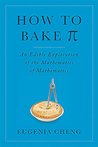
Book Review: How to Bake Pi

How to Bake Pi: An Edible Exploration of the Mathematics of MathematicsHow to Bake Pi: An Edible Exploration of the Mathematics of Mathematics by Eugenia Cheng
My rating: 4 of 5 stars

How to Bake Pi by Eugenia Cheng is a fascinating look at mathematics from an atypical perspective. In this work Eugenia shows how math is far larger, varied, and more encompassing than merely solving equations. She introduces each of her chapters with a "recipe" involving real food as an analogy to illustrate the points she makes.

In the early part of the book Eugenia describes how many people find math difficult and drop away at different stages. For some, arithmetic is hard. For other algebra or geometry is where they drop away. For some it might be trigonometry. For others calculus. And so on.

In my own personal experience, I found that I could not get past the plateau of calculus. This book finally gave me insight into why: up to calculus, math was still primarily about solving problems/equations and finding the "right" answer. Starting with calculus and going further into advance mathematics, problem-solving and finding the "right" answer is no longer the goal. My belief was that math was about solving problems, and so calculus increasingly made little sense in my mind. Perhaps if I had known what this book describes about math, I may have had a chance to get past the wall of calculus.

The first part of the book discusses abstractions and generalizations as one of the key goals of math. The second part of the book discusses Eugenia's field of specialty: Category Theory, and how the purpose of this meta-math (or math of math) is to simply math.

The final chapter brings all the earlier pages together as Eugenia summarizes the knowledge and makes a case to have her readers come away with the belief that math isn't hard. She does so by applying in her literary work the principles she discusses in this very chapter: she uses her discussions to bridge the knowledge and belief through understanding. So in the end I find that her math "principles" apply to not just math, but to cooking and to writing.

What is contained in this book is probably of most interest to someone familiar with high school math and onward. Many of the examples given assume a basic knowledge of algebra and geometry.

Eugenia alludes to math education a number of times in her book. Although this is not a book about math education, I believe that the reader can discover a vision for math education that she would like her readers to leave with. I think that this book will be an interesting and helpful volume for aspiring teachers and math educators, from elementary through high school and even into higher ed.

(This review is based on ARC supplied by the publisher through NetGalley.)

View all my reviews

Sunday, March 01, 2015

Finding Jesus (TV) – The Shroud of Turin (ep. 1/6)

This year, 2015, we get a series on Jesus from CNN during this Lenten and Easter season. The series looks for Jesus in the handful of artifacts that claim to be connected to Jesus in one way or another. In the start to the series the Shroud of Turin is featured.
 
The episode examines the shroud and compares it to the accounts of his suffering, crucifixion, death, burial and resurrection. The show attempts to depict how the various markings on the shroud correspond to descriptions in the gospel accounts. No counterevidence or counterarguments are presented during this part of the program. The question that comes to my mind is, are the researchers fitting the evidence to the account, seeing what they want to see?
 
Around the 43 minute mark it is finally revealed that the shroud fails the dating test. It cannot be the burial shroud of Jesus; it is a forgery. The program discusses the forgery of artifacts during the Middle Ages.
 
Another theory is proposed: that the shroud is the earliest example of photography. Camera obscura is discussed. The dating of this and the shroud correspond. The chemical process was known at that time. Urea in urine would have been used to remove the silver sulphate. When the process is reproduced today, the image formed is strikingly similar to what is seen on the shroud. It would then be easy to add blood by panting onto the linen. The main problem with this theory is that there are no other extent examples of this technique from the same period.
 
There is another artifact that potentially argues for the authenticity of the shroud: the face cloth claimed to have covered Jesus' face. The organic remnants on the cloth seem to evidence its authenticity.
 
I found this first episode far more compelling, believable, and worthwhile than similar series that I saw broadcast on the History and H2 channels. Most of the individuals given air time seem to be respectable scholars, rather than in the earlier series where the scholars seemed to be outnumbered by popular authors and journalists. Unlike, say The Bible series on the History channel, this episode remained quite close to the biblical text when it depicted scenes from the Bible.
 
The program itself takes the discussion and debate seriously. The concluding few minutes present voices from both sides, and suggest spiritual and devotional elements that these artifacts can lead people toward.

Friday, February 27, 2015

The Gospel Formulation: Simple or Simplistic?

So the following popped up in my Twitter feed today. And yes, I have some issues with it. 

It is certainly simple (I mean, it fits into a 140-character tweet). But is it simplistic? Is this an accurate definition of “the gospel”?

There are three subparts to the statement, and each one is correct. But just because there are no errors in fact does not necessarily follow that the composed statement is the best representation of what is true. To be fair, the statement does not explicitly state the relationships between the elements, but I think it is clear that the assumptions being made are that (italics are unstated assumptions required to make the statement work):

  • A (God is holy) –>
  • B (and we are sinners) –>
  • C (and we need a Savior and Jesus is our Savior) =
  • D (therefore, this is the gospel).

imageAgain, I don’t see anything wrong with the stated parts of A, B, and C. But does D necessarily follow A, B, and C? I realize this is a very common formulation, especially in evangelical and neo-Reformed circles.

But where is “love” in the gospel? The same circles that formulate the above are also very fond of John 3:16. But many also hold that God’s holiness is his supreme attribute (hence the “A” above) and that love is merely a manifestation of his holiness (or something along these lines).

So what I see is that this “simple” formulation of the gospel is in fact, not generally applicable to all groups who are defined as Christian (and who, by the way, defines who is and isn’t “Christian”?). This formulation is based on a priori theological axioms that may or may not be agreed upon by all Christians, and makes many relational assumptions between the elements.

As a Progressive Arminian/Wesleyan with leanings toward aspects of open and process theologies, my theological foundation is that:

  • God is primarily defined by his love,
  • And that love requires that there can be no force or coercion,
  • Therefore, humans must be free to choose in an absolute sense;
  • Because of that, God knows all possibilities but does not fully know which choices creation will take.

I also accept for myself that the best explanation for Jesus Christ’s incarnation and atonement work is described by the Christus Victor metaphor where the birth, life, death, and resurrection of Jesus Christ is a dramatic event (as opposed to the more common forensic/legal/penal-substitution theory from Anselm) that defeated sin and death.

So my formulation is that:

  • M: God is love
  • N: Love demands creation be given freedom
  • O: Love compelled God to act when creation fell
  • P: Jesus Christ (his whole life, death, and resurrection) shows the natural consequences of sin
  • Q: Christ defeated sin and death by destroying its power through his death and resurrection
  • R: Creation is restored through the power of life, evidenced in the resurrection
  • S: Therefore, the entirety of creation has hope for new life; and this is the gospel.

It isn’t as short and concise, but it isn’t simplistic either. And I believe it offers better hope than the more simplistic formulation that is more commonly seen and heard.

There is more than one way to explain and define “the gospel.” Some, I think, are better than others.

Wednesday, February 25, 2015

Video: Origins Today–Genesis 1-3 Through Ancient Eyes by John H. Walton

How should modern Christians interpret and understand the creation accounts of Genesis 1-3?

My notes follow.


Notes

  • What does the Bible reveal? How does the Bible reveal what it reveals?
  • God reveals his purpose through human communicators. This communication is limited to human means, culture, time, language.
  • Bible is written “for us, but not to us. Message transcends culture, but form is culture-bound.” We are reading someone else’s mail.
  • We have to learn to see the world as the original writers of the text saw the world. What was their view of cosmology? (E.g., they didn’t see the world as a globe/sphere.)
  • What we see today as “mythology” was the ancients’ truth.
  • The Israelites/Hebrews had their particular cosmological view that does not look like anything like our modern scientific one.
  • If God is going communicate into the ancient culture, which cosmology would he use? Theirs or ours? God uses what is familiar, but by his communication he is not endorsing the cosmological viewpoint.
  • The human view of cosmology is always in flux. Much has changed even in the last century about how we see the universe.
  • “We must see the text the way the ancient Israelites saw the text.” The definition and meaning of words in the Bible must be what they understood. We must not impose our definitions onto the text.
  • The Bible does not provide new scientific revelation – it is a theological text.
  • When the Bible speaks about “thinking or feeling” in the heart, we know what that means. We don’t feel the need to “defend” the Bible’s “physiological” and “neurological” perspective of thought, mind, and emotions. So we should extend this to other “science claims” in the Bible.
  • The Bible is not teaching or revealing science. It is making certain historical claims. But it’s primary intent is theological.
  • The Creation account of Genesis is not about material origins, but about functional origins. Ancients did not consider “existence” to be about material origins, but about something being given a “function.”
  • “Naming and separating are acts of creation.”
  • Genesis 1 is “not about building a house, but making a house a home.”
  • Days 1-3: functions proclaimed (no material creation)
    • Basis for 1) time, 2) weather and space, 3) food provision
  • Days 4-6: functionaries installed
    • 4) Lights (not objects) for signs, celebrations, days, years; 5) fish and birds to fill the world; 6) animals to fill the world and people to subdue and rule
    • The Israelites saw sun, moon, and stars as “lights,” not objects. (The other peoples in ANE saw these as both lights and gods.)
  • The world is thus a home. Whose home?
  • The world is a cosmic temple. The Creation account is the arrival and enthroning of God in his home. It is a cosmological account; not a material account.
    • The Sabbath is the day in which God arrives.
    • In the ancient world, gods “rest” in temples
    • “Rest” is the main goal of creation and the creation account
    • Resting expresses having control over an ordered system
    • It is from where God governs the world
  • “Rest” in the Bible is not about downtime. It is about order and stability.
    • When the book of Hebrews talks about “not yet having achieved rest” it means that there is yet another level of order and stability that has not yet been seen.
    • Rest is not about activity/inactivity
    • Biblical rest is about engagement
    • The opposite of rest is unrest
  • Creation account
    • The days are 24-hour periods – but it’s not about material creation
    • Therefore, it is not making a claim about the age of the earth of how it was created
  • Second account of creation: Genesis 2
    • It is not about an expansion of Day 6
    • There is a sequence problem if we try to fit it into Day 6
  • Synoptic (doubling back, restating) vs. Sequel (moving forward, a different account)
    • All Genesis synoptic relationships concern brothers
    • Genesis 2 does not involve brothers
    • Genesis 1 speaks of a large multitude of human beings created
    • Genesis 2 speaks of two distinct individuals: Adam and Eve
  • If Genesis 2 is a sequel account, it is a later time period than Genesis 1
    • Solves the problem of Cain and a large population that is assumed to exist
  • Genesis 2 – an account of archetypal function of humans
    • Adam and Eve may be historical individuals, but Genesis 2 is more about their forming as archetypes
    • If the text is making statements that is true about all humanity, it is most likely archetypal
    • If the text is making statements that cannot be true for all humanity, it is about individuals
  • The “forming” account of humans
    • Not about chemistry or sculpting
    • Dust cannot be formed (clay works better)
    • Dust represents mortality (Gen. 3:19)
    • Genesis 2 is making a statement about human mortality
      • Humans were created mortal (otherwise there would have been no need for the tree of life)
    • What about Paul’s statement that sin brought death? Doesn’t that mean humans were originally immortal?
      • No. Sin caused humans to lose access to the tree of life. Thus sin brought death.
      • Paul’s statement says nothing about the original immortality of human beings
  • When the Bible speaks of “forming” people, it is about functions and identity – not material origins
    • E.g., Psalm 103:14; 1 Cor. 15:47-48
  • Genesis 1 – functional creation of the world and all its inhabitants. Genesis 2 – a “choosing” of some subset of humans for a specific purpose.
  • What about the creation of woman?
    • More than just rib – bone and flesh
    • “Rib” – never used anatomically again. Used architecturally to mean “one side of a pair.”
    • Not about surgery.
    • “Deep sleep” – a visionary state. Adam is “seeing” something in a vision; something that is deeply theological.
    • The collective human race is only complete when both men and women come together (not specifically about marriage or sex).
    • This is another archetypal statement.
  • Both men and women designed and commissioned to serve as priests (Gen. 2:15)
    • “Helpmeet” – Eve to help Adam in sacred task
  • Genesis contains no information about the “forming” of individuals
  • There is no biblical account of material/biological human origins
  • The Bible says nothing on whether evolution and common origins is true or not; but the Bible would not contradict, either.
  • The theological, ontological human creation account
    • Endowed with the image of God
    • Creation of a spiritual being
    • Designation as priests
  • Biology being could have evolved, but the spiritual being could not
  • Genesis 3: Order, non-order, and disorder
    • Order – connected to sacred space
    • Non-order – remained after creation
    • People given the task of expanding sacred space and order
    • Presence of God brought life
    • Serpent as chaos creature promoting disorder
    • People wanted (desired) to be the center of order (temptation)
      • The fall isn’t about disobedience and eating fruit, but about wanting to be like God – center of order
      • This desire led to disobedience and eating fruit
    • Sin brought disorder
    • Humans cast out from sacred space into les ordered realm
  • An alternate way to interpret Genesis 1-3
  • How can people who read the Bible and accept its authority, but interpret it very differently, get along together?
  • By only allowing a singular interpretation of the Bible (usually a strict creationism), Christians fail to minister to one another graciously, Christians fail to evangelize effectively, and is leading to attrition among Christians.
  • By defending the singular, traditional interpretations so strongly, are Christians failing in our mission?
  • Q&A
    • Original sin or original innocence? Case can be made for latter.
    • Human soul – not tied to the breath of life (because all living beings have it) but connected with being created in the image of God.
    • Origin of civilizations – distinct from material and ontological origins

Tuesday, January 27, 2015

Book Review: “Inconspicuous Providence: The Gospel According to Esther”

Inconspicuous Providence: The Gospel According to Esther (Gospel According to the Old Testament)Inconspicuous Providence: The Gospel According to Esther by Bryan R. Gregory
My rating: 4 of 5 stars

Inconspicuous Providence The Gospel According to Esther Gospel According to the Old Testament by Bryan R. Gregory is written as part commentary, part devotional. The first chapter sets the context in which this work understands and interprets the story of Esther in the Bible. The remaining chapters go through the text of Esther in units, as exegetical commentary, a theological commentary, a Christological commentary, life applications, and questions for reflection.

The theological position taken by Bryan, in my perspective, is a moderate Evangelical one. He takes as actual history the story of Esther as found in the Bible. He does not discuss some of the issues about the historicity of the story that have been raised by recent biblical scholars. He also takes the position that Christ is intentionally foreshadowed in the Esther story, hence the subtitle "The Gospel According to Esther." Finally he takes the Calvinist position of God's omniscience and omnipotence; i.e., that God is fully in control of human affairs.

Where Bryan diverges from the more conservative or fundamentalist Evangelical traditions is that in his discussions he presents a number of alternatives in interpretation that are sometimes at odds with the more traditional ones. For example he describes the cultural and social situation of commoners during the time and suggests that it was more than likely that Esther was a willing participant, perhaps even voluntary in her acceptance of going into the king's harem; and that later interpreters, uncomfortable with Esther's complicity, tried to find ways to "preserve her purity." Another example is that he sees in Esther a very strong female "type" of Christ. Bryan also sees in Esther a leader of the Jews, not merely a political one but a spiritual one who inaugurates a new celebration for the Jews in the midst of exile; and in this way follows in the footsteps of Moses, the liberator and law-giver.

Even though I do not share all of Bryan's theological positions through which he writes, I found this book informative and helpful in gaining a deeper understanding of Esther and how it found support among the Jews and early Christians. Even though it does not explicitly mention "God" anywhere, his presence is assumed through the various literary allusions to earlier Old Testament stories and characters. It is a story of a hidden God who is nevertheless present with his people, to comfort and to lead them through trials and sufferings.

(This review is based on ARC supplied by the publisher through NetGalley.)

View all my reviews

Monday, January 26, 2015

Book Review: “Paul: Apostle and Fellow Traveler”

Paul: Apostle and Fellow TravelerPaul: Apostle and Fellow Traveler by Jerry L. Sumney
My rating: 5 of 5 stars

Paul Apostle and Fellow Traveler by Jerry L. Sumney is an excellent work offering an overview of recent scholarship on Paul and the epistles in the New Testament written by him and/or attributed to him. The issues of authorship of each epistle is discussed in clear and easy to understand terms.

The book itself is divided into three main sections: the first part is a historical, cultural, and theological overview of the New Testament era; the second part discusses the undisputed Pauline epistles; and the third part discusses the disputed ones.

The writing is simple and clear; in fact, it took me a few chapters to get used to it because of its style - short sentences and very simple style. I guess I expected a more heavy, complicated writing given the topic. The content is not superficial in any way, however.

The first part that discusses the overall environment of the Pauline churches is quite informative and provides necessary background for understanding how to read, interpret, understand, and apply each of the epistles that are discussed in the remainder of the book.

The second and third parts discuss each epistle. Most chapters discuss one epistle, but a few of the shorter epistles are discussed together in a single chapter. The discussions include the use of rhetoric, literary features, the possible issue(s) addressed, the historical setting and context, the theologies, and what it reveals about the author.

When discussing the disputed epistles, Jerry provides clear reasons why the material for each is disputed and why Paul most likely could not have been the author, but also why the early chose to accept it as authoritative.

To be clear, this is not a liberal Christian work. It takes the incarnation, the crucifixion, and resurrection of Christ as historical. However, it is not hold to the conservative (and certainly not fundamentalist) Christian tradition of the historicity of Pauline authorship of all of the epistles attributed to him. It accepts recent, sound, mainstream Christian Pauline scholarship in both authorship and theology.

I think Paul Apostle and Fellow Traveler is a worthwhile book to have on my shelf (or e-shelf) as a quick and concise reference to the Pauline epistles and their time and place.

(This review is based on ARC through NetGalley and the publisher.)

View all my reviews

Book Review: “Undiluted” by Benjamin L. Corey

Undiluted: Rediscovering the Radical Message of JesusUndiluted: Rediscovering the Radical Message of Jesus by Benjamin L. Corey
My rating: 5 of 5 stars

In this book Benjamin Corey reverses the usual understanding of "watering down the gospel." Through the discussions in this book, he demonstrates that a rigid, fundamentalist/conservative Evangelical dogma and beliefs are, in fact, watering down the gospel by becoming too much like the surrounding culture. He writes from an American perspective and argues against the popular American versions of Christianity. This book describes his journey out of rigid Christianity to a fluid, progressive one; a journey that begins when he enrolls in seminary.

Benjamin argues against the kind of exclusionary, tribalism that is common among Americanized Christianity. He argues against the extreme individualism that permeates much of what is valued - individual sin, repentance, and salvation - and argues for a more inclusive Christianity - community, social justice, non-violence. He argues that the gospel is spoken of by Jesus and Paul as "offensive" not because the boundaries are so narrow, but because they are so wide and broad. The gospel is offensive because of who it lets in, and not because of who it keeps out. Benjamin argues that the gate is narrow not because it is so difficult, but the gospel is so offensive to institutional and conservative religion.

Benjamin argues against the more widely accepted views of atonement and salvation that employ violence as a means of atonement. He argues for a non-violent atonement. It is because Jesus was so non-violent, that people became violent against him which resulted in his execution on the cross. The gospel is not merely about individual salvation but about restoring and reconciling relationships - between humankind and with communities of humans to God.

This is a call to set aside rigid, black-and-white versions of Christianity and embrace a nuanced, fluid one in which we do not have all the answers, but in which together as community we pursue the questions and journey together in the quest for answers.

View all my reviews

Thursday, January 08, 2015

Interpreting Genesis 1-3

Dr. John Walton presents and Joe Fleener provides a response. My notes on the video are found after the video and I conclude with my assessment of the response.

Dr. John Walton, Old Testament, Wheaton College (dur. 1:08)

·         Inspiration and interpretation of scripture.

·         The importance of context and culture.

·         Scripture written for us, but not to us.

·         We must strip away our culture from our reading of scripture.

·         We need to place ourselves into the original setting as much as possible.

·         Communication takes place on the basis of what is familiar.

·         God could not communicate something completely foreign to ancient peoples.

·         Understanding ancient cosmology is crucial to reading creation accounts.

·         “Who’s in charge?” was the most important concept to communicate.

·         Material structure was not important.

·         God doesn’t always use “right” science to communicate, rather he uses familiar.

·         We can’t read the words of the text with our assumptions.

·         We have to define words and concepts according to what it meant to the original audience.

·         Textual authority can only come from what the original context would have communicated.

·         Naturalistic explanations do not eliminate God.

·         The Bible does not provide scientific revelations.

·         God does not “upgrade” Hebrew scientific understandings.

·         God accommodates the understandings of his audience to communicate using the already familiar.

·         Inerrancy only applies to what the Bible is meant to affirm.

·         Day 1: God created the basis of time.

·         Day 1: Time is not an object, light is not an object - no objects created on day 1.

·         We think creation means “creation of objects.”

·         The ancients did not think that way.

·         Usage is the key to meaning.

·         English words can mean different things in different cultures.

·         Usage determines meaning.

·         “Create” [baw-raw] does not have to create an object.

·         “Create” can mean creation of functions and orderings.

·         That God created everything is not in question.

·         The question is, what part of this creation story is the creation account telling?

·         The creation account begins with Gen 1:2.

·         Genesis 1:1 is an introduction.

·         There is already material at verse 2.

·         The starting point of this account is “no order” and “no function,” not “no material.”

·         the Egyptians talk about the desert and sea as “non-existent” - not materially, but in function.

·         Thesis: Genesis 1 is an origin account of order and functions; not material objects.

·      Ancients thought of the cosmos as a kingdom with someone in charge.

·         Creation account: who is in charge?

·         When God says “it is good” in the creation account it doesn’t mean perfect or righteous, but ready to function.

·         When God says “it is not good” it means something is not ready to function.

·         It is futile to ask “what objects were created on a particular day?”

·         Moderns are concerned with how the material aspects are built.

·         The ancients weren’t particularly concerned with that.

·         Moderns are concerned with the story of how the house was built.

·         The ancients were concerned with the story of how a home was created.

·         John 14 - Jesus says he will build a home for his family.

·         In the house story we are insignificant.

·         In the home story we are honored guests.

·         Day 2: Creation of weather.

·         Day 3: Food.

·         Time, weather, food - three crtitical functions of existence.

·         Days 4-6: functionaries are installed

·         Hebrews did not see sun, moon, and stars as objects - they were functionaries providing functions.

·         Day 7: a temple account

·         We moderns don’t see “temple” in the text, but the ancients would not have required it.

·         Why does God need to “rest”?

·         It is not six days of creation, but a full seven days.

·         When God “rests” it screams “a temple”!

·         God takes up residence by “resting.”

·         God moves in to take charge.

·         When the Bible says that the Israelites rested, it means they took charge and order established.

·         When Jesus says “I will give you rest” it means he will elevate his people to take charge in the kingdom.

·         When the book of Hebrews says “rest hasn’t been achieved” it means full order and charge has not been established.

·         Rest is where a being rules, not where someone sleeps.

·         Rest is the climax of the creation account.

·         The opposite of rest is not activity, but unrest.

·         The temple does not “exist” until God moves in.

·         God moves in by an “inauguration ceremony”

·         In ANE texts, an inauguration ceremony involves proclaims the functions of the temple, functionaries are installed, and a deity takes up rest in the temple, and takes seven days.

·         Genesis 1:1-2:3 is the Hebrew version of an ANE temple inauguration ceremony.

·         The Genesis creation account is a theological account, of the past but also of the promise for the future.

·         Seven, literal, 24-hours days – but it isn’t about the literal construction of the material world.

·         No claims are being are made about the age of the earth.

·         Genesis 2 is not about Day 6.

·         Genesis 2 is a sequel account.

·         If Genesis 1 and 2 are sequel accounts, the humans in Genesis 1 are not Adam and Eve.

·         Genesis 2 describes the “creation” of Adam and Eve.

·         Second account does not need to fit into Day 6.

·         Adam and Eve are not the first people – solves quite a few problems.

·         Biblical text suggests there were a whole lot more people than Adam and Eve’s descendants.

·         Adam and Eve are archetypes – one who represents all the others.

·         Does Genesis 2 refer to individuals or archetypes?

·         “Dust” – not chemistry or craftsmanship.

·         “Dust” = “mortality”.

·         People were created mortal (from dust).

·         Tree of life – no sense if people were created immortal.

·         Sin – humans lost the antidote to immortality.

·         Psalm 103:14 – “we” are all formed from “dust”.

·         Not unique to Adam – every human being formed from “dust”.

·         Formed from “dust” is not about material formation.

·         Formed from “dust” does not preclude being born from a woman.

·         Formed from “dust” is a statement about every human being throughout history; it is a statement about identity.

·         Gen 2: Does Adam believe Eve was created from his rib? No.

·         The word “rib” in Gen 2 is never used anatomically anywhere else.

·         Biblical text is not talking about surgery.

·         When Adam falls into deep sleep, God shows him a vision.

·         Adam sees a vision of him being cut into two halves, and Eve being created out of one half.

·         When Adam and Eve join together, humanity is restored to wholeness.

·         It is not about the material origins of woman; but about identity.

·         They (together) are given a priestly role.

·         Adam and Eve can be historical individuals, without being the very first biological humans.

·         There is no biblical account of human (material, biological) origins.

·         The Bible does not endorse or rule out evolutionary processes.


Joe Fleener provides a response to John Walton in the remaining 45 minutes.

·         How did the LXX translators understand Genesis 1?

·         How did pre-Enlightenment Christians understand it?

·         How did pre-Enlightenment Jews understand it?

·         How did the Qumran community understand it?

·         There is strong evidence that these understood Genesis 1 as material creation.

·         There is ample evidence that pre-Enlightenment.

·         God is The Author of the entire Bible.

·         The entirely of the Bible has an intentional beginning and an end.

·         Revelation refers back to the Genesis creation account.

·         Revelation discusses new material creation.

·         The language in Revelation is the same as LXX Genesis accounts of creation (therefore, Genesis 1 must be referring to material creation).

·         Various examples from Bible passages that describe God as creator of the material world.

·         The Flood is about material destruction.

·         Genesis 1 and 2 must be about material creation.

·         Paul’s use of the creation account as requiring it to be chronologically and materially literal.

·         Creation of sea creatures in Genesis 1: sometimes thought to be a polemic, but it is clearly a material creation.

·         Not either/or – but both/and.

·         Genesis 1 and 2 is both functional and material creation.

·         Genesis 1 is not science, but it is history.

·         There can be no conflict between science and Genesis 1, even though the Bible is not a science text.

·         How accurate are our understandings of ANE cultures?

·         Are the ANE texts reflective of how people really thought?

·         Scripture must be inerrant and true in all aspects: can something be theologically true, yet ontologically untrue?

·         Criticism of higher criticism in interpreting scripture.

·         Discomfort with the idea of a Cosmic Temple imagery.

My assessment of the response

In my opinion, Fleener’s response fails to convince. John Walton never said God didn’t materially create, which is what Fleener appears to be trying to answer. What John Walton says is that Genesis 1 and 2 are about functional creation which pre-supposes a material creation ex nihilo. Fleener is addressing a single statement from Walton’s work in which Walton appears to put forth a claim that reading Genesis 1 and 2 as a material creation account is strictly an Enlightenment development. Fleener falls into some of the interpretation issues that Walton describes: reading anachronistically; assuming the later Jews and pre-Enlightenment commentators were expressing the original author’s intent; assuming later text in the Bible perfectly reflect the understanding of the Genesis account; assuming a perfect revelation of theology and science from the Bible. What this tells me is that Walton and Fleener is talking past each other due to their different starting points.

Sunday, December 28, 2014

Christmas Eve Service

Here is the Christmas Eve service in which I took part at the Baptist Church on December 24, 2014.

Monday, December 15, 2014

Advent: Joy Amidst Lament

imageAdvent 2014 – Week 3 – Joy

Zephaniah claims to have been written during the time of Judah’s King Josiah (1:1), nearing the end of Judah’s sovereignty before exile into Babylon. This short (three chapters), prophetic book contains oracles of doom against basically the entire known world, culminating with prophecies of destruction against Judah/Jerusalem. But at the very end of the oracles, a message of restoration is given (3:9-20). This is our Advent reading for this third week.

9 Then I will change the speech of the peoples into pure speech,
that all of them will call on the name of the Lord
and will serve him as one.
10 From beyond the rivers of Cush,
my daughter, my dispersed ones, will bring me offerings.
11 On that day, you won’t be ashamed of all your deeds
with which you sinned against me;
then I will remove from your midst those boasting with pride.
No longer will you be haughty on my holy mountain,
12 but I will cause a humble and powerless people to remain in your midst;
they will seek refuge in the name of the Lord.
13 The few remaining from Israel won’t commit injustice;
they won’t tell lies;
a deceitful tongue won’t be found on their lips.
They will graze and lie down;
no one will make them afraid.
14 Rejoice, Daughter Zion! Shout, Israel!
Rejoice and exult with all your heart, Daughter Jerusalem.
15 The Lord has removed your judgment;
he has turned away your enemy.
The Lord, the king of Israel, is in your midst;
you will no longer fear evil.
16 On that day, it will be said to Jerusalem:
Don’t fear, Zion.
Don’t let your hands fall.
17 The Lord your God is in your midst—a warrior bringing victory.
He will create calm with his love;
he will rejoice over you with singing.

18 I will remove from you those worried about the appointed feasts.
They have been a burden for her, a reproach.
19 Watch what I am about to do to all your oppressors at that time.
I will deliver the lame;
I will gather the outcast.
I will change their shame into praise and fame throughout the earth.
20 At that time, I will bring all of you back,
at the time when I gather you.
I will give you fame and praise among all the neighboring peoples
when I restore your possessions and you can see them—says the Lord. (CEB)

In present day America, the Christmas season seems to begin earlier and earlier. Holiday decorations go up in retailers almost as soon as the Back-to-School sales end. Halloween and Christmas compete for attention. Thanksgiving is nearly forgotten. Part of this undoubtedly has to do with profit-motive – both Halloween and Christmas are great money-makers with Christmas being the greater of the two. But is there something underneath all that? Perhaps I’m reading more into it than there actually is, but is there perhaps a underlying, subconscious desire to extend for as long as possible the hope and joy that Christmas promises?

We listen to Christmas and winter jingles over the speakers. We take in the bright lights and the shiny tinsels and ornaments. We try to feel joy. We pretend to feel joy. Because in common vernacular, joy has come to mean cheerfulness and happiness. We are supposed to be happy, cheerful, and optimistic. To be otherwise is… unChristmas.

I am obviously generalizing, but I think we’ve all see this. America is supposed to be land of opportunity. American and her residents are supposed to be happy and optimistic. America knows her place in the world. America does not like questions; she is the answer. Americans do not like to dwell on the darker side of things. Americans do not like lament.

In my observations, American Christians are no different. In the more popular and mainstream churches, Christmas is celebrated all December. It is a time of putting on cheeriness and happiness. Even in those places where Advent is observed, it is quite often an way to merely lead into the joy of Christmas. There is very little time, if at all, dwelling on the darker side of Advent.

Advent and Christmas is not a happy, cheery, joyful time for all people. Some have lost loved ones recently or are watching loves ones on the inevitable road to death, others are experiencing life difficulties, others are going through terminal diseases. In the rest of the world people daily fear for and some lose their lives. We do these and everyone else a disservice when we skip the lament of Advent.

The Old Testament oracles revealed to their audiences that things were going to get a lot worse. According to the prophets much of what was to happen was due to the consequences of the nation’s own actions. Both the guilty and innocent were going to be caught up in the foretold judgment. Whether an individual was personally culpable or not, it was a time to lament for the nation.

But as our text reveals, all is not lost. In the midst of judgment and lament there is hope. God himself promises a restoration and a rebuilding. However hopeless present circumstances may be, however hopeless the future may appear, God says that there is an alternative future that is not dependent on human actions, but will come about because God will intervene.

It is because of God’s promises of intervention that throughout history, his people have been able to find joy and rejoice that an alternative future will come.

Advent is not Christmas. Advent is that period in the darkness where we don’t yet see the light. We don’t see the light, but we know that it will come. We long for it to come. That is Advent. It is a time in which we find joy amidst lament.

Advent is a time in which it would be well for us to join our global brothers and sisters, believers and unbelievers, in lamenting the evils and injustice of this world. We ought to spend some time in the darkness of economic, racial, and gender inequalities; the darkness of war and violence; the darkness that justifies mistreatment (aka, torture) of other human beings in the cause of expediency and security; the darkness of human trafficking…

imageWhile human happiness is dependent on present circumstances, Christian joy looks ahead to a promise of a future in which all oppression and injustice is wiped away. In the present time, as Christians participate in activities that work toward the elimination of oppression and injustices, we become the agents of joy in the world.

We lament presently. We hold on to the promise of future joy. We rejoice presently. We are bringers of joy into the world.

Let’s not skip too quickly ahead of Advent. Let’s spend some time in lament. When we learn to find joy amidst lament, our witness can become that much greater in this world.

Friday, December 12, 2014

Advent: Longing for True Justice

Advent 2014 – Week 2 – Justice

imageIt doesn’t take much effort to realize that the world isn’t just. There are inequities and oppression everywhere, from war-torn nations to the (supposedly) most civilized.

There are two definitions for justice. The first perhaps is the most commonly recognized: it is the fair application of laws to all. But instinctively most of us recognize that laws themselves can be unjust. Thus today’s passage, especially 3:5 defines what God sees as true justice.

I will draw near to you for judgment.
I will be quick to testify against the sorcerers,
the adulterers, those swearing falsely,
against those who cheat the day laborers out of their wages
as well as oppress the widow and the orphan,
and against those who brush aside the foreigner and do not revere me,
says the Lord of heavenly forces.
(CEB)

At the risk of being anachronistic, here are ways in which I reinterpret some of the above injustices:

  • Sorcerers – those who manipulate people and things for their own benefit
  • Adulterers – anyone who takes advantage of another
  • Swearing falsely – anyone failing to keep their word to another
  • Those who cheat the day laborers – anyone who fails to pay a living wage, or indirectly by failure to support policies that will provide one
  • Oppress the widow and the orphan – anyone who fails to assist families in need, stigmatizes them, abuses women and children, fails to support policies that will provide for the needs of families who are unable to adequately provide for themselves, or fail to support policies that protect women and children
  • Against those who brush aside the foreigner – anyone who fails to assist and protect immigrants, legal or not; anyone who sees only the letter of the law and who fail to see the injustices that have caused someone to leave their native homes

In regards to the final point, I think it is vital to note that God identifies himself with the foreigner/immigrant (“and do not revere me”). Anyone who calls themselves a Christian must identify first with the oppressed and the marginalized. To do any less is equivalent to blaspheming God.

Wednesday, December 03, 2014

Advent: Hope for Israel in Jeremiah 33

image

Advent 2014 – Week 1 – Hope

The Christian year begins, not with a popular holiday such as Christmas or Easter, but with Advent, the four weeks leading up to Christmas. Advent is a bit like Lent. Just as Lent is a period for reflection and introspection to prepare for Easter, Advent is a time to reflect in preparation for Christmas.

On this first week of Advent, we look at a passage in Jeremiah. We reflect upon the struggles, the trials, and sufferings of the world around us. We do our best to place ourselves amidst the hopelessness that is the experience of so many in the world. We do this because the Christian hope that doesn’t relate to the actual experiences of despair, is not really much of a hope.

The hope is God’s chesed – his steadfast love, his grace. While we seem to be helpless when it comes to breaking our covenant with God, he remains faithful. Our hope is in God’s faithfulness. When he promises that he will restore all things in justice and righteousness, we know that it will come to pass.

Sunday, November 23, 2014

Book Review: A Short History of the Headship Doctrine in the Seventh-day Adventist Church

A Short History of the Headship Doctrine in the Seventh-day Adventist ChurchA Short History of the Headship Doctrine in the Seventh-day Adventist Church by Gerry Chudleigh
My rating: 5 of 5 stars

Male Headship / Complementarianism is incompatible with Seventh-day Adventist theology and history.

This is a very short, concise book summarizing how the Adventist church got from being co-founded by a woman, preaching from the pulpit, to today where a huge controversy exists on whether or not women ought to be given full inclusion in ministry.

This book confirms what I have come to suspect: the introduction of Calvinist/neo-Reformed theology into the Adventist church and a slippery-slope fear of radical feminism.

Chudleigh provides a succinct, but excellent summary of those points of Calvinism that are most problematic to Adventist's historical Arminian/Wesleyan theology in regards to gender roles and relations. He shows that historically the church is silent on the issue until the 1970-80's with the rise of certain proponents of headship and complementarian theology in the Reformed Evangelical world: Gotham, Piper, Grudem, etc. and the Council on Biblical Manhood and Womanhood. Chudleigh shows how these forces made strong impressions on certain Adventist leaders, who then in turn propagated these to the rest of the church.

Chudleigh shows how the argument for headship is flawed and circular. He shows that by accepting one premise, all arguments against are automatically invalidated with no room for dissent or even discussion.

He writes, "So the headship principle is a closed system. Once Eve's original, pre-sin role has been defined as submission to Adam, no other argument or text can disprove it." (Kindle ed., location 503)

In conclusion he writes, "Were it not for the new headship doctrine, the church might have easily adopted a policy of unity in diversity, allowing each division, union and conference to decide how to incorporate women into ministry. Instead, the church is faced with the difficult task of learning how to relate to a new theology that is rooted in a Calvinistic view of God and that permits no compromise or diversity." (location 543)

He makes a very insightful observation and asks a very important question, "No one is advocating that Seventh-day Adventists adopt the entire package of Calvinist predestination theology. But is it possible to pick just one apple [headship] from the Calvinist tree without changing Adventists' traditional understandings of such things as the gracious character for God, the spiritual relationship between Christ and his followers, the commitment to religious liberty for all, and the urgency to take the gospel to every person on earth?" (location 547)

Although this book is directed specifically to Seventh-day Adventists, it may be of interest to others involved in the issue of women in the church. It is a very short read and can be completed easily in one or two sittings. There are extensive endnotes supporting the research.

View all my reviews

Book Review: A God I’d Like to Meet

A God I'd Like to Meet: Separating the Love of God from Harmful Traditional BeliefsA God I'd Like to Meet: Separating the Love of God from Harmful Traditional Beliefs by Bob Edwards
My rating: 5 of 5 stars

In this short book, Bob Edwards argues for the case that Calvinism and its modern manifestations are really ancient Platonism couched in Christian language. He presents the case that many of Augustine's key theological points were derived not from the Bible, but from Platonic philosophy. In turn, Calvin saw himself as a faithful inheritor of Augustine, and some of today's prominent theologians and preachers see themselves as faithful to Calvin.

Bob utilizes extensive quotes from Platonic philosophers, St. Augustine, John Calvin, John Piper, and a few others to build his case. The similarities in words and ideas from Plato to Piper are uncanny. Bob uses numerous Bible texts in his arguments against Calvinistic interpretations.

The first chapter is a high-level overview of what the remainder of the book discusses in more detail.

The second chapter deals with the overall theological framework, motivation, and history that drives Calvinism. Bob discusses how modern psychology sheds light on the formation and perpetuation of the framework. He concludes the chapter writing, "Calvinism, then, is a systematic method of interpreting the Bible through the interpretive lenses, or schemas, of a philosophy that predates Christianity by approximately 400 years."

The third chapter discusses the problems of assigning absolute sovereignty to God. Also is discussed the issues with the concept of predestination, sin, and evil as is understood through Calvinism.

The fourth chapter deals with reason vs. emotion. Bob shows how this is a direct descendant of Platonic dualism. He shows how this leads to the teaching that "anything coming from 'the self' was declared by Calvin to be unholy... Calvin's solution to his understanding of the problem of sin was very straightforward: the self must be annihilated... there must be a destruction of our ordinary nature... All of our natural inclinations, therefore, must be put to death." Bob discusses how this leads to the preoccupation of some Calvinist adherents to the concept of working to achieve holiness above all else.

The fifth chapter is a logical progression from the fourth: how Augustine's desire to eliminate human passion and emotion led to his doctrine of control of women, and how this doctrine persists in hierarchicalism, patriarchy, and complementarianism in some Christian groups today. Bob shows how this philosophy, again, is derived directly from Platonism and its followers. He also discusses how errant translations and faulty interpretations of key passages in the Bible have contributed to these erroneous and problematic doctrines.

The final chapter discusses a different picture of God: a God who is first of all, love, rather than all-controlling and whose primary attribute is depicted as holiness.

Bob writes in this final chapter,

Many people today turn away from a God who is depicted as controlling, abusive and sexist. I believe this is understandable. They reject God as he has been made known to them by church leaders following in the interpretive footsteps of Augustine and John Calvin. Fortunately, there is good news. The distorting lens of Platonic philosophy can be removed from our perception of God. When we remove this lens, I believe that we have an opportunity to see God in the way the biblical authors intended. We are able to perceive that God is love.


He concludes,

In fact, as one looks closely at some of the doctrines of St. Augustine, they can begin to look as if they are anything but Christian... Dualism, a hierarchy of spirit over body, denial of the free will of humanity and the doctrine of self-mortification; these are some of the philosophical principles that eventually led to the formation of the Gnostic heresy. Shockingly, they are also some of alleged “principal matters of Christian philosophy” through which John Calvin encouraged all believers to make sense of the Bible. He derived them from Augustine, and Augustine derived them from the “books of the Platonists.” Rather than being a benchmark for Christian orthodoxy, St. Augustine’s theology appears more like a “union of Christian and pagan doctrines.”


I highly recommend this book to anyone who is interested in some of the historical and philosophical origins of Calvinism, to anyone who has problems with some of its doctrines, and to anyone who wants to explore a different Christian theological framework.

A devoted Calvinist ought to take a look and see if they are able to provide reasonable responses that don't depend on Augustine or Calvin's interpretive framework to explain the problems.

View all my reviews

Book Review: From the Maccabees to the Mishnah

From the Maccabees to the MishnahFrom the Maccabees to the Mishnah by Shaye Cohen
My rating: 5 of 5 stars

The book describes itself as an introduction to the 350 or so years of Jewish history between the Maccabees to the Mishnah. For most people what is found in this book should be more than sufficient to inform and revise many commonly held assumptions about Jews, Judaism: their history, culture, society, religion, and politics during that time.

Chapter Eight is new in this Third Edition. This chapter discusses the "separation" that took place between Judaism and Christianity. What the chapter reveals is that this was a lengthy process and not nearly as clear-cut as it has been so frequently presented. In fact in some cases it is difficult to see that a "separation" actually took place since because there was no common communion between the two groups. In other cases a separation occurred, not because there was an explicit forcing out of Christianity from Judaism, but because it simply became difficult to maintain social connections when social practices became so different. These and other possibilities are discussed.

The end of the book includes extensive bibliography and suggestions for further study for those who desire to go beyond this "introduction."

Writing as a life-long Christian and as a pastor, this book opened my eyes to ways of thinking about the period of the gospels and the apostles in new ways. The relationships between Jesus, the apostles, the various Jewish sects, the controversies, the intent of the New Testament writings, etc. are far more complicated than is typically heard in Christian settings. The way Christians interpret and discuss Jews and Judaism of the period needs to become more nuanced and charitable. For example, the picture of Pharisees in the gospels are more stereotypes and caricatures than what history reveals as reality of the period. What seems to have happened is that later Christian attitudes crept into the preserved writings and their interpretations, which have been handed down as "true traditions" ever since. This book provides a needed corrective to the "jaundiced" tradition that Christians have received over the centuries and millennia.

I recommend this book to all pastors. As pastors we need to stop perpetuating inaccurate histories and traditions when accurate ones are available. Yes, doing so will challenge us in how to incorporate and present new understandings, and it will challenge our congregations.

(Based on ARC via NetGalley.)

View all my reviews